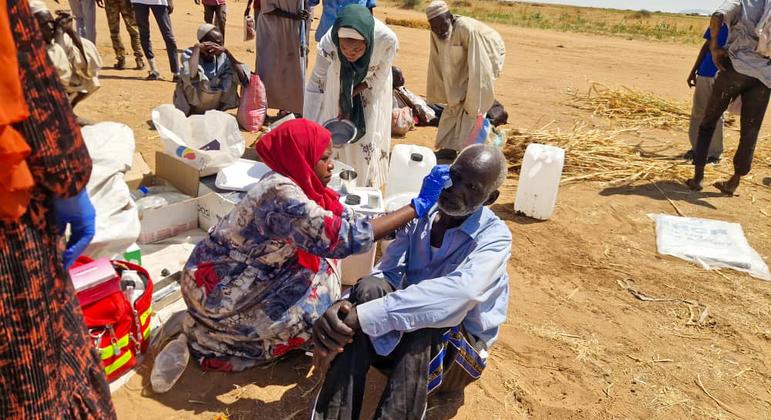
Sudan’s Zamzam Camp massacre: A UN Report Details Widespread Atrocities and Potential War Crimes
The escalating conflict in Sudan has reached a horrifying new low, as detailed in a recent report issued by the UN Human Rights Office (OHCHR). The report meticulously documents a brutal three-day offensive by the rapid Support Forces (RSF) against Zamzam camp for displaced persons in April 2024, revealing a pattern of deliberate violence against civilians that may constitute war crimes. This in-depth analysis will explore the findings of the report, the context of the attack, the scale of the atrocities, and the urgent need for accountability.
the context: Sudan’s Descent into Conflict
The violence at Zamzam camp isn’t an isolated incident, but a grim manifestation of the wider conflict engulfing Sudan. The country plunged into chaos in April 2023 following a breakdown in the transition to civilian rule, igniting a power struggle between the Sudanese Armed Forces (SAF) and the RSF. This conflict has triggered a massive humanitarian crisis, displacing millions and creating a climate of fear and insecurity. Zamzam camp, already home to an estimated 500,000 people uprooted by the fighting, became a focal point of this brutality. The camp’s vulnerability stemmed from it’s large population of internally displaced persons (IDPs), many of whom had already endured significant trauma and hardship.Prior to the April offensive, the OHCHR had already issued alerts regarding relentless attacks on El Fasher and surrounding camps, including Zamzam and Abu Shouk, as early as September 2024. These warnings, tragically, went largely unheeded.
The Zamzam Offensive: A Deliberate Campaign of Terror
From April 11th to 13th, 2024, the RSF, reportedly supported by allied Arab militias, launched a devastating attack on Zamzam camp. the offensive involved heavy artillery shelling and ground incursions, resulting in widespread death, destruction, and displacement. The OHCHR report paints a harrowing picture of deliberate targeting of civilians, with evidence suggesting a systematic attempt to instill terror within the community.
the scale of the violence is staggering.The report confirms over 1,000 civilian deaths directly attributable to the Zamzam offensive. Crucially, the report details 319 cases of summary execution – individuals deliberately killed at home, in markets, schools, health facilities, and even places of worship like mosques. this isn’t simply collateral damage; it’s a clear indication of intent to inflict maximum harm on the civilian population.
The Horrifying Details: Sexual Violence and Brutal Executions
Beyond the sheer number of deaths, the report reveals the notably heinous nature of the violence perpetrated against the residents of Zamzam camp. The OHCHR documented at least 104 instances of gruesome sexual violence, disproportionately affecting women and girls. This included rape, gang rape, and sexual slavery, with evidence suggesting sexual violence was deliberately used as a weapon of terror against the Zaghawa ethnic tribe, a particularly vulnerable group within the camp.
The testimonies collected by the UN human rights monitors are deeply disturbing. Survivors recount chilling details of summary executions,including:
* Targeted killings at religious sites: Seven elderly men were executed at a mosque,and sixteen others at a religious school.
* Indiscriminate gunfire: A community leader described how RSF fighters fired randomly into a room where he and ten other men were hiding, killing eight.
* the desolate aftermath: A woman searching for her missing 15-year-old son described a camp littered with corpses, eerily silent except for the presence of scavenging animals. Her son remains missing.
These accounts, corroborated by physical evidence and witness statements, underscore the brutality and calculated nature of the attack.
Methodology and Source Reliability
The OHCHR report is based on a rigorous methodology, combining UN human rights monitoring with a field mission to eastern Chad in July 2024. Importantly, the findings are grounded in direct testimony from 155 victims and witnesses who fled Zamzam camp during and after the offensive. This includes a significant representation of women (114),girls (3),and boys (6),ensuring a diverse range of perspectives are included. The detailed documentation and corroboration of accounts substantially enhance the report’s credibility and reliability.
International Law and the Call for Accountability
UN High Commissioner for Human Rights, Volker Türk, has unequivocally condemned the attacks, stating that the deliberate killing of civilians or hors de combat may constitute the war crime of murder. He stressed the urgent need for international action, warning that “the