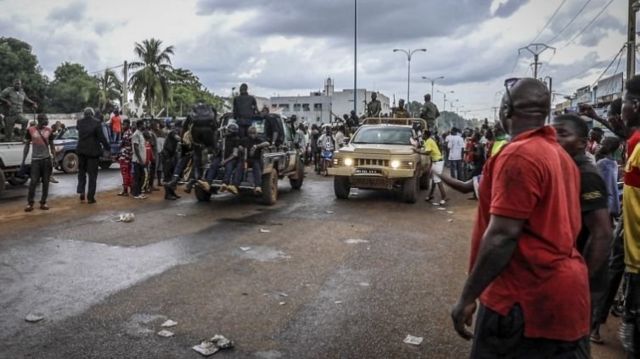
Mali Terror Attack: Defense Minister Killed in Coordinated Assault by Al Qaeda-Linked JNIM
BAMAKO, Mali — Mali’s defense minister, Gen. Sadio Camara, was killed on Sunday in a brazen attack by Islamist insurgents, marking one of the highest-profile assassinations in the country’s decade-long conflict. The assault, claimed by the al Qaeda-affiliated Group for Support of Islam and Muslims (JNIM), targeted military bases and towns across central Mali, underscoring the escalating violence that has gripped the Sahel region despite international counterterrorism efforts.
The attack, which as well left dozens of soldiers dead, occurred as Mali’s military junta—led by interim President Col. Assimi Goïta—faces mounting pressure to stabilize the country amid a withdrawal of United Nations peacekeeping forces and a fractured relationship with former colonial power France. Camara, a key architect of the 2020 coup that brought the junta to power, was a central figure in Mali’s pivot toward Russia for military support, including the deployment of Wagner Group mercenaries in 2021.
JNIM, which has expanded its influence across Mali, Burkina Faso and Niger, claimed responsibility for the attack in a statement circulated on Telegram, describing it as a “punishment” for the junta’s collaboration with “infidel forces.” The group has increasingly targeted high-ranking officials, military convoys, and civilian infrastructure, exploiting the power vacuum left by the departure of French troops in 2022 and the UN’s MINUSMA mission in 2023.
The Attack: A Coordinated Strike
The assault began early Sunday morning when JNIM fighters, alongside allied rebel groups, launched simultaneous attacks on military bases in the towns of Sévaré, Boni, and Bankass, near Mali’s border with Burkina Faso. According to reports from Malian military sources, Camara was traveling in a convoy near Sévaré when his vehicle came under heavy fire from insurgents using improvised explosive devices (IEDs) and small arms. The minister and at least 10 soldiers were killed in the ambush, while several others sustained injuries.

Witnesses in Sévaré described scenes of chaos as gunfire and explosions echoed through the town. “We heard heavy shooting for over an hour,” said a local shopkeeper who requested anonymity for safety reasons. “The military tried to push back, but the attackers were well-armed and knew exactly where to strike.” The attack on Sévaré, a strategic town housing a major military base, was particularly symbolic, as it has been a frequent target of JNIM in recent years.
By Sunday evening, JNIM had seized control of several military outposts, including a base in Boni, where insurgents reportedly looted weapons and ammunition before retreating. The group’s ability to overrun multiple locations simultaneously highlights the growing sophistication of its operations, which now include coordinated ground assaults and drone surveillance.
Who Was Gen. Sadio Camara?
Gen. Sadio Camara, 52, was a pivotal figure in Mali’s military government, serving as defense minister since the August 2020 coup that ousted President Ibrahim Boubacar Keïta. A graduate of Mali’s prestigious Kati military academy, Camara rose through the ranks during the country’s long-standing conflict with Tuareg separatists and Islamist insurgents in the north. He was one of the five colonels who led the National Committee for the Salvation of the People (CNSP), the junta that initially took power before transitioning to civilian rule—only to stage a second coup in May 2021.
Camara’s tenure as defense minister was marked by a dramatic shift in Mali’s foreign policy. Under his leadership, the junta expelled French troops in 2022, ending a nine-year counterterrorism operation that had failed to curb the insurgency. Instead, Mali turned to Russia, welcoming hundreds of Wagner Group mercenaries to train its forces and conduct joint operations. This pivot drew sharp criticism from Western governments, which accused the junta of aligning with Moscow to consolidate power rather than address the root causes of the conflict.
Despite the controversy, Camara remained a staunch defender of the junta’s approach. In a November 2023 interview with France 24, he argued that Mali’s partnership with Russia was necessary to “liberate” the country from foreign interference. “We are fighting for our sovereignty,” he said. “The West has failed us. Russia is a partner that respects our independence.”
The Broader Crisis: Escalating Violence in the Sahel
Camara’s death comes at a critical juncture for Mali, where violence has surged since the withdrawal of French and UN forces. According to the Armed Conflict Location & Event Data Project (ACLED), Mali recorded over 2,500 conflict-related fatalities in 2025 alone, a 30% increase from the previous year. JNIM and its rival, the Islamic State in the Greater Sahara (ISGS), have capitalized on the security vacuum, expanding their control over rural areas and imposing harsh interpretations of Islamic law in territories they occupy.
The junta’s reliance on Wagner mercenaries has also drawn scrutiny. While the group has provided critical support to Malian forces, its presence has been linked to allegations of human rights abuses, including extrajudicial killings and torture. In March 2026, Human Rights Watch reported that Wagner operatives were involved in a massacre of at least 50 civilians in the central town of Moura, an incident the junta has denied.
The attack on Camara is likely to further destabilize Mali’s already fragile political landscape. The junta has postponed elections indefinitely, citing security concerns, and has cracked down on dissent, arresting journalists and opposition figures. With Camara’s death, the military government loses one of its most influential leaders, raising questions about the junta’s ability to maintain cohesion amid growing internal and external pressures.
International Reactions: Condemnation and Concern
The killing of Mali’s defense minister has drawn swift condemnation from the international community. United Nations Secretary-General António Guterres issued a statement calling the attack “a heinous act of terrorism” and urging all parties to “exercise restraint and prioritize dialogue.” The African Union and the Economic Community of West African States (ECOWAS) also condemned the violence, with ECOWAS warning that the attack could “further destabilize the region.”
France, which has had a tense relationship with Mali’s junta since the expulsion of its troops, expressed “solidarity with the Malian people” but stopped short of offering military support. Russian officials, meanwhile, have not publicly commented on Camara’s death, though Moscow has previously described its partnership with Mali as a “strategic alliance” in the fight against terrorism.
The United States, which has designated JNIM as a foreign terrorist organization, reiterated its support for regional efforts to combat extremism. “This attack is a stark reminder of the persistent threat posed by al Qaeda-affiliated groups in the Sahel,” said a State Department spokesperson. “We stand with our partners in the region to counter this scourge.”
What Happens Next?
Camara’s death leaves a significant void in Mali’s military leadership, with no immediate successor named. Interim President Col. Assimi Goïta is expected to appoint a new defense minister in the coming days, though the process is likely to be fraught with political maneuvering within the junta. Analysts warn that the attack could embolden JNIM and other insurgent groups, leading to further violence in the lead-up to what the junta has described as “inclusive national dialogues” aimed at restoring civilian rule.

For Mali’s civilian population, the outlook remains grim. The United Nations estimates that over 8 million people—nearly 40% of the population—require humanitarian assistance, with displacement and food insecurity at record levels. The attack on Camara is likely to exacerbate these challenges, as aid organizations struggle to operate in areas controlled by insurgents.
As Mali grapples with this latest crisis, the international community faces a difficult question: how to address the root causes of the conflict—including governance failures, climate change, and economic marginalization—without empowering military juntas that have shown little interest in democratic reforms. For now, the focus remains on preventing further bloodshed and ensuring that Camara’s death does not mark the beginning of an even darker chapter in Mali’s history.
Key Takeaways
- High-Profile Assassination: Gen. Sadio Camara, Mali’s defense minister and a key figure in the 2020 coup, was killed in a coordinated attack by the al Qaeda-linked JNIM.
- Escalating Violence: The attack targeted multiple military bases and towns, reflecting JNIM’s growing operational capacity and the deteriorating security situation in the Sahel.
- Foreign Policy Shift: Camara was instrumental in Mali’s pivot toward Russia, including the deployment of Wagner Group mercenaries, a move that has drawn international criticism.
- Humanitarian Crisis: Over 8 million Malians require humanitarian assistance, with displacement and food insecurity worsening amid the conflict.
- International Condemnation: The attack has been widely condemned by the UN, ECOWAS, and Western governments, though concrete support for Mali remains limited.
FAQ
1. Who was Gen. Sadio Camara?
Gen. Sadio Camara was Mali’s defense minister and a central figure in the 2020 coup that brought the current military junta to power. He played a key role in shifting Mali’s foreign policy toward Russia and was a vocal critic of Western intervention in the Sahel.
2. What is JNIM?
The Group for Support of Islam and Muslims (JNIM) is an al Qaeda-affiliated insurgent group active in Mali, Burkina Faso, and Niger. It has been responsible for numerous attacks on military and civilian targets, including the 2017 ambush in Tongo Tongo that killed four U.S. Soldiers.
3. Why is Mali’s conflict worsening?
The withdrawal of French and UN forces, coupled with the junta’s reliance on Wagner mercenaries, has created a security vacuum that insurgent groups like JNIM and ISGS have exploited. Political instability, climate change, and economic marginalization have also fueled the crisis.
4. What is the Wagner Group’s role in Mali?
The Wagner Group, a Russian private military company, has been operating in Mali since 2021, providing training and support to Malian forces. Its presence has been linked to human rights abuses, including extrajudicial killings.
5. What happens next for Mali?
The junta is expected to appoint a new defense minister, but political instability and infighting could further weaken the government. The attack may also embolden insurgent groups, leading to more violence and displacement.
For the latest updates on the situation in Mali, follow World Today Journal’s Africa coverage. Share your thoughts in the comments below—how do you think the international community should respond to the crisis in the Sahel?