
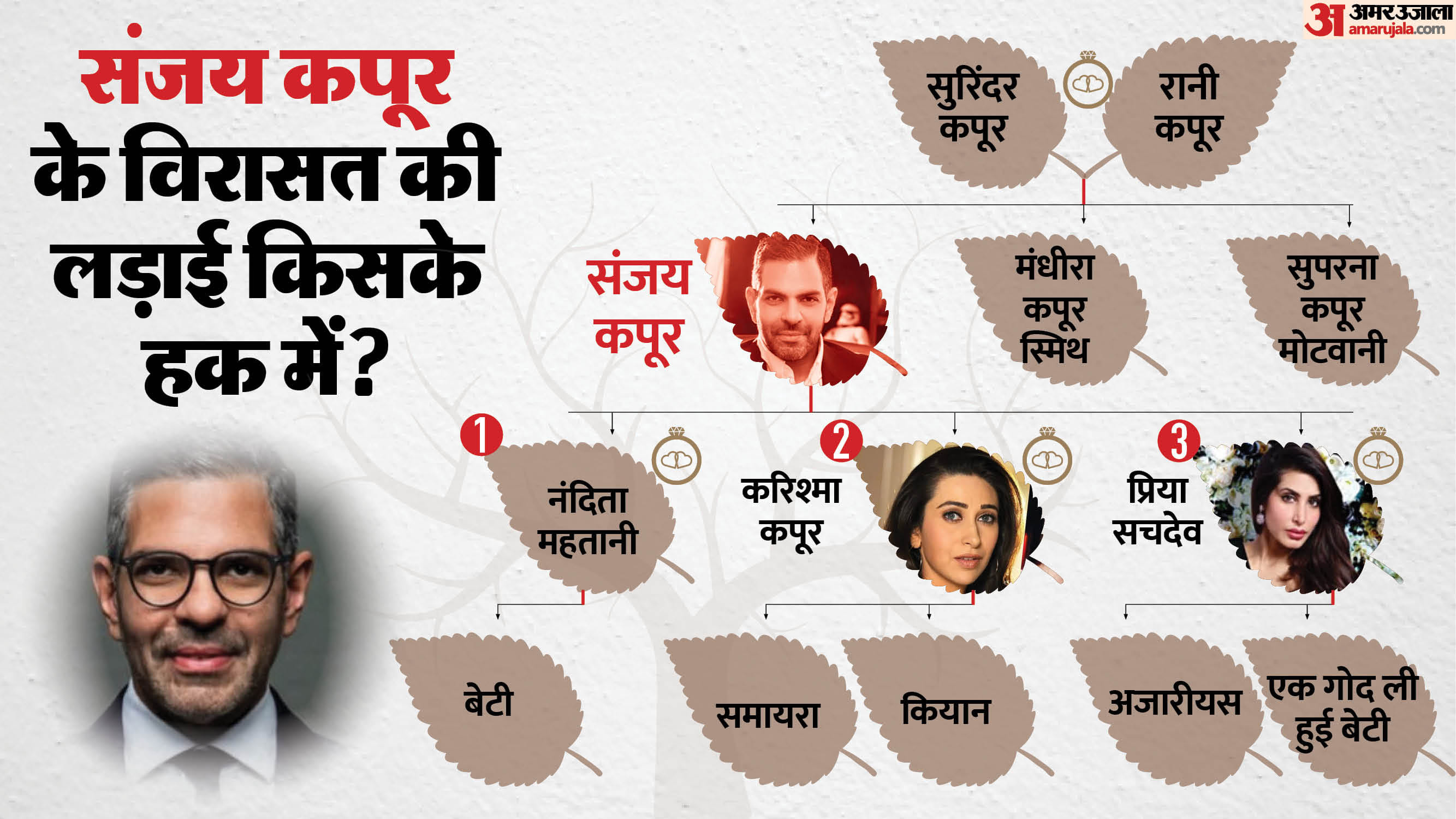
NEW DELHI — In a legal saga that has captivated India’s judiciary, the Supreme Court has escalated its involvement in the ₹30,000 crore property dispute between Sunjay Kapur’s mother, 80-year-old Rani Kapur, and his wife, Priya Kapur, by appointing former Chief Justice D.Y. Chandrachud as a mediator. The court’s unprecedented intervention—comparing the case’s complexity to the ancient Indian epic Mahabharata—highlights the unprecedented scale of this family feud, which has now become a landmark legal battle over inheritance, trust management, and corporate control.
The appointment of Chandrachud, one of India’s most respected jurists, marks a turning point in a dispute that has dragged through courts for years. The Supreme Court bench reportedly remarked that the case’s intricacies were so profound that “even the Mahabharata would look small in comparison.” This dramatic framing underscores the stakes: not just personal assets, but the future of the RK Trust, a conglomerate with interests spanning real estate, hospitality, and media.
At the heart of the conflict lies a bitter power struggle between two women from the same family, each representing different generations and legal strategies. While the public details remain scant due to ongoing litigation, legal experts describe this as one of India’s most complex inheritance disputes, involving multiple trusts, offshore entities, and allegations of financial misconduct. The case has already set precedents in Indian corporate law, with lower courts grappling to reconcile family law with commercial governance.
The ₹30,000 Crore Dispute: What’s at Stake
While the exact valuation of the contested assets remains under seal, court filings suggest the dispute centers on a portfolio worth approximately ₹30,000 crore ($3.6 billion at current exchange rates). This figure encompasses:
- Commercial real estate: Prime properties in Mumbai, Delhi, and Bangalore, including the iconic RK Tower complex
- Hospitality assets: Luxury hotels under the RK Hospitality brand, valued at over ₹5,000 crore
- Media interests: Stakes in production houses and broadcasting entities linked to the Kapur family’s entertainment empire
- Trust funds: The RK Trust, established by Sunjay Kapur’s father, which manages charitable and family assets
The dispute gained particular attention when the Supreme Court recently heard allegations that a previous court order had been circumvented, prompting the bench to intervene directly. While specifics remain confidential, legal observers suggest the allegations involve:
- Disputes over trustee appointments and management decisions
- Allegations of financial irregularities in asset valuations
- Conflicting interpretations of the original trust deed’s provisions
What makes this case unique is its intersection of personal family law with corporate governance. Unlike typical inheritance disputes, this battle involves complex corporate structures where family members hold competing roles as beneficiaries, trustees, and directors of affiliated companies.
D.Y. Chandrachud: The Mediator Who Could Reshape the Case
The appointment of D.Y. Chandrachud as mediator represents the Supreme Court’s most significant intervention yet. Chandrachud, who served as Chief Justice of India until 2025, brings unparalleled experience in constitutional law and commercial disputes. His appointment suggests the court recognizes this as:
/bollyy/media/media_files/2025/12/02/sunjay-kapur-property-case-2025-12-02-17-22-08.jpg "Sunjay Kapur Property Dispute Case")
- A test case for India’s trust law and corporate governance frameworks
- A precedent-setting matter that could affect how family-controlled businesses operate
- A public interest issue given the economic scale involved
Mediation under Chandrachud’s leadership could take several forms, legal experts suggest:
- Structured negotiations: Facilitating direct discussions between the parties with legal safeguards
- Independent valuation: Appointing experts to reassess the disputed assets
- Trust restructuring: Proposing amendments to the RK Trust’s governance framework
- Alternative dispute resolution: Exploring settlements that preserve family relationships while resolving financial claims
The mediation process is expected to operate under strict confidentiality, with Chandrachud’s recommendations potentially binding on the parties. His role differs from traditional mediation in that he carries the moral authority of a former Chief Justice, which could significantly influence the outcome.
Legal Background: How Did We Get Here?
The Kapur family dispute has its roots in the complex inheritance structures established by Sunjay Kapur’s father, Raj Kapur, a prominent businessman in the 1990s. The RK Trust was created with multiple layers of beneficiaries and trustees, designed to:
- Protect family assets across generations
- Maintain control over corporate entities
- Provide for charitable initiatives
However, as is common in family trusts, the original documents contained ambiguities that have been exploited by competing factions. The current dispute intensified when:
- Rani Kapur (Sunjay’s mother) sought to consolidate control over certain assets
- Priya Kapur (Sunjay’s wife) challenged these moves through legal proceedings
- Multiple lower courts issued conflicting rulings on trust management
- A fresh petition alleged that previous court orders had been ignored or circumvented
The Supreme Court’s intervention comes after the case spent years in India’s lower courts, with each side accusing the other of:
- Breaching fiduciary duties
- Engaging in financial misrepresentation
- Seeking undue influence over trust decisions
Broader Implications: Why This Case Matters
Beyond the personal drama, the Kapur family feud has significant implications for:
- Indian trust law: The case could clarify how courts interpret ambiguous trust deeds, particularly regarding successor trustees
- Corporate governance: Family-controlled businesses will watch closely to see how disputes are resolved when personal and commercial interests collide
- Wealth management: High-net-worth families may reconsider their trust structures in light of this precedent
- Judicial intervention: The Supreme Court’s comparison to the Mahabharata suggests it views this as a matter of exceptional public importance
Legal scholars note that similar cases have led to:
- Increased scrutiny of trustee appointments
- More detailed disclosure requirements for family-controlled entities
- Greater judicial involvement in resolving deadlocks within family businesses
For ordinary Indians, this case serves as a cautionary tale about the complexities of managing wealth across generations. The Kapur family’s situation—where personal relationships have become entangled with billion-dollar assets—highlights the challenges of maintaining family harmony while preserving financial legacies.
What Happens Next: The Road Ahead
The mediation process under D.Y. Chandrachud is expected to unfold in several phases:
- Initial assessment (June 2026): Chandrachud will review all court filings and financial documents
- Structured negotiations (July-August 2026): Direct discussions between parties with legal representation
- Expert evaluations (August-September 2026): Independent valuation of disputed assets
- Proposed settlement (October 2026): Chandrachud will present non-binding recommendations
- Court consideration (November 2026): Supreme Court will review the mediation outcome
The timeline remains fluid, but legal sources suggest the process could take 6-12 months. If mediation fails, the case will return to the Supreme Court for final adjudication, potentially setting new legal precedents.
For those following the case, key documents to monitor include:
- The mediation agreement between parties and Chandrachud
- Independent asset valuation reports
- Any revised trust documents proposed during mediation
- Subsequent court orders regarding the mediation process
All documents will be available through the Supreme Court’s e-filing portal (sci.gov.in).
Key Takeaways
- The Kapur family dispute involves assets worth approximately ₹30,000 crore ($3.6 billion), making it one of India’s largest inheritance battles
- Former Chief Justice D.Y. Chandrachud has been appointed as mediator, bringing unprecedented judicial involvement
- The Supreme Court compared the case’s complexity to the Mahabharata, signaling its exceptional nature
- Allegations of circumventing previous court orders have led to this escalation
- The case could set new precedents for trust law, corporate governance, and family dispute resolution in India
- Mediation is expected to take 6-12 months, with potential court proceedings if no settlement is reached
As this legal drama unfolds, it serves as a reminder of how even the most carefully constructed wealth protection strategies can unravel when personal relationships become entangled with financial empires. The Kapur family’s story will be watched not just by legal professionals, but by every Indian family considering how to preserve their legacy across generations.
What are your thoughts on this unprecedented legal battle? Should families with significant wealth consider alternative structures to avoid such protracted disputes? Share your perspectives in the comments below.
Next confirmed checkpoint: Supreme Court mediation proceedings to commence in June 2026, with initial assessment reports due by July 15, 2026.