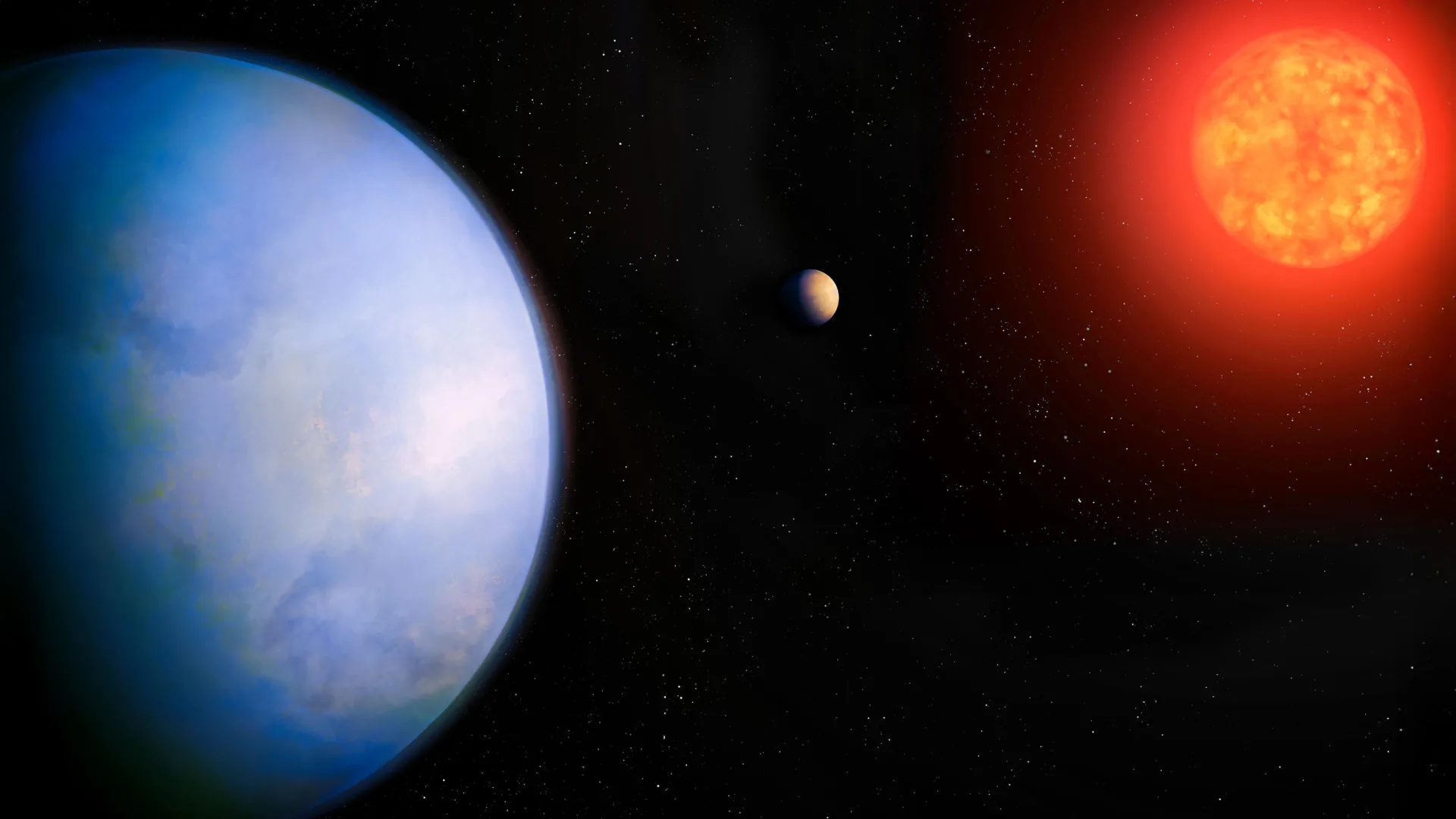
Promising New Exoplanet, GJ 251 c, Offers Hope in the Search for Extraterrestrial Life
The quest to find life beyond Earth has taken a significant step forward with the discovery of GJ 251 c, a newly identified exoplanet orbiting the star GJ 251. This planet, positioned within its star’s habitable zone – the region where liquid water coudl exist – is emerging as a prime candidate for atmospheric study and the potential detection of biosignatures, marking a pivotal moment in exoplanet research. This discovery, spearheaded by a team at Penn State University, represents a culmination of two decades of meticulous observation and cutting-edge analytical techniques.
A Decades-Long Pursuit: Detecting a Subtle Planetary Influence
For years, astronomers have been refining their methods for identifying exoplanets – planets orbiting stars other than our Sun. A key technique employed by Dr.Suvrath Mahadevan and his team relies on detecting the subtle “wobble” of a star caused by the gravitational pull of orbiting planets. This wobble manifests as minute shifts in the star’s light spectrum, known as Doppler shifts.
The team initially focused on refining data for GJ 251 b, a previously known planet completing an orbit every 14 days. By combining long-term observations with data from the Habitable zone Planet Finder (HPF), a high-precision instrument, they uncovered a stronger, repeating signal with a 54-day period. This signal strongly suggests the presence of a second, more massive planet: GJ 251 c. Confirmation of this discovery was further bolstered by observations from the NEID spectrometer at Kitt Peak National Observatory, another instrument developed by Penn State researchers.
“This discovery represents one of the best candidates in the search for atmospheric signature of life elsewhere in the next five to ten years,” explains Dr. mahadevan, highlighting the planet’s potential for future investigation.
Overcoming the Challenges of Stellar “weather”
Detecting exoplanets isn’t simply a matter of observing stellar wobble. A significant hurdle lies in differentiating planetary signals from the inherent activity of the host star itself. Stars, like our Sun, exhibit magnetic activity – starspots, flares, and other surface phenomena – that can mimic the periodic variations caused by orbiting planets. This “stellar weather,” as Dr. Mahadevan describes it, can create false positives, obscuring the true planetary signal.
To overcome this challenge, the team employed advanced modeling techniques, analyzing how signals vary across different wavelengths of light. This sophisticated approach allowed them to effectively filter out stellar noise and isolate the genuine planetary signature. “This is a hard game in terms of trying to beat down stellar activity and also measuring its subtle signals,” Dr. Mahadevan acknowledges, emphasizing the complexity of the process.
The Power of Collaboration and Data Science
The success of this research underscores the importance of interdisciplinary collaboration and advanced data analysis. Eric Ford, Director of Research for Penn State’s Institute of Computational & Data Sciences (ICDS), emphasizes that mitigating stellar activity required not only state-of-the-art instrumentation but also customized data science methods tailored to the specific characteristics of GJ 251. ”The combination of exquisite data and state-of-the art statistical methods enabled our interdisciplinary team to transform data into an exciting discovery,” he states.
This project exemplifies how long-term funding and international teamwork are crucial for achieving breakthroughs in exoplanet research, as meaningful discoveries frequently enough require decades of dedicated effort.
Looking Ahead: The Promise of Next-Generation Telescopes
While current technology prevents direct imaging of GJ 251 c, the future looks luminous. Upcoming telescopes, notably the next generation of 30-meter-class ground-based observatories, will possess the capability to directly image exoplanets within their stars’ habitable zones. This will allow scientists to analyze the planet’s atmosphere, searching for chemical indicators of life - biosignatures – such as oxygen, methane, or other compounds that could suggest biological activity.
Dr. Mahadevan and his team are actively preparing for this new era of exoplanet exploration, designing and building the technology needed to analyze the atmospheres of potentially habitable worlds. “We are always focused on the future,” he says, “Whether that’s making sure the next generation of students can engage in cutting-edge research or designing and building new technology to detect potentially habitable planets.”
GJ 251 c represents a significant step forward in our understanding of planetary systems beyond our own. While confirmation of life remains a distant goal, this discovery provides a compelling target for future exploration and reinforces the belief that we are closer than ever to answering the age-old question: are we alone?
this research was supported by the U.S. National Science Foundation,NASA,and the Heising-Simons Foundation.
Keep reading