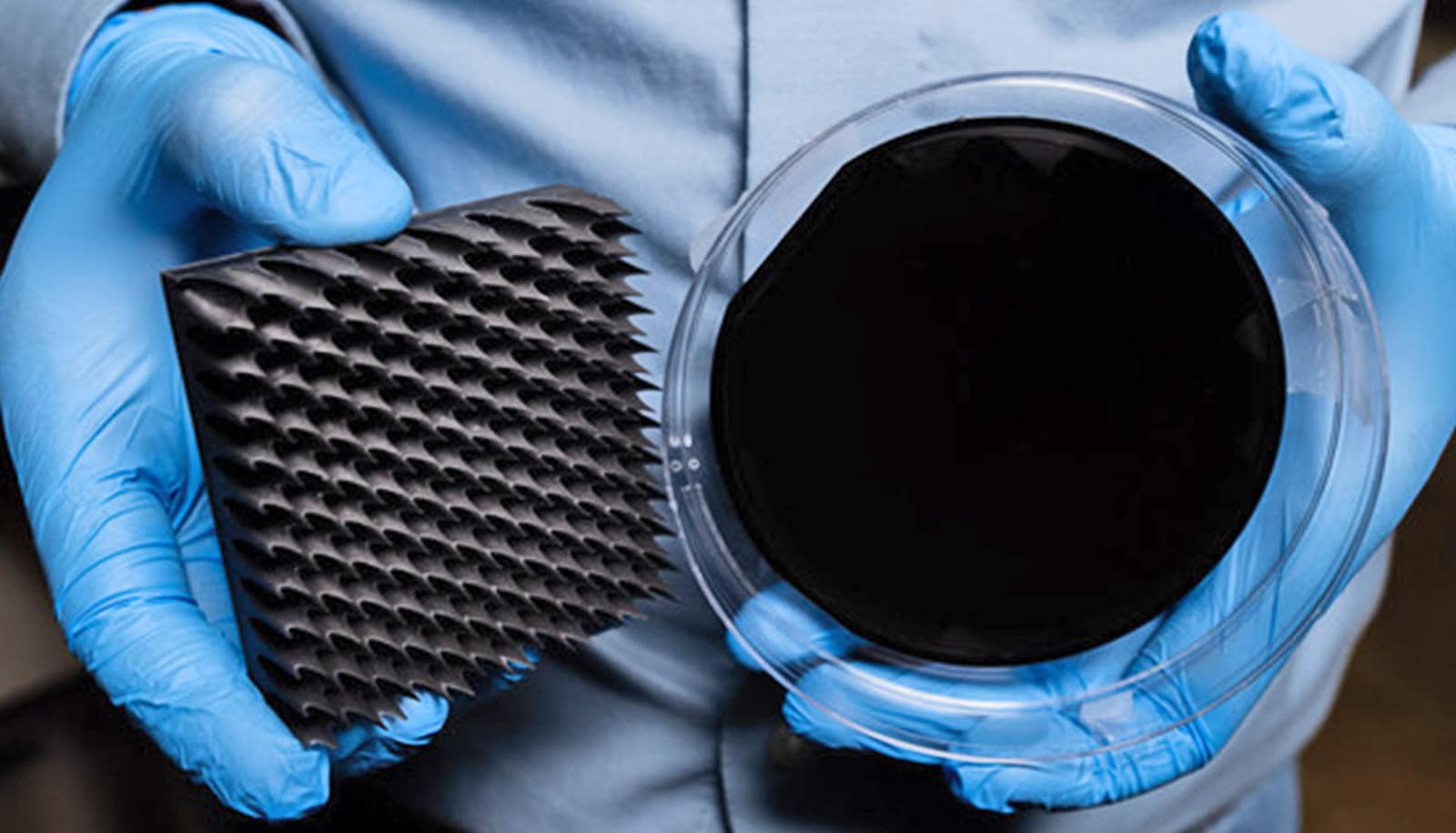
Beyond Black: A New Era of Light Absorption with Notre Dame’s Superblack Material
for decades, scientists have pursued the holy grail of materials science: a truly black surface. Now, researchers at the University of Notre Dame have unveiled a groundbreaking “superblack” material that absorbs an astounding 99.6% of visible light. This isn’t just a cosmetic achievement; it’s a leap forward with implications for everything from advanced imaging to stealth technology.
This new material stands apart from previous attempts, offering a unique combination of robustness, low cost, and customizable properties. let’s delve into the science behind it, its potential applications, and why this advancement is so significant.
The Science of Superblack: Mimicking Nature’s Light Traps
Think about the darkness of a cave. It’s not simply the absence of light, but the trapping of it. Light enters, bounces around the uneven surfaces, and is repeatedly absorbed before it can escape. The Notre Dame team cleverly replicated this natural phenomenon at a microscopic level.
They engineered a material featuring a matrix of tiny, sheer-walled “caves” – each just 10 microns wide. These microscopic structures,arranged like a honeycomb,are the key to its exceptional light-absorbing capabilities. As explained by Matthew Rosenberger, assistant professor of aerospace and mechanical engineering at Notre Dame, “It’s not the color of the cave that makes it appear black, it’s the structure.”
how It’s Made: A Novel Molding Process
The creation process is surprisingly straightforward, leveraging existing microfabrication techniques. Here’s a breakdown:
- Mold creation: A mold is crafted from silicon,featuring a microscopic pattern of cone-shaped holes arranged in a honeycomb structure. This is essentially the inverse of the final material.
- Material Casting: Soft, flexible silicone mixed with black dye is poured into the mold.
- Extraction: Once hardened, the material is carefully peeled from the mold, revealing a surface covered in tiny, light-trapping cone-shaped bumps.
This method offers a significant advantage over previous approaches. the team can easily engineer molds and microcavities with specific optical and mechanical properties, tailoring the material to its intended application. You can adjust the process to prioritize either maximum blackness or increased durability.
Why This Matters: Applications Across Industries
The versatility of this superblack material opens doors to a wide range of possibilities. Consider these potential applications:
* Imaging Systems: Enhanced sensitivity in cameras and sensors, particularly in low-light conditions.
* Stealth Technology: Reducing the visibility of objects to radar and other detection methods.
* Telescopes: Improving the performance of telescopes by minimizing stray light interference.
* Optical Sensors: Creating more accurate and reliable sensors for various applications.
* Camouflage & Obscuration: The material can effectively erase shadows and highlights, obscuring the shape of objects. In testing, covering a coffee mug with the material made it nearly invisible to the eye.
Beyond Color: A Focus on Geometry and Scalability
Previous attempts to create superblack materials often relied on complex interactions with the wave nature of light. This new approach, however, is rooted in simple geometry.
“It’s mostly about geometry-how light reflects and scatters,” Rosenberger explains. “Unlike approaches that rely heavily on the wave nature of light, this method is easier to understand and control, wich makes it more scalable and predictable.”
This ease of control and scalability is crucial for moving beyond laboratory demonstrations and into real-world applications.
Looking Ahead: Funding and Future Research
This research was supported by the U.S. government and an Interdisciplinary Materials Science and Engineering Fellowship. The team also benefited from the resources available at Notre Dame Nanofabrication, notre Dame Integrated Imaging, and the Materials Characterization Facility, with additional funding from ND Energy.
The development of this superblack material represents a significant advancement in materials science. It’s a testament to the power of biomimicry – learning from nature to solve complex engineering challenges – and a promising step towards a future where light can be controlled with unprecedented precision.
Source: [University of notre Dame](https://research.nd.edu/news-and-events/news/robust-low-cost-superblack-material-leverages-
Keep reading