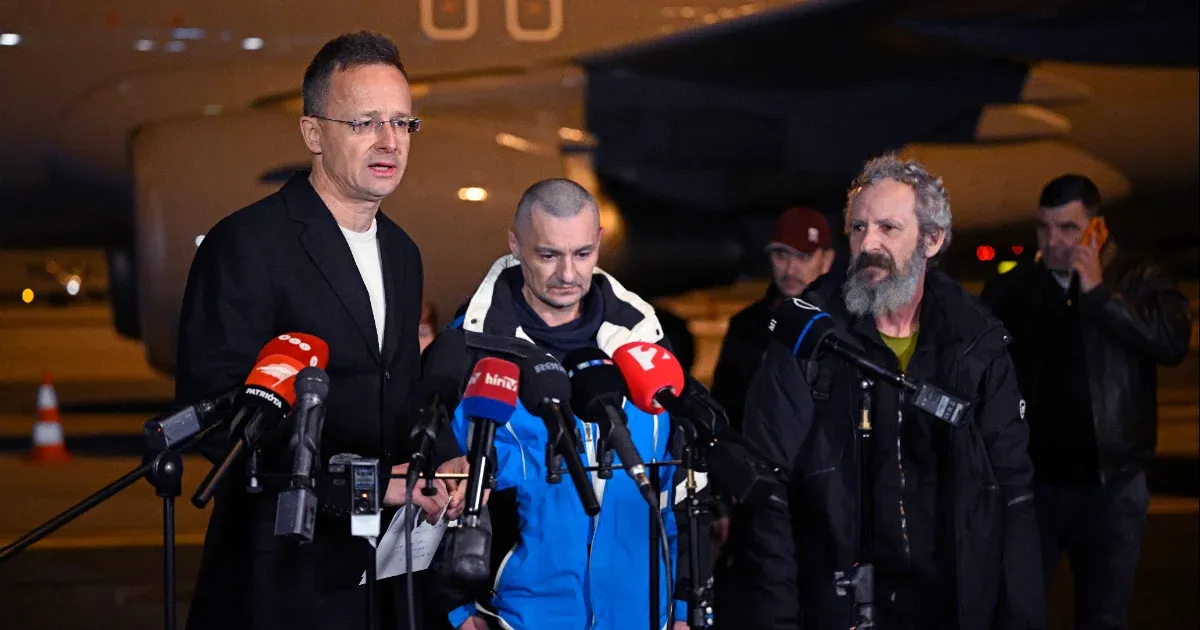
Budapest, Hungary – Two individuals with both Ukrainian and Hungarian citizenship, held as prisoners of war, have been released and returned to Hungary, arriving early Thursday morning. The release came following a direct request from Hungarian Prime Minister Viktor Orbán to Russian President Vladimir Putin, with Hungarian Foreign Minister Péter Szijjártó stating that Putin did not request anything in return for the men’s freedom. The development marks a rare instance of direct negotiation yielding the release of prisoners amid the ongoing conflict in Ukraine.
Szijjártó announced the release upon the arrival of the two men at Budapest’s Liszt Ferenc International Airport. He attributed the successful outcome to what he described as Hungary’s “grounded and rational foreign policy” over the past decade, enabling the unconditional return of the prisoners. The minister detailed that contact with Russian authorities was initiated after one of the men directly appealed to Orbán in a video message, while the family of the other man similarly sought assistance. Orbán subsequently spoke with Putin on Tuesday, formally requesting their release, according to statements from both governments.
“A decision was made to release the two prisoners of war, as requested by Prime Minister Orbán, and they will be transported on the same plane they arrived on, returning to Budapest,” Putin announced on Wednesday, as reported by Telex.hu. This confirmation followed a visit by Szijjártó to Moscow on Wednesday, specifically to discuss Hungary’s energy security and the fate of the two citizens.
Negotiations and the Absence of Demands
The release of the prisoners is particularly noteworthy given the context of the ongoing war in Ukraine and the often-complex negotiations surrounding prisoner exchanges. Szijjártó’s assertion that Putin did not demand any concessions in return is a significant detail, diverging from typical prisoner release scenarios. While the specifics of the negotiations remain largely undisclosed, the Hungarian government has emphasized its commitment to securing the release of its citizens caught in the conflict. The Hungarian government has been actively engaged in diplomatic efforts to assist Hungarian citizens in Ukraine, particularly those in the Transcarpathian region, which has a significant Hungarian minority population.
The case has garnered attention within Hungary, with the government and pro-government media outlets having previously highlighted the plight of Hungarian citizens who found themselves conscripted into the Ukrainian army and subsequently taken prisoner. Hungarian state media, MTVA, has broadcast programs, such as “The Horrors of War,” featuring videos of Hungarian prisoners of war in Russian captivity expressing gratitude to their Russian captors. This coverage, however, has drawn criticism from legal experts.
Tamás Hoffmann, an international law expert and associate professor at the International Relations Department of Corvinus University of Budapest, told Telex.hu that the dissemination of such videos could be interpreted as a violation of international law. Hoffmann explained that the creation and broadcast of these videos potentially breaches the Geneva Conventions, which govern the treatment of prisoners of war, including their right to dignity and protection against public humiliation.
Diplomatic Context and Previous Discussions
This latest development follows a previous conversation between Orbán and Putin in October 2025, where they discussed the possibility of hosting a peace summit between Russia and the United States in Budapest. According to a report by Magyar Nemzet, Moscow initiated the discussion following a trip by U.S. President Donald Trump to the Middle East. Both Moscow and Washington reportedly expressed openness to the idea, with Hungary being seen as a neutral ground due to its NATO and European Union membership, yet maintaining a pragmatic relationship with Russia.
The potential summit, as outlined by the Kremlin, would involve the participation of foreign ministers from both countries to finalize the agenda and delegation composition. Putin reportedly reaffirmed Moscow’s willingness to engage in diplomatic efforts, while Trump urged a swift resolution to the conflict. Orbán indicated Hungary’s readiness to provide a venue for such a summit, underscoring the country’s ambition to play a mediating role in the ongoing geopolitical tensions.
The Situation of Hungarian Citizens in Ukraine
The release of these two prisoners highlights the precarious situation faced by Hungarian citizens residing in Ukraine, particularly in the Transcarpathian region. Since the escalation of the conflict in February 2022, concerns have grown regarding the conscription of Hungarian citizens into the Ukrainian army. The Hungarian government has consistently called for the protection of the rights of its citizens in Ukraine and has advocated for their exemption from mandatory military service. The issue has become a sensitive point in relations between Budapest and Kyiv, with Hungary accusing Ukraine of violating the rights of its Hungarian minority.
Szijjártó emphasized that the Hungarian government’s priority is to prevent Hungary from being drawn into the war. He stated that the successful release of the prisoners demonstrates the effectiveness of Hungary’s foreign policy approach, which he characterized as “grounded and rational.” The minister reiterated Hungary’s commitment to maintaining peaceful relations with both Russia and Ukraine, despite the ongoing conflict.
International Law and Prisoner Treatment
The circumstances surrounding the capture and treatment of prisoners of war are governed by the Geneva Conventions, a set of international treaties that establish standards for humanitarian treatment in armed conflict. These conventions outline the rights of prisoners of war, including protection against violence, intimidation, and public humiliation. The conventions also regulate the conditions of detention and require that prisoners be provided with adequate food, medical care, and communication with their families.
As noted by legal expert Tamás Hoffmann, the dissemination of videos featuring prisoners of war expressing gratitude to their captors raises concerns about potential violations of these conventions. Such actions could be interpreted as coercion or propaganda, undermining the prisoners’ dignity and potentially violating their rights. International organizations, such as the International Committee of the Red Cross (ICRC), play a crucial role in monitoring the treatment of prisoners of war and ensuring compliance with the Geneva Conventions.
Looking Ahead
The release of the two Hungarian-Ukrainian citizens represents a positive development in a complex and challenging situation. However, the broader issue of Hungarian citizens affected by the conflict in Ukraine remains unresolved. The Hungarian government is expected to continue its diplomatic efforts to secure the release of any remaining citizens held in captivity and to advocate for the protection of the rights of the Hungarian minority in Ukraine. Further negotiations with both Russia and Ukraine are anticipated as Hungary seeks to play a constructive role in de-escalating tensions and finding a peaceful resolution to the conflict.
The Hungarian Ministry of Foreign Affairs has not yet announced any immediate plans for further prisoner exchanges or diplomatic initiatives. However, officials have indicated that they remain open to dialogue with both sides and are committed to exploring all possible avenues for securing the safety and well-being of Hungarian citizens affected by the war. The next official update from the Ministry is expected in the coming weeks, providing further details on the government’s ongoing efforts.
What are your thoughts on this development? Share your comments below and let us know what you think.