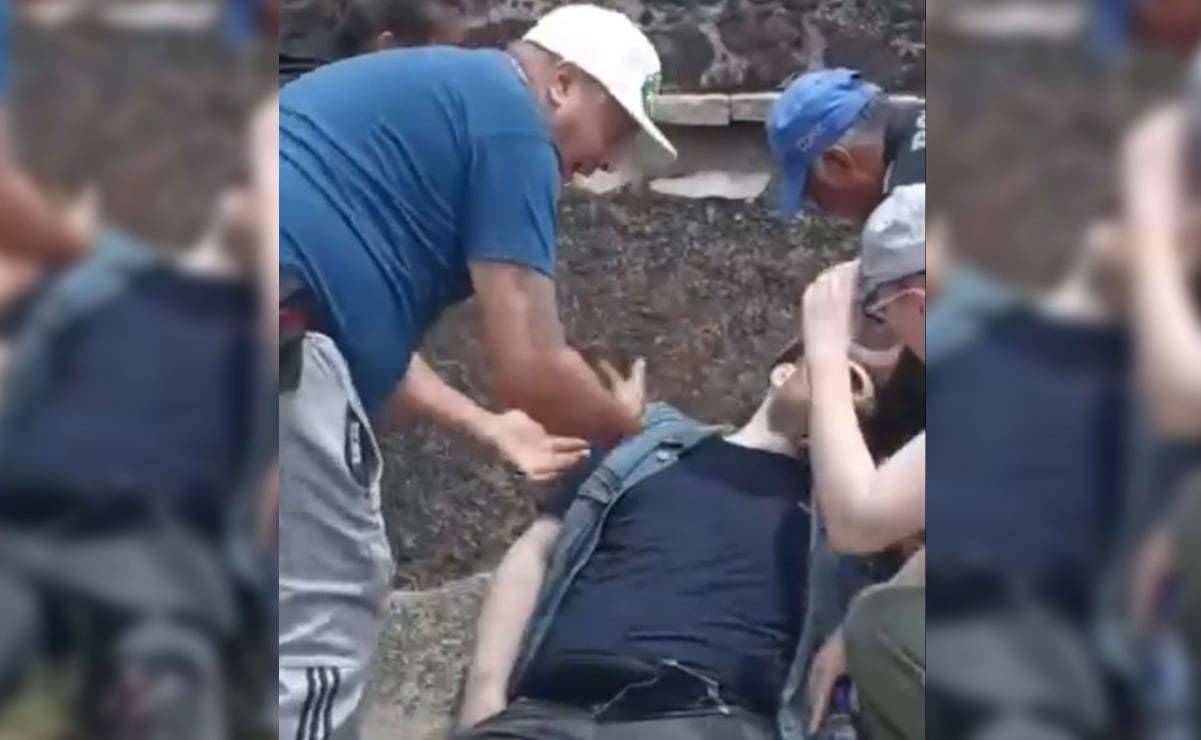
New video footage has emerged from the armed attack at the Teotihuacán archaeological site, capturing witnesses urgently pleading with an injured person: “¡vive, vive, por favor, no te mueras!” The recordings, verified by Mexican authorities and media outlets, show the chaotic aftermath of the shooting that occurred on Monday, April 21, 2026, at one of Mexico’s most visited pre-Hispanic ruins.
The attack left one Canadian tourist dead and 13 others injured, according to official reports from the State of Mexico’s security prosecutor’s office. The assailant, identified as Julio César Jasso, a 25-year-old local resident, opened fire on visitors near the Pyramid of the Sun before being neutralized by security personnel at the scene. Federal authorities have since classified the incident as an isolated act of violence, though investigations continue into possible motives.
The newly surfaced videos, shared widely on social media and confirmed by El Universal through forensic analysis, depict tourists and guides attempting to assist the wounded while shouting for emergency help. One clip shows a woman kneeling beside a victim, repeatedly urging them to stay conscious as others call for ambulances. Another angle captures the moment law enforcement arrived, with officers securing the perimeter and evacuating civilians from the site.
In response to the attack, the Mexican federal government immediately ordered heightened security measures at major archaeological zones nationwide. As reported by multiple verified sources, elements of the Guardia Nacional were deployed to Monte Albán in Oaxaca, Chichén Itzá in Yucatán, and Uxmal, also in Yucatán, beginning the morning of April 22, 2026. Their presence included baggage checks, visitor screenings, and coordinated patrols with INAH (National Institute of Anthropology and History) staff.
At Monte Albán, a Zapotec-era UNESCO World Heritage site, National Guard personnel established access filters and reviewed the belongings of entering tourists under the direction of site subdirector David Andrade. The reinforcement followed direct coordination between federal security agencies and INAH officials, who confirmed the measures were precautionary and aimed at restoring visitor confidence.
Officials from the U.S., Canadian, and British embassies in Mexico issued travel advisories urging citizens to exercise increased caution when visiting archaeological sites in the country. While no blanket restrictions were imposed, the alerts highlighted concerns about security response times during the Teotihuacán incident, with witnesses reporting delays of over 10 minutes before armed personnel arrived despite multiple emergency calls.
The attack has reignited national debate over the protection of cultural heritage sites, which attract millions of international visitors annually. Teotihuacán alone received over 2.3 million tourists in 2025, according to INAH’s annual visitation report, making it one of the most frequented archaeological destinations in Latin America. Security experts note that the open-air layout and high foot traffic of such sites present unique challenges for threat prevention and rapid response.
INAH has announced a review of its security protocols across all federal archaeological zones, though no timeline for implementation has been released. The agency stated it is working with the Secretariat of Security and Citizen Protection to assess gaps in emergency preparedness, particularly regarding communication systems and on-site medical readiness.
As of April 25, 2026, the Teotihuacán zone remains open to the public under enhanced surveillance. Visitors are subject to mandatory bag inspections and may notice increased patrols by uniformed officers. Authorities have urged the public to report any suspicious activity while emphasizing that isolated incidents should not deter travel to Mexico’s cultural landmarks, which continue to operate under strict safety guidelines.
For ongoing updates, the public is encouraged to consult official bulletins from INAH’s website and the State of Mexico’s Attorney General’s Office. Both institutions are expected to release further findings from the investigation in the coming weeks, including toxicology reports and digital evidence recovered from the suspect’s belongings.
What are your thoughts on balancing public access with security at historical sites? Share your perspective in the comments below and help spread awareness by sharing this article with your network.
Related reading
- Ryanair Flight Diverted to Dublin Due to Passenger Illness
- Republicans see ‘scary’ lack of enthusiasm among core voters ahead of midterms – The Washington Post
- Berlin Pride Attack: One Dead, Many Injured as Police Hunt Suspect (archynewsy.com)
- Menteng Clashes: Police Secure Scene After Two Injured (newsdirectory3.com)