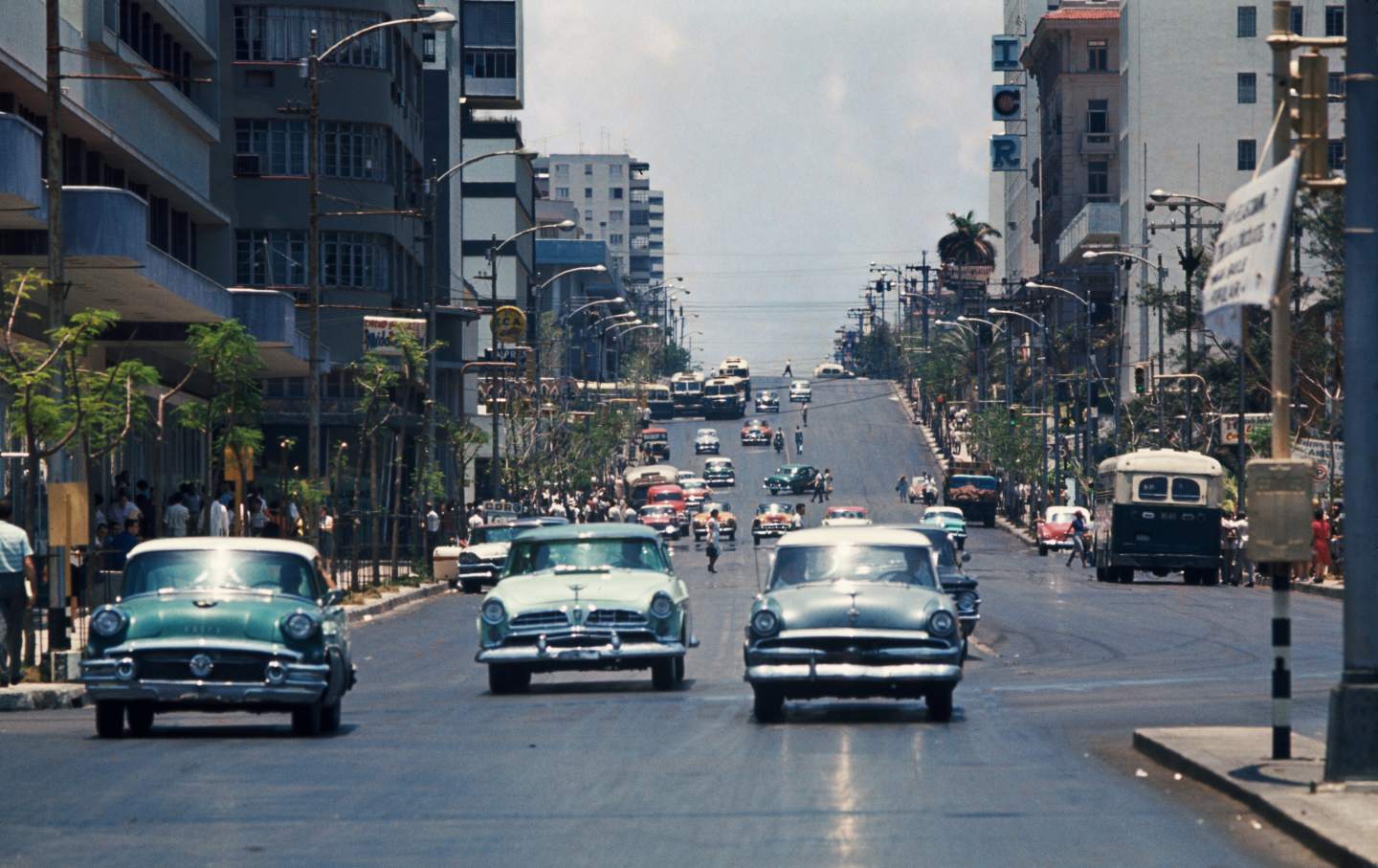
Cuba’s economic collapse and political isolation have shattered the American fantasy of a tropical paradise, replacing it with a reality of food shortages, mass emigration, and a crumbling healthcare system. The island nation, once romanticized as a postcard destination or revolutionary symbol, now faces a crisis so severe that the United Nations has warned of a “humanitarian emergency” according to UN reports. While Americans may still envision Cuba through the lens of vintage cars, rum cocktails, and Fidel Castro’s speeches, the reality is far more dire: a country where 80% of the population lives in poverty (Economist, 2023), and where the government’s grip on power is being tested like never before.
This disconnect between perception and reality stems from decades of U.S. policy, cultural nostalgia, and Cuba’s own political isolation. The American fantasy—rooted in Cold War-era propaganda, jazz-age tourism, and exile communities—has obscured the island’s struggles. Today, Cuba’s challenges are no longer just political but existential, with over 500,000 Cubans leaving the country in 2023 alone (Reuters, 2024), a brain drain that threatens its future.
The fantasy persists in part because Cuba has been mythologized as a place of resistance—against U.S. imperialism, against capitalism, against global austerity. But the island’s current crisis, marked by power outages lasting up to 18 hours a day (BBC, 2023) and a healthcare system on the brink, challenges that narrative. For many Americans, Cuba remains a symbol rather than a nation in crisis—a relic of a bygone era when the island was a playground for the wealthy or a revolutionary beacon. The reality, however, is one of inflation exceeding 200% (Financial Times, 2023), a collapsing currency, and a government struggling to maintain control.
This article explores how Cuba’s current crisis contradicts the American fantasy, examines the root causes of the island’s economic and political struggles, and looks at what the future might hold for a nation caught between revolution and collapse.
How the American Fantasy of Cuba Was Built—and Why It’s Falling Apart
The idea of Cuba as a tropical paradise is not new. For decades, Americans have viewed the island through two competing lenses: the romanticized vision of Ernest Hemingway’s Havana, where old cars rumble through cobblestone streets and mojitos flow freely, and the political fantasy of a socialist revolution standing defiant against U.S. imperialism.
This dual perception was reinforced by Cold War-era propaganda, exile communities in Miami, and Hollywood depictions—from Our Man in Havana to Scarface. The result? A Cuba that existed more in the American imagination than in reality. Even as the island faced economic crises in the 1990s—after the Soviet Union collapsed and U.S. sanctions tightened—many Americans clung to the fantasy, seeing Cuba as a place of resilience rather than despair.
But today, that fantasy is unraveling. The U.S. embargo, now in its 64th year (U.S. Department of State), has worsened Cuba’s economic struggles, while internal mismanagement and global isolation have pushed the country to the brink. Meanwhile, the brain drain—with thousands of doctors, engineers, and scientists fleeing—has left Cuba with a shortage of 50,000 healthcare workers (World Health Organization, 2023), threatening its once-proud public health system.
For many Americans, this reality is hard to reconcile with the Cuba they know from history books or family stories. Yet the numbers tell a different story: GDP shrank by 3.2% in 2023 (IMF, 2023), inflation remains off the charts, and the government’s attempt to introduce a dual-currency system in 2021 led to chaos, with Cubans lining up for hours to exchange money at official rates.
Cuba’s Economic Crisis: A Country on the Brink
Cuba’s economic collapse is not just a matter of sanctions or political mismanagement—it is a perfect storm of factors that have left the island struggling to feed its population, keep the lights on, and maintain basic services.
At the heart of the crisis is Cuba’s dual-currency system, which has led to hyperinflation and a black market for essential goods. The official exchange rate is 1 USD = 240 Cuban pesos, but on the black market, it can reach 1 USD = 1,000+ pesos (Reuters, 2023). This disparity has made it nearly impossible for ordinary Cubans to afford basic necessities, with food prices rising by over 500% in some cases (BBC, 2023).
The government’s response has been a mix of price controls, rationing, and state-run markets, but these measures have only deepened shortages. Cubans now rely on remittances from abroad—over $4 billion annually (World Bank, 2023)—to survive, with many families dependent on relatives in the U.S. or Spain.
Meanwhile, the energy sector is in tatters. Cuba imports most of its fuel, and with U.S. sanctions restricting trade, the country has been forced to rely on barter deals with Venezuela—a relationship that has become increasingly unstable. In 2023, Venezuela cut oil shipments by 40% (Bloomberg, 2023), leaving Cuba with frequent blackouts and fuel shortages that have crippled hospitals, schools, and businesses.
Political Instability: Can Cuba’s Government Survive the Crisis?
While Cuba’s economic struggles are severe, the political fallout may be even more dangerous. The government of President Miguel Díaz-Canel has faced growing dissent, with protests erupting in 2021 and 2022 (New York Times, 2021) as Cubans took to the streets demanding freedom, food, and the end of the Communist Party’s rule.
Unlike previous protests, which were quickly suppressed, the July 2021 demonstrations spread across the country, with reports of hundreds of arrests (Amnesty International, 2021). The government responded with a crackdown, arresting activists, journalists, and even bystanders, while state media accused protesters of being U.S.-backed counterrevolutionaries.
Yet the unrest has not subsided. In 2023, independent labor unions emerged, demanding wage increases and an end to repression. The government has responded with a mix of concessions and repression, including the release of some political prisoners while continuing to monitor and arrest dissenters.
The biggest question now is whether Cuba’s government can hold together in the face of such challenges. The Communist Party, which has ruled since 1959, shows no signs of loosening its grip, but the economic crisis has eroded public trust. A 2023 survey by Cuba’s Center for Research on Public Opinion found that 72% of Cubans believe the government is responsible for the country’s problems (Cuba Center, 2023).
What Happens Next? Cuba’s Possible Futures
Cuba’s future is uncertain, but several scenarios are possible—each with profound implications for the island and its relationship with the U.S.
Scenario 1: Gradual Reform and Economic Opening
Some analysts believe Cuba may eventually adopt limited market reforms, similar to Vietnam’s economic liberalization in the 1980s. This could include allowing more private enterprise, easing restrictions on foreign investment, and negotiating with the U.S. to ease sanctions. However, any such changes would likely be slow and controlled, with the government maintaining tight political control.
Scenario 2: Political Unrest and Potential Collapse
If economic conditions worsen, protests could escalate, leading to a power struggle within the government or even a coup attempt. The military, which has significant economic influence, could play a key role in any transition. A collapse of the current system would likely lead to chaos, civil unrest, and possibly foreign intervention.

Scenario 3: U.S. Policy Shift and Diplomatic Engagement
A change in U.S. policy—such as lifting sanctions or reopening embassies—could provide Cuba with much-needed economic relief. However, any such shift would depend on political will in Washington, which remains divided on Cuba policy. The Biden administration has taken small steps, such as allowing family remittances and travel, but a full normalization of relations seems unlikely in the near term.
Regardless of the path Cuba takes, one thing is clear: the American fantasy of the island as a tropical paradise or revolutionary stronghold is no longer tenable. The reality is far more complex—and far more urgent.
Key Takeaways: What You Need to Know
- Cuba’s economy is in freefall: Inflation exceeds 200%, GDP shrank by 3.2% in 2023, and food shortages are widespread.
- The U.S. embargo has worsened the crisis: Sanctions, now in their 64th year, restrict trade and investment, deepening Cuba’s isolation.
- Mass emigration is accelerating: Over 500,000 Cubans left in 2023 alone, creating a brain drain that threatens the country’s future.
- Political dissent is growing: Protests in 2021 and 2022 showed widespread frustration, but the government has responded with repression.
- The future is uncertain: Possible outcomes include gradual reform, political unrest, or a shift in U.S. policy—but none are guaranteed.
The next major checkpoint for Cuba will be the 2024 National Assembly meetings, where lawmakers are expected to discuss economic reforms and the government’s response to the crisis. The sessions, scheduled for April 2024, will be closely watched for signs of change—or further crackdowns.
For readers seeking updates, the United Nations Development Programme and U.S. Department of State provide regular reports on Cuba’s economic and political situation. Meanwhile, independent journalists like 14ymedio offer on-the-ground coverage of protests and government responses.
What do you think about Cuba’s future? Share your thoughts in the comments below—or tag a friend who has visited the island and ask them how they see the changes. For more in-depth analysis, subscribe to World Today Journal for updates on global politics and economics.
Worth a look