
In the rapidly evolving landscape of digital healthcare, the reliance on Software-as-a-Service (SaaS) platforms has become a cornerstone of clinical operations. However, recent insights from industry leadership suggest that many health systems may be operating under a dangerous misconception regarding the stability and redundancy of these third-party tools. As healthcare organizations increasingly migrate critical infrastructure to the cloud, the assumption that SaaS providers inherently offer genuine multi-region resiliency is being challenged.
For health IT leaders, navigating SaaS outages and cloud dependencies has moved from a routine operational concern to a strategic imperative. The prevailing industry assumption—that cloud-native applications are automatically shielded from regional service failures—is proving to be less reassuring than many executives previously believed. When these systems falter, the impact extends beyond simple technical downtime, potentially affecting clinical workflows, patient data access, and the overall continuity of care across large-scale health systems.
The Hidden Reality of Cloud Resiliency
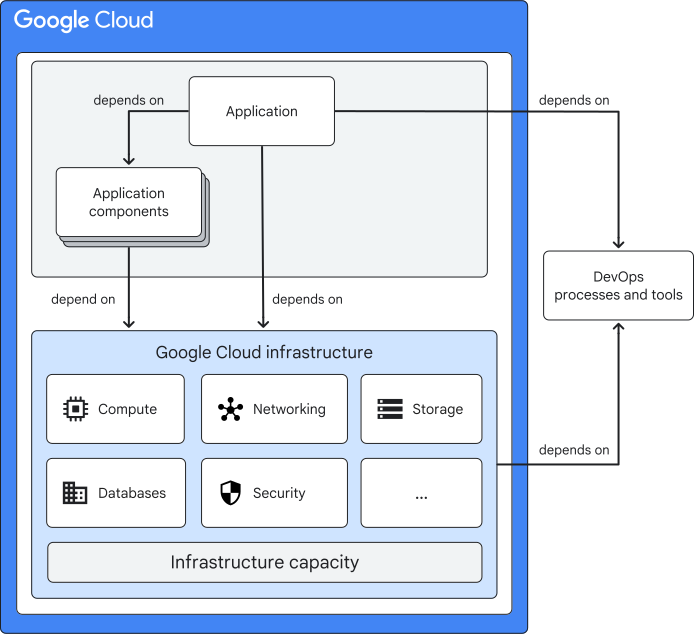
The core of the issue lies in the distinction between an application being “cloud-hosted” and an application being “truly resilient.” Many SaaS providers utilize major cloud infrastructure providers, such as Amazon Web Services (AWS), but the configuration of these services often lacks the cross-region failover capabilities that health systems require for mission-critical operations. According to recent reports from healthcare technology leaders, the vulnerability is often buried in the underlying architecture of the service agreements themselves.
When a cloud service experiences a regional outage, the lack of automated, multi-region failover means that healthcare providers are left waiting for the vendor to restore connectivity. This dependency creates a “single point of failure” dynamic that contradicts the perceived reliability of modern cloud environments. For context on how such disruptions are managed, organizations like Mass General Brigham maintain specific protocols for reporting and addressing service interruptions, as seen in their public-facing service alert documentation, which provides transparency regarding ongoing technical issues and resolution status.
Addressing the Missing Habit in IT Governance
The fix for these systemic vulnerabilities begins with a shift in institutional practice. Industry experts suggest that health IT teams have been neglecting a fundamental habit: rigorous, independent verification of vendor disaster recovery and business continuity plans. Rather than accepting vendor assurances of “high availability” at face value, IT departments are being urged to conduct deeper due diligence into how exactly a provider handles regional outages.
This missing habit involves moving beyond high-level service level agreements (SLAs) and requiring vendors to provide evidence of multi-region deployment strategies. This includes:
- Geographic Redundancy Audits: Requesting architectural documentation that proves data and application logic are replicated across geographically distinct regions.
- Failover Testing: Requiring vendors to participate in, or provide reports from, regular failover simulations.
- Contractual Clarity: Defining clear expectations for recovery time objectives (RTO) and recovery point objectives (RPO) specifically in the context of regional cloud failures.
What This Means for Healthcare Operations
For health systems, the goal is to decouple clinical operations from the volatility of external cloud dependencies. This is particularly vital for hospitals that rely on SaaS for electronic health records (EHR) modules, imaging archives, or patient scheduling tools. When these systems go offline, the burden of downtime procedures—often paper-based or manual—falls heavily on clinicians and nursing staff.

The current climate underscores the necessity for a “trust but verify” approach to vendor management. As healthcare continues its digital transformation, the responsibility for system uptime is no longer solely the vendor’s. it is a shared risk that must be managed through proactive governance and robust contingency planning. By identifying these hidden dependencies early, health systems can implement local caching or secondary failover mechanisms that ensure patient care remains uninterrupted, regardless of the status of external cloud servers.
Looking Ahead: Ensuring Systemic Stability
The path forward requires a more granular understanding of the cloud ecosystem. As health systems continue to scale their digital capabilities, the focus must shift from the convenience of SaaS to the resilience of the supporting infrastructure. Future efforts in healthcare IT policy will likely emphasize standardized transparency requirements for cloud service providers, ensuring that hospitals have the information necessary to assess risk accurately before integrating new technologies into their clinical environments.
For IT professionals and health system administrators, the next phase of this evolution involves staying informed through institutional updates and industry-wide cybersecurity and infrastructure advisories. Organizations are encouraged to monitor official communications from their specific health system portals, such as the Commonwealth of Massachusetts official resources for regional guidance or internal enterprise dashboards, to stay ahead of potential disruptions. We invite our readers to share their experiences with vendor resilience and cloud management in the comments section below.
Related reading