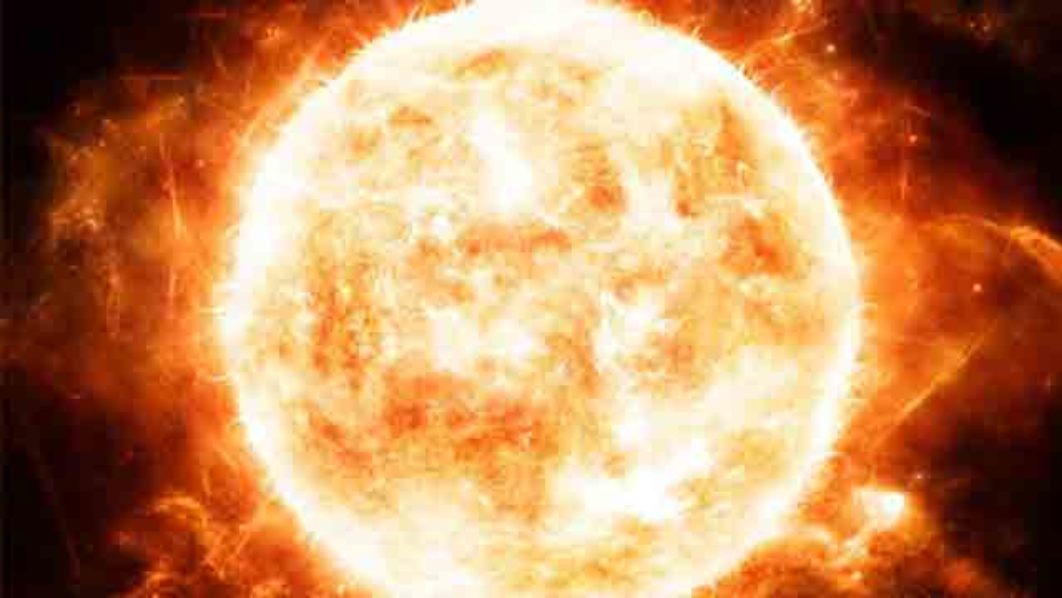
The Sun is a massive sphere of hot plasma located at the center of the Solar System, serving as the primary source of energy for life on Earth. As a G-type main-sequence star, or G2V, it accounts for approximately 99.8% to 99.86% of the total mass of the Solar System. Formed about 4.6 billion years ago from the gravitational collapse of a large molecular cloud, the Sun acts as the gravitational anchor for all orbiting planets, asteroids, comets, and debris.
Physical Composition and Structure
The Sun is a dynamic, non-solid object composed primarily of hydrogen (approximately 73%) and helium (approximately 25%), with smaller quantities of heavier elements including oxygen, carbon, neon, and iron. Because it is not a solid body, the Sun rotates at different rates: it completes a rotation approximately every 25 days at the equator and every 34.4 to 36 days at the poles. Its scale is immense compared to Earth. With a diameter of approximately 1.39 million to 1.4 million kilometers (about 864,600 to 865,000 miles), its volume is roughly 1.3 million times that of Earth. The Sun’s mass is estimated to be 330,000 times that of Earth. The star is structured into several distinct regions. The interior includes the core, the radiative zone, and the convection zone. The visible surface is known as the photosphere, which maintains a temperature of about 10,000 °F (5,500 °C). Beyond this lies the corona, the Sun’s outer atmosphere, which presents a scientific mystery: it reaches temperatures up to 3.5 million °F (2 million °C), becoming significantly hotter as it extends further from the surface.
Energy Production and Heliophysics
The core is the hottest part of the Sun, with temperatures topping 27 million °F (15 million °C). Within this region, nuclear fusion reactions convert hydrogen into helium. Every second, the Sun fuses approximately 600 billion kilograms of hydrogen, converting 4 billion kilograms of matter into energy. This energy is radiated from the surface mainly as visible light and infrared radiation, with 10% emitted as ultraviolet energy. The study of this star and its influence on the Solar System is known as heliophysics. The Sun’s interactions with Earth—driven by its light, energy, and gravity—are responsible for weather, climate, ocean currents, seasons, radiation belts, and auroras.

For more on this story, see Terraforming Space Stations: The Energy to Revive Dead Planets.
Orbital Dynamics and Galactic Context
The Sun is located in the Milky Way galaxy within a spiral arm known as the Orion Spur. It orbits the Galactic Center at a distance of 24,000 to 28,000 light-years. While the Sun and its entire system move at an average velocity of 450,000 miles per hour (720,000 kilometers per hour), it takes between 225 million and 250 million years to complete a single orbit around the galaxy. Within the Solar System, the Sun maintains a mean distance from Earth of approximately 149.6 million kilometers, or about 8 light-minutes. This distance is the basis for the astronomical unit (au).
Evolutionary Lifecycle
Scientists estimate that the Sun is currently slightly less than halfway through its lifespan. In approximately 4 to 7 billion years, hydrogen fusion in the core will diminish, causing the Sun to lose its hydrostatic equilibrium. At that stage, the core density and temperature will increase, causing the outer layers to expand. The Sun will transform into a red giant, potentially engulfing Mercury, Venus, and Earth. Following the red giant phase, the Sun will shed its outer layers and transition into a white dwarf—a dense, cooling star that no longer produces energy through fusion but continues to glow from residual heat. Eventually, it is theorized to become a black dwarf, emitting negligible energy.
Quick Reference: Solar Characteristics
| Feature | Data | | :— | :— | | Age | 4.6 billion years | | Mean distance from Earth | 1 au (approx. 149.6 million km) | | Principal elements | Hydrogen (~73%), Helium (~25%) | | Solar System mass share | ~99.8% | | Core temperature | ~27 million °F (15 million °C) | | Photosphere temperature | ~10,000 °F (5,500 °C) | | Rotation (Equator) | ~25 days | | Rotation (Poles) | ~34–36 days | The Sun remains a central subject of astronomical research and has been an object of cultural veneration since antiquity. It is frequently referenced in mythology, religion, and global pop culture, and serves as a vital resource for scientific exploration of magnetism, gravity, and light.
Find more reporting in our Tech section.