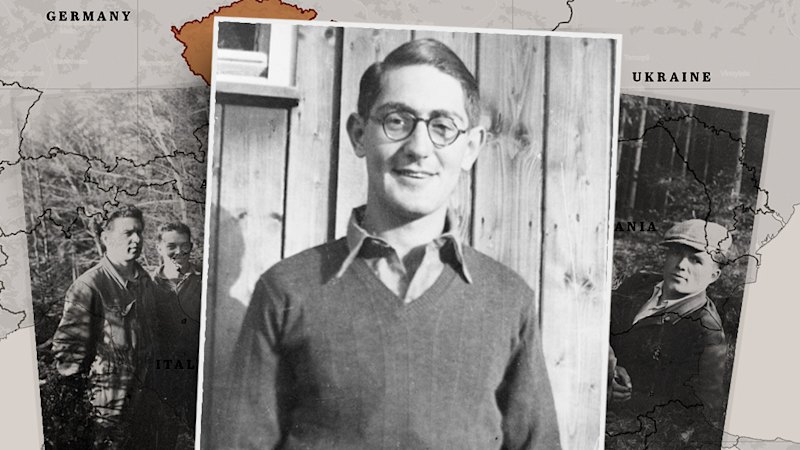
On the very day Nazi Germany surrendered, an Australian soldier who had escaped captivity to fight alongside Czech partisans met his tragic end in a small village in what is now the Czech Republic. Lawrence Phillip Saywell, a private in the Australian Army Service Corps, was killed on May 8, 1945 — Victory in Europe Day — while resisting the last remnants of Nazi occupation. His story, long overlooked in Australian military history, has been preserved through Czech memorials and archival records that confirm his service with local resistance fighters in the final days of World War II.
Saywell’s journey to the Czech countryside began after his capture during the North African campaign. According to verified records from the Australian War Memorial and corroborated by Czech historical sources, he was initially held at Stalag VIIA in Moosburg, Germany, before being transferred to Stalag VIIB (344) at Lamsdorf, now Łambinowice in Poland. During his imprisonment, Saywell used his time in labour camps to improve his German and learn basic Russian, skills that later allowed him to act as an interpreter in a paper mill and build trust with local civilians.
After escaping from a work detail, Saywell found refuge with Czech families near the village of Zderaz in the Pardubice Region. There, he joined local partisans in sabotage operations against retreating Nazi forces. As documented by Czech Radio and verified through the Australian War Memorial’s public domain photographs, Saywell fought alongside fighters led by individuals such as Pavel Koutný, whose family had sheltered him. His fluency in German and growing knowledge of Czech made him a valuable asset to the resistance movement in the closing weeks of the war.
The circumstances of his death are marked by both tragedy and historical irony. On May 8, 1945 — the same day German forces signed an unconditional surrender in Reims, France, and later in Berlin — Saywell was fatally wounded in the village of Miřetín, also in the Pardubice Region. A memorial in the local cemetery, maintained by residents and verified through photographic records from Wikimedia Commons, states: “Lawrence Saywell, English Partisan, was murdered in the resistance here by the German SS, 8.5.1945.” Whereas the inscription identifies him as English, military records confirm he was Australian, serving with the 17th Brigade Company of the Australian Army Service Corps.
His death occurred just hours before the formal cessation of hostilities, making him one of the last Allied soldiers to die in the European theatre. While exact casualty figures for the final day of the war vary across sources, historians agree that scattered resistance actions continued despite the surrender signing, particularly in areas where Nazi units refused to lay down arms or where SS remnants carried out reprisals. Saywell’s killing exemplifies the chaotic and violent end of the conflict, even as celebrations erupted in London, Moscow, and Washington.
In the years following the war, Saywell’s story was preserved primarily through Czech efforts. The Australian ambassador to Poland, the Czech Republic, and Lithuania, Lloyd Brodrick, has acknowledged his service in diplomatic remarks, though no official Australian military decoration was posthumously awarded to Saywell. His name does not appear on the Australian War Memorial’s Roll of Honour for those killed in action during World War II, a discrepancy noted by researchers who argue that his status as an escaped POW fighting with partisans may have complicated formal recognition.
Nonetheless, local commemorations in Miřetín and Zderaz continue to honour his contribution. Annual observances around May 8 include visits to his grave by Czech veterans’ groups and, occasionally, representatives of the Australian Embassy in Prague. The village, with a population of around 100 according to regional census data cited in Czech Radio broadcasts, maintains the memorial as a site of remembrance for foreign fighters who aided the Czech resistance.
Saywell’s experience reflects a broader, though often under-documented, narrative of Allied prisoners of war who joined resistance movements across occupied Europe. From Yugoslavia to France and the Netherlands, escaped POWs sometimes linked up with partisan groups, using their military training and language skills to support sabotage and intelligence efforts. Historians at institutions such as the National WWII Museum in New Orleans have noted that while these collaborations were rarely formalized, they played a role in disrupting German retreat operations in the spring of 1945.
The Prague Uprising of May 1945, which began just days before Saywell’s death, provides context for the intensity of resistance activity in the region. Though centred in Prague, the uprising inspired actions in surrounding areas, including the Pardubice Region, where Saywell was operating. The five-day revolt, verified through museum archives and historical accounts, saw Czech citizens and resistance fighters seize key infrastructure before being suppressed by superior German forces — only to be relieved days later by the arrival of Soviet troops.
Today, Saywell’s legacy endures not through grand national ceremonies in Australia, but through the quiet persistence of memory in a Czech village cemetery. His story serves as a reminder that the end of war often comes unevenly — that victory in capitals can coexist with continued danger in the countryside, and that individuals far from home can choose to keep fighting even when liberation seems imminent.
For those wishing to learn more about Lawrence Saywell, verified sources include the Australian War Memorial’s public domain photograph collection, the Czech Radio feature on his life and death, and archival documents from Stalag VIIB detailing his time as a prisoner of war. These materials, accessed through official cultural and historical institutions, provide the most reliable account of a soldier whose final act of courage occurred not on a battlefield, but in the struggle for freedom in a foreign land — on the very day the war in Europe was declared over.
We invite readers to reflect on the lesser-known stories of World War II and share their thoughts in the comments below. If you found this account informative, please consider sharing it with others interested in hidden histories of the conflict.
Related reading