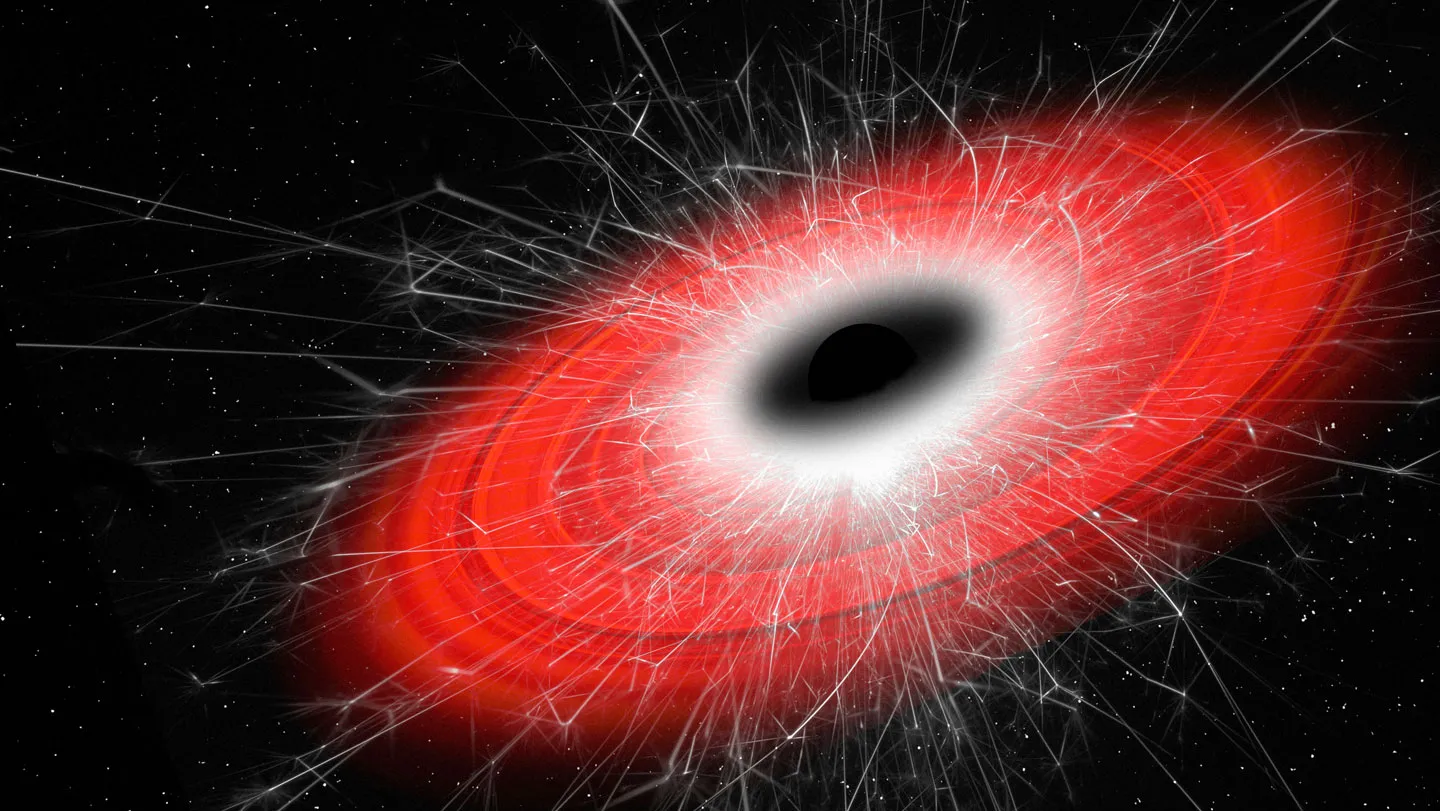
For decades, black holes have stood as the most formidable enigmas in the known universe, acting as gravitational traps from which not even light can escape. However, they are not entirely silent or dark. According to theoretical physics, they emit a faint, ghostly mist of particles known as Hawking radiation, a phenomenon that sits at the heart of several profound scientific puzzles.
The challenge for researchers has always been one of visibility. Hawking radiation is so incredibly faint that it remains impossible to observe directly with current technology. To bypass this observational wall, physicists are now employing a mathematical Rosetta stone for black holes—a sophisticated link known as the “double copy”—to translate the complex equations of gravity into the more manageable language of particle physics.
This theoretical breakthrough allows scientists to investigate the nature of black holes by leveraging the mathematics of subatomic particles. By bridging two previously distinct camps of physics, researchers are finding new ways to calculate gravitational effects that were once considered unreachable, offering a fresh perspective on how the universe operates at its most extreme limits.
The Paradox of Hawking Radiation
To understand why a mathematical translation is necessary, one must first understand the nature of the phenomenon being studied. Hawking radiation refers to the theoretical process by which black holes lose mass over time through the emission of particles. While this concept is central to our understanding of black hole thermodynamics, the radiation is too weak to be detected by telescopes, leaving physicists to rely on mathematical models to prove its existence and behavior.

The struggle to study these emissions stems from a fundamental divide in science. The universe is currently described by two primary, yet often incompatible, frameworks. One is the Standard Model, which governs the physics of subatomic particles and the forces that act upon them. The other is the general theory of relativity, which describes gravity and the curvature of spacetime on a cosmic scale.
Because black holes involve both massive gravity and tiny particles, they require a synthesis of these two theories. This is where the “double copy” becomes an essential tool for discovery.
Bridging the Gap: The ‘Double Copy’ Mechanism
The double copy acts as a mathematical translation tool, allowing physicists to switch a calculation from one “language” of physics to another. It reveals that many phenomena within the realm of general relativity are mathematically equivalent to those found in the Standard Model, provided a specific adjustment is made.
Specifically, the double copy posits that in the equations of general relativity, Notice two copies of a particular part of the equation. By identifying this relationship, scientists can take a known result from particle physics and “copy” or translate it to find a corresponding result in gravity. This method effectively allows researchers to recycle existing data from the study of subatomic particles to solve problems involving black holes and gravity.
This mathematical link was first discovered in 2010. In the years since, it has been developed into a robust framework for understanding a variety of gravitational effects that previously defied calculation.
New Insights into Gravitational Calculations
The application of the double copy to Hawking radiation is providing physicists with a new angle on long-standing puzzles. By treating gravitational equations as a “double copy” of particle physics equations, the complexity of the math is often reduced, revealing insights that were previously obscured by the sheer difficulty of the calculations.
Chris White, a theoretical physicist at Queen Mary University of London, emphasizes the utility of this approach. “It allows us to calculate things we’ve never been able to calculate before, just by recycling results in a clever way,” White noted.
This approach is particularly valuable because it does not require new observational data from space—which is currently impossible to obtain for Hawking radiation—but instead relies on the internal consistency of mathematical laws. By proving that the math of a particle behaves like the math of gravity when doubled, physicists can infer the behavior of black holes with greater confidence.
Why This Matters for Modern Science
The ability to translate between the Standard Model and general relativity is more than just a mathematical convenience; it is a step toward a “Theory of Everything.” For years, the incompatibility between quantum mechanics (the highly small) and relativity (the very large) has been the primary obstacle in physics. The double copy suggests a deeper, intrinsic connection between these two worlds.

By applying this Rosetta stone to Hawking radiation, scientists are not only learning about black holes but are also testing the limits of how we describe the universe. If the double copy continues to yield accurate predictions, it may fundamentally change how we approach the study of gravity, dark matter, and the origins of the cosmos.
As theoretical physicists continue to refine these translations, the goal remains to turn these mathematical insights into a comprehensive understanding of the life cycle of black holes—from their violent formation to their eventual, slow evaporation through the radiation that the double copy is now helping us understand.
The scientific community continues to refine these mathematical models, with future publications expected to further detail the specific gravitational effects revealed by the double copy framework. Readers interested in the intersection of quantum mechanics and relativity can follow updates from major research institutions like CERN and NASA.
Do you believe mathematical models can eventually replace the need for direct observation in deep space? Share your thoughts in the comments below.