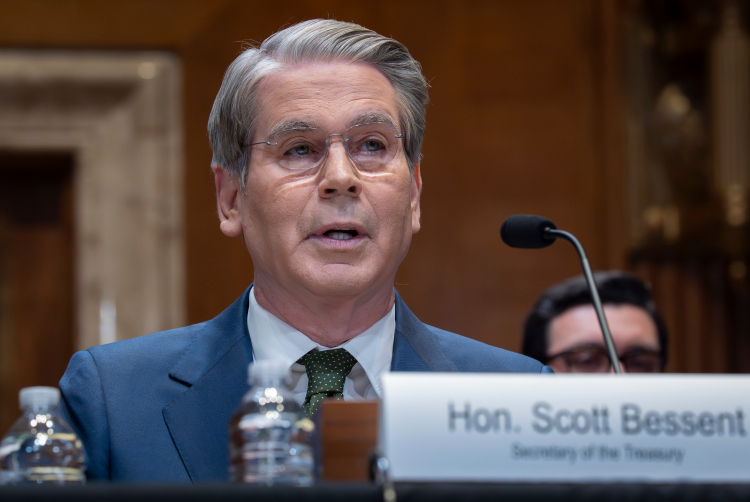
Scott Bessent has emerged as a central figure in the Trump administration’s economic strategy, serving as Treasury Secretary and playing a pivotal role in shaping policy on trade, taxation, and international financial institutions. His background as a hedge fund manager and close adviser to former President Donald Trump has positioned him as a key architect of the administration’s approach to global economic relations, particularly with China.
Bessent’s influence became especially pronounced in early 2025 amid escalating trade tensions between the United States and China. Following Trump’s return to the White House in January 2025, the administration imposed additional tariffs of 145% on many Chinese imports, citing concerns over unfair trade practices and the fentanyl supply chain. In response, Beijing implemented sweeping counter-tariffs of 125% on U.S. Goods, creating what Bessent described as a “reciprocal trade embargo” between the world’s two largest economies.
Despite the heightened tensions, Bessent has consistently signaled openness to de-escalation and negotiation. Speaking at the Institute of International Finance Global Outlook Forum in Washington, D.C. On April 23, 2025, he stated there was “an opportunity for a big deal here” on trade issues between the U.S. And China. “If they want to rebalance, let’s do it together,” Bessent said, adding that such an effort could resemble what Bridgewater founder Ray Dalio might call “a beautiful rebalancing.”
His remarks came shortly after The Wall Street Journal reported that the Trump administration was considering reducing the 145% tariffs on China to between 50% and 65%, levels still significantly high but representing a potential step toward easing the standoff. Bessent acknowledged the severity of the current tariff levels, echoing Trump’s own assessment that 145% is “a incredibly high” rate that would “come down substantially,” though not to zero.
At a closed-door event hosted by JPMorgan Chase around the same time, Bessent reiterated that the administration’s goal was not to decouple the U.S. And Chinese economies. According to a source present at the meeting, he expressed confidence that de-escalation was expected in the near future, a development he believed could bring relief to financial markets. This outlook contributed to a positive reaction on Wall Street, with major indexes rising following news of his comments.
Beyond trade, Bessent has used his platform to critique the role of major international financial institutions. In his address to the Institute of International Finance, he outlined what he described as “a blueprint to restore equilibrium to the global financial system,” specifically targeting the International Monetary Fund and the World Bank. Whereas affirming that “the IMF and World Bank have enduring value,” he argued that “mission creep has knocked these institutions off course,” suggesting they have strayed from their original mandates through expanded lending practices.
He specifically pointed to the World Bank’s lending to nations with advanced economic growth—including China—as an example of this mission drift, arguing that such allocations undermine the institution’s purpose of supporting the world’s poorest countries. This critique aligns with broader Republican skepticism toward multilateral lending practices that, in their view, benefit emerging economies at the expense of U.S. Interests or global equity.
Bessent’s economic philosophy reflects a blend of market-oriented principles and strategic nationalism. His tenure at Treasury has emphasized reducing what he views as unfair trade imbalances, pressuring China to adjust its industrial and trade policies, and advocating for reforms in global institutions to better reflect what he sees as fairer economic outcomes. These efforts are framed not as isolationist but as recalibrative—aimed at creating a more balanced and sustainable international economic order.
As the Trump administration continues to navigate complex trade negotiations, Bessent remains a key voice in defining its economic posture. His upcoming participation in high-level discussions, including potential engagements ahead of any Beijing summit, will be closely watched for signals about the direction of U.S.-China relations. Market analysts and policymakers alike are monitoring his statements for clues about potential tariff adjustments, institutional reforms, and the broader trajectory of global economic policy under his stewardship.
The next major checkpoint in this evolving situation will be the spring meetings of the International Monetary Fund and World Bank, where Bessent is expected to continue advocating for his vision of institutional reform. Officials and analysts will be watching for any concrete proposals or diplomatic overtures that could signal progress toward resolving the current trade impasse.
For ongoing coverage of Scott Bessent’s role in shaping U.S. Economic policy and its global implications, readers are encouraged to follow official Treasury announcements, statements from the Institute of International Finance, and reputable financial news outlets that provide verified updates on trade negotiations and international economic developments.
Keep reading