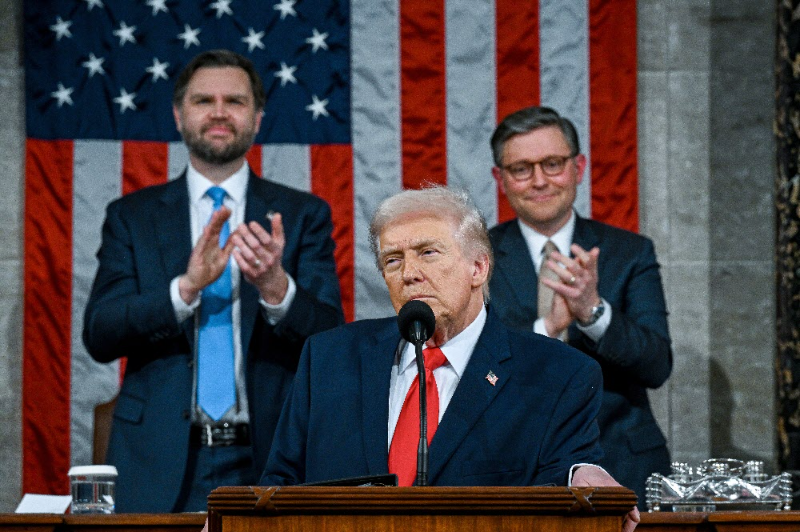
Washington D.C. – In a defiant address to the nation during his State of the Union address on February 24th, U.S. President Donald Trump reaffirmed his commitment to maintaining existing tariffs and signaled the potential for even more aggressive trade measures. The speech, delivered before a joint session of Congress, came just days after the Supreme Court ruled against the legality of some of his administration’s previous tariff actions. Despite the court’s decision, President Trump asserted his authority to implement trade policies, citing legal avenues that do not require congressional approval. This stance sets the stage for continued tensions in global trade relations and raises questions about the future of international economic agreements.
President Trump framed his administration’s trade policies as essential to restoring American economic strength and protecting American jobs. He declared, “America is back – stronger, richer, and more powerful than ever before. Now is the golden age of America!” This rhetoric, reminiscent of his 2016 campaign promises, underscores his focus on prioritizing domestic interests in trade negotiations. The President’s address also touched upon a range of other issues, including border security, inflation, and the state of the U.S. Military, but trade policy remained a central theme.
Supreme Court Ruling and the Pursuit of New Trade Measures
The backdrop to President Trump’s speech is a recent Supreme Court ruling that deemed his administration’s use of the International Emergency Economic Powers Act (IEEPA) to impose tariffs unlawful. As reported by Voice of America, the President acknowledged the unfavorable ruling but indicated his administration is prepared to circumvent it. He stated that the administration possesses “more powerful solutions” and intends to continue utilizing tariffs as a tool to protect American industries. He specifically referenced Section 122 of the Trade Act of 1974, which he believes provides the legal basis for imposing a 15% tariff on goods from all nations. This move, he argued, does not require congressional approval.
The legality of this approach is likely to be challenged, but President Trump expressed confidence in his administration’s legal position. He emphasized that the tariffs have generated substantial revenue for the U.S. Government, allowing him to address critical issues such as national security and resolve international conflicts. He claimed that these revenues have also helped alleviate the financial burden on American citizens, though this claim has not been independently verified by economic analysts. The President’s assertion that he has resolved “many wars” due to tariff revenue is a bold statement that requires further scrutiny.
Domestic Economic Claims and Criticism of Predecessors
Throughout his address, President Trump touted the economic successes of his administration, claiming that the U.S. Has experienced unprecedented growth and that inflation has been contained. He dismissed criticisms from economists, including Nobel laureates, stating they were “seriously wrong.” He asserted that the economic gains were a direct result of his policies, including the tariffs. However, independent economic data and analyses are needed to substantiate these claims. According to KBS News, the official theme of the State of the Union address was “America at 250: Strong, Prosperous, and Respected.”
President Trump also took aim at his predecessor, Joe Biden, without directly naming him, criticizing the state of the country when he took office. He described inheriting a nation grappling with economic stagnation, record-high inflation, uncontrolled borders, and widespread crime. He contrasted this with the current state of affairs, claiming his administration has achieved a “historic turnaround.” This narrative is consistent with his broader political strategy of portraying himself as a transformative leader who has rescued the country from decline.
Guest List and Symbolic Representation
The State of the Union address is traditionally an opportunity for the President and members of Congress to highlight specific policies and individuals. Voice of America reported that First Lady Melania Trump invited Everest Nebromong, a student, and Sierra Burns, an advocate for children in foster care, to attend the address. These invitations were intended to spotlight issues related to education and child welfare. House Speaker Mike Johnson invited Claire Lai, the daughter of Jimmy Lai, a pro-democracy media mogul currently imprisoned in China. Johnson described Lai as a champion of free speech who has been unjustly detained by the Chinese Communist Party.
Implications for Global Trade and International Relations
President Trump’s unwavering commitment to tariffs, despite the Supreme Court’s ruling, signals a potentially turbulent period for global trade. His willingness to invoke Section 122 of the Trade Act of 1974, bypassing congressional oversight, raises concerns about the future of the U.S.’s trade relationships with key partners. The potential for retaliatory tariffs from other countries could escalate into a full-blown trade war, disrupting supply chains and harming economic growth worldwide. Save Internet New Daily reported that the speech was closely watched for signals regarding tariff and immigration policies.
The administration’s focus on securing favorable trade deals, even if it means imposing tariffs on other nations, reflects a broader shift towards protectionism. This approach could have significant implications for international cooperation on issues such as climate change, global health, and security. The President’s rhetoric suggests a willingness to prioritize American interests above all else, potentially straining alliances and undermining multilateral institutions.
The Role of Section 122 of the Trade Act of 1974
Section 122 of the Trade Act of 1974 allows the President to impose tariffs or other import restrictions if the U.S. International Trade Commission (ITC) determines that imports are causing or threatening to cause serious injury to a domestic industry. While this provision has been used in the past, its application by President Trump has been particularly aggressive and controversial. The ITC’s determination is subject to judicial review, but the President retains significant discretion in implementing the tariffs. The legal challenges to this approach are expected to continue, potentially leading to further court battles.
The use of Section 122 also raises questions about the balance of power between the executive and legislative branches. Critics argue that the President is circumventing Congress by relying on this provision to impose tariffs without seeking its approval. This could set a dangerous precedent, eroding the role of Congress in shaping trade policy.
President Trump’s State of the Union address underscored his determination to reshape America’s economic and trade policies in line with his “America First” agenda. While the legal challenges to his tariff policies remain unresolved, his commitment to protecting American industries and prioritizing domestic interests is clear. The coming months will be crucial in determining the long-term impact of his policies on the U.S. Economy and its relationships with the rest of the world. The next key development to watch will be the response from international trading partners and any further legal challenges to the President’s use of Section 122 of the Trade Act of 1974.
What are your thoughts on President Trump’s trade policies? Share your comments below and let us know how you think these changes will impact the global economy.
Worth a look