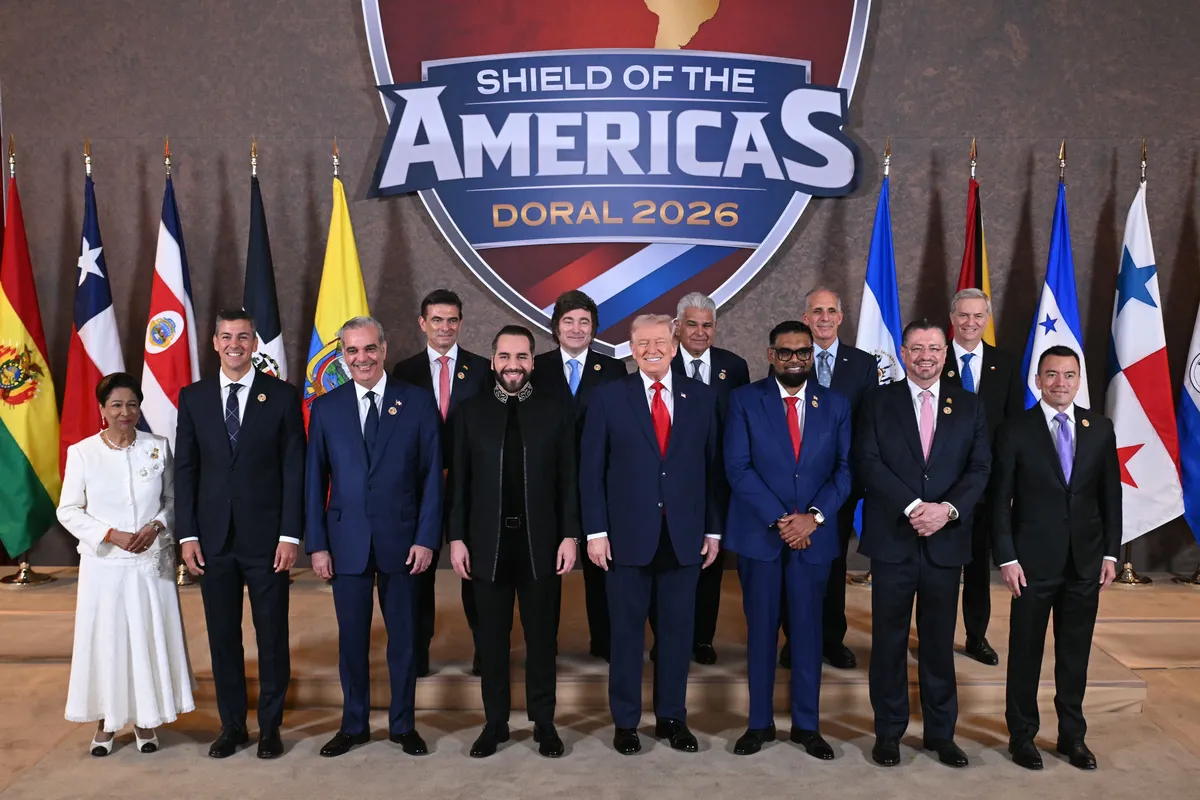
MIAMI, Florida – In a bold move signaling a significant escalation in the fight against transnational crime, U.S. President Donald Trump on Saturday announced the formation of “Escudo de las Américas” (Shield of the Americas), a novel regional security alliance. The initiative, unveiled at a summit in Miami, aims to dismantle drug cartels and counter what the administration views as growing threats from terrorism and foreign influence in the Western Hemisphere. The launch of this coalition comes amidst ongoing U.S. Military action in Venezuela and heightened tensions with Iran, framing the alliance as a critical component of a broader geopolitical strategy.
The alliance, currently comprised of twelve Latin American and Caribbean nations, represents a concerted effort to address the increasingly complex nexus between drug trafficking, terrorism, and the expansion of geopolitical rivals like China. According to a statement released by the White House, the coalition will focus on disrupting the financial networks and territorial control of criminal organizations, and will involve joint military training and operations. This initiative builds upon a previously signed agreement between the Pentagon and twenty countries in the region, solidifying a multi-faceted approach to regional security. The core of the strategy, as articulated by President Trump, centers on leveraging military force to dismantle these organizations, a departure from previous approaches that emphasized law enforcement and interdiction.
A New Regional Security Architecture
The participating nations in the “Escudo de las Américas” coalition include Argentina, Bolivia, Costa Rica, the Dominican Republic, Ecuador, El Salvador, Guyana, Honduras, Panama, Paraguay, Trinidad and Tobago, and Chile (represented by President-elect José Antonio Kast, who will assume office on March 11th). The summit in Miami, held at the Trump Doral resort, served as a platform for outlining the alliance’s objectives and coordinating a joint strategy. The administration intends for the alliance to serve as a bulwark against the increasing influence of external actors, specifically citing concerns about the relationship between Latin American drug cartels and terrorist groups like Hezbollah, allegedly operating on behalf of Iran. This concern is not new; for years, U.S. Officials have expressed worry over the potential for terrorist organizations to exploit the vulnerabilities created by the illicit drug trade to establish a foothold in the region. Infobae reports that the alliance also aims to counter China’s growing commercial influence in the region.
President Trump, in a 40-minute address, outlined what he described as a corolary to the Monroe Doctrine, emphasizing the need for regional leaders to reclaim control of territory lost to transnational criminal organizations. He asserted that the U.S. Would assist partner nations in confronting these cartels, offering military training and support. His rhetoric was forceful, suggesting a willingness to employ lethal force against cartel leaders, stating, “¿Quieren que usemos un misil? Son extremadamente precisos. Lo mandamos directo a la sala de estar y se acabó el miembro del cartel.” (Do you want us to use a missile? They are extremely precise. We send it straight to the cartel member’s living room and that’s it.)
The Shadow of Iran and Venezuela
The formation of “Escudo de las Américas” is inextricably linked to the ongoing geopolitical tensions involving Iran and Venezuela. The Trump administration has taken a hard line against both regimes, launching military action in Venezuela in January that resulted in the capture of Nicolás Maduro and his wife, Cilia Flores, who were subsequently transported to New York to face narcotics trafficking charges. Lasillarota.com reports that this action, coupled with a blockade of Cuba and the ongoing war against Iran – which has reportedly resulted in nearly 800 deaths, including the death of Ayatollah Ali Khamenei, Iran’s supreme leader – forms the backdrop for the new alliance. The administration alleges that Iran utilizes Venezuela and other regional partners to support and fund terrorist activities and facilitate the flow of narcotics into the United States.
The administration’s concerns regarding Iran’s influence extend beyond direct support for terrorist groups. Officials believe that Iran is actively seeking to expand its economic and political influence in Latin America, potentially undermining U.S. Interests. The alliance aims to counter this influence by strengthening regional security cooperation and reducing the vulnerability of Latin American nations to external interference. The U.S. Also views China’s increasing economic engagement in the region as a challenge to its own influence, and the “Escudo de las Américas” initiative is intended, in part, to provide a counterweight to Beijing’s growing presence.
Mexico’s Absence and Regional Implications
Notably absent from the “Escudo de las Américas” summit was Mexico, a key player in the fight against drug trafficking. President Trump acknowledged Mexico’s current situation, describing it as “the epicenter of cartel violence,” but also praised President Claudia Sheinbaum as a “incredibly good person.” The exclusion of Mexico raises questions about the long-term effectiveness of the alliance, as any comprehensive strategy to combat drug trafficking must involve cooperation with its southern neighbor. The decision to exclude Mexico may also reflect strained relations between the two countries, stemming from disagreements over trade, immigration, and security policy.
The inclusion of nations like Argentina, under President Javier Milei, and El Salvador, led by President Nayib Bukele, signals a shift towards aligning with leaders who have adopted hardline approaches to crime and security. Bukele, in particular, has gained international attention for his controversial crackdown on gang violence in El Salvador. The alliance’s success will depend on the willingness of these nations to commit resources and personnel to the effort, and to coordinate their actions with the United States. The participation of Chile’s President-elect José Antonio Kast, prior to his inauguration on March 11th, underscores the political significance of the alliance and its potential to shape regional dynamics.
Challenges and Concerns
While the “Escudo de las Américas” initiative has been hailed by the Trump administration as a landmark achievement, it faces significant challenges. The potential for unintended consequences, such as increased violence and human rights abuses, is a major concern. Critics argue that a purely military approach to combating drug trafficking is unlikely to be effective and could exacerbate existing problems. The alliance’s focus on external threats may divert attention from the underlying social and economic factors that contribute to crime and instability in the region.
The long-term sustainability of the alliance also remains uncertain. The political landscape in Latin America is constantly evolving, and future governments may be less willing to cooperate with the United States. The success of the “Escudo de las Américas” will ultimately depend on the ability of the participating nations to build trust, share intelligence, and coordinate their efforts effectively. The initiative also raises questions about the role of international law and the potential for violations of sovereignty. The use of military force in foreign countries is a sensitive issue, and the alliance must operate within a legal framework that respects the rights and sovereignty of all nations involved.
Key Takeaways:
- The U.S. Has launched “Escudo de las Américas,” a new security alliance with twelve Latin American and Caribbean nations.
- The alliance aims to combat drug cartels, terrorism, and foreign influence, particularly from Iran and China.
- Mexico was notably excluded from the summit, raising questions about the initiative’s comprehensiveness.
- The alliance’s success hinges on sustained regional cooperation and adherence to international law.
The next key development to watch will be the implementation of the joint military training programs and the deployment of resources to support the alliance’s objectives. Further details regarding the specific operational plans and the allocation of funding are expected to be released in the coming weeks. The international community will be closely monitoring the “Escudo de las Américas” initiative to assess its impact on regional security and stability. Share your thoughts on this developing story in the comments below.