Trump Launches Regional Coalition to Combat Cartels in ‘Shield of the Americas’ Initiative
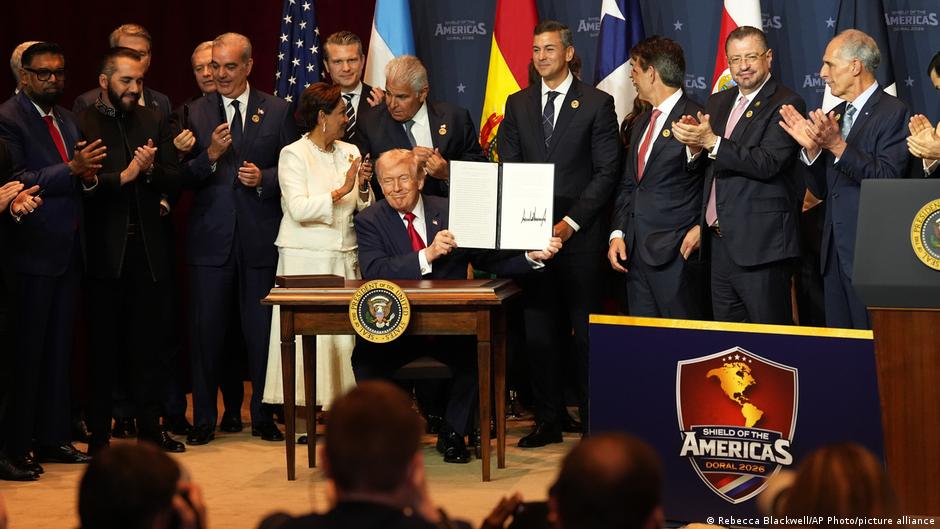
Doral, Florida – President Donald Trump on Saturday announced the formation of the “Americas Counter Cartel Coalition” at the “Shield of the Americas” summit held at Trump National Doral Miami. The initiative, framed as a renewed commitment to regional security, brings together leaders from twelve Latin American and Caribbean nations to collaboratively address the escalating threat posed by transnational criminal organizations. The summit unfolded against a backdrop of ongoing geopolitical tensions, including the conflict in Iran, where the U.S. Remains actively involved, demonstrating a continued prioritization of Western Hemisphere issues despite global demands on U.S. Foreign policy.
The gathering follows a recent summit hosted by Secretary of Defense Pete Hegseth focused on drug trafficking enforcement, further signaling a concerted effort to bolster security cooperation within the region. While the White House touts the coalition as a significant step towards dismantling cartel operations, the absence of key players like Brazil, Mexico, and Colombia – all currently led by left-leaning administrations – raises questions about the initiative’s long-term efficacy and regional buy-in. The move reflects a long-standing policy focus on combating drug trafficking and criminal activity in Latin America, a commitment that has evolved through administrations, though the current approach emphasizes a more assertive, and potentially unilateral, stance.
During his remarks, President Trump signed a proclamation committing to counter cartel criminal activity and offered a stark warning to cartels, suggesting the potential for direct U.S. Military intervention, including the use of missile strikes. This rhetoric, while echoing previous calls for a stronger response to cartel violence, has drawn criticism and sparked debate about the legality and potential consequences of such actions. The administration’s approach, described by some as a “Trump Corollary” to the 19th-century Monroe Doctrine, aims to assert U.S. Influence in the region and prevent external interference, but also risks exacerbating existing tensions and fueling anti-American sentiment.
A Renewed Focus on Regional Security
The “Shield of the Americas” summit represents a deliberate effort by the Trump administration to refocus U.S. Foreign policy on Latin America. According to the White House, the initiative is designed to foster a collaborative approach to dismantling criminal networks that destabilize the region and threaten U.S. National security. The Americas Counter Cartel Coalition, as it’s formally known, is intended to be a military partnership, facilitating intelligence sharing, joint operations, and coordinated efforts to disrupt the flow of illicit drugs and weapons. The administration has pledged to provide resources and support to partner nations, but the specifics of this assistance remain largely undefined.
Notably, the coalition’s special envoy will be former Homeland Security Secretary Kristi Noem, who was recently removed from her position as head of the Department of Homeland Security. Noem expressed her enthusiasm for the new role, stating that the summit’s declaration centers on “how we’re going to go after cartels and drug trafficking in the entire Western Hemisphere.” She will work alongside Secretary of State Marco Rubio and Secretary of Defense Hegseth to coordinate security efforts and implement the coalition’s objectives. The appointment of Noem, a staunch ally of the President, underscores the administration’s commitment to a hardline approach to border security and counter-narcotics operations.
The participating nations at the summit included Argentina, Bolivia, Chile, Costa Rica, the Dominican Republic, Ecuador, El Salvador, Guyana, Honduras, Panama, Paraguay, and Trinidad and Tobago. The absence of Brazil, Mexico, and Colombia – three of the largest and most influential countries in the region – is a significant omission. These nations are currently governed by left-leaning presidents who have often expressed skepticism towards U.S. Interventionist policies and have advocated for alternative approaches to drug control, such as harm reduction and social programs. This divergence in political ideologies and policy priorities likely contributed to their decision not to participate in the summit.
Trump’s Offer of Direct Military Action
President Trump’s remarks at the summit were particularly striking, as he openly discussed the possibility of using U.S. Military force against drug cartels, even suggesting the deployment of missile strikes. “The only way to defeat these enemies is by unleashing the power of our militaries,” Trump stated, echoing the message from Hegseth’s earlier summit on drug trafficking. He went on to say, “We’re working with you to do whatever we have to do. We’ll use missiles. You want us to use a missile? They’re extremely accurate.” He then mimicked the sound of a missile launch, adding, “’Piu,’ right into the living room. That’s the end of that cartel person. But we’ll do whatever you need.”
This rhetoric has raised serious concerns among legal experts and international observers, who question the legality and potential consequences of such actions. Under international law, the use of military force in another country is generally prohibited without a clear justification, such as self-defense or a mandate from the United Nations Security Council. A unilateral military intervention by the U.S. Could violate the sovereignty of other nations and escalate tensions in the region. Such actions could have unintended consequences, such as civilian casualties and the destabilization of already fragile governments. Images circulating online also show Secretary of Defense Pete Hegseth making a gesture during the press conference that some observers have likened to a Nazi salute, sparking further controversy and criticism.
The administration’s willingness to consider such drastic measures reflects a growing frustration with the ongoing drug trade and its devastating impact on both the U.S. And Latin America. Cartels are responsible for a significant portion of the violence and corruption in the region, and their operations have a direct impact on U.S. Communities through the flow of illicit drugs. Still, critics argue that a purely military approach is unlikely to be effective and could even exacerbate the problem. They advocate for a more comprehensive strategy that addresses the root causes of drug trafficking, such as poverty, inequality, and lack of economic opportunity.
Implications and Challenges Ahead
The “Shield of the Americas” initiative and the Americas Counter Cartel Coalition represent a significant shift in U.S. Policy towards Latin America. While the administration hopes to forge a stronger partnership with regional allies to combat drug trafficking and criminal activity, the absence of key players and the controversial rhetoric surrounding potential military intervention pose significant challenges. The success of the coalition will depend on its ability to build trust and cooperation with partner nations, address the underlying causes of crime and instability, and avoid actions that could undermine regional sovereignty.
The long-term impact of the initiative remains to be seen. However, the Trump administration is determined to prioritize security concerns in Latin America and to take a more assertive role in addressing the challenges facing the region. The coming months will be crucial in determining whether the “Shield of the Americas” can deliver on its promises and contribute to a more secure and prosperous future for both the U.S. And its Latin American neighbors. The administration has indicated that further details regarding the coalition’s operational plans and resource allocation will be announced in the coming weeks.
Key Takeaways:
- President Trump launched the “Americas Counter Cartel Coalition” at the “Shield of the Americas” summit in Doral, Florida.
- The initiative aims to foster regional cooperation in combating drug trafficking and criminal organizations.
- The absence of Brazil, Mexico, and Colombia raises questions about the coalition’s effectiveness.
- President Trump suggested the potential for U.S. Military intervention, including missile strikes, against cartels.
- The initiative faces legal and political challenges, and its long-term impact remains uncertain.
The next key development to watch will be the formalization of the coalition’s operational framework and the announcement of specific resource commitments. Readers are encouraged to share their thoughts and perspectives on this evolving situation in the comments below.
Related reading