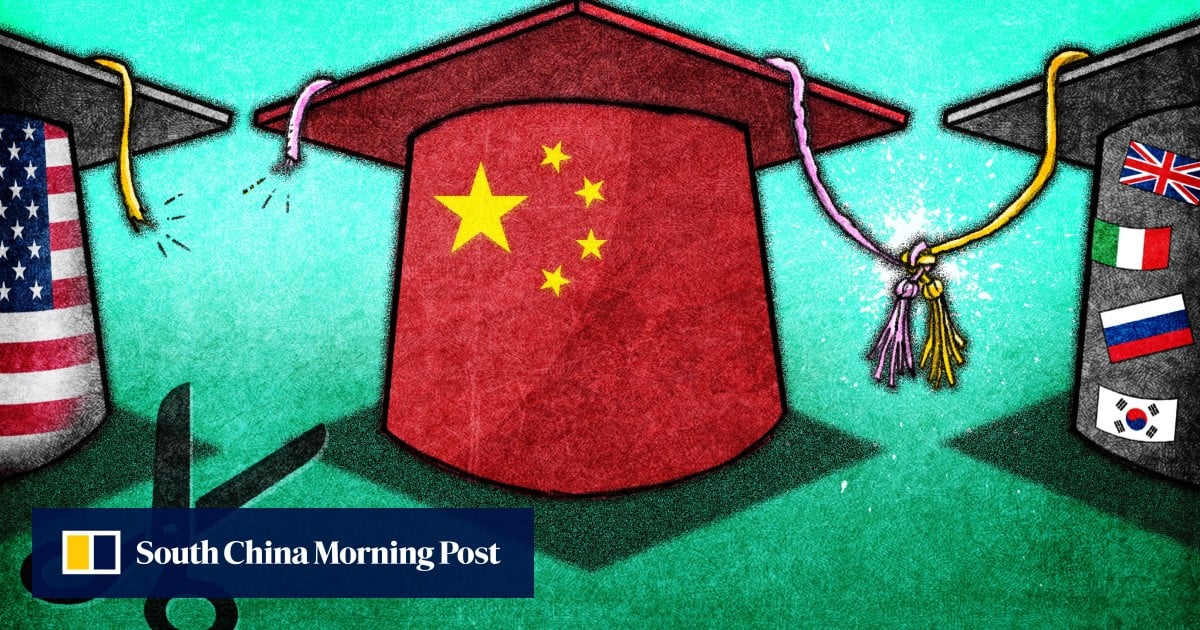
The decades-long partnership between US universities and their Chinese counterparts is undergoing a significant shift, driven by geopolitical tensions and increasing scrutiny from US lawmakers. While collaboration once flourished, a growing number of American institutions are scaling back or ending joint programs in China, leaving a void in international academic exchange. This retrenchment raises questions about who will fill the gap and what the future holds for global higher education partnerships. The evolving landscape is prompting Chinese universities to diversify their international collaborations, seeking new alliances beyond the United States.
The story of academic exchange between the US and China dates back to 1978, a pivotal moment following Deng Xiaoping’s reforms. A delegation of professors from Shanghai Jiao Tong University (SJTU) embarked on a mission to the US, visiting universities, research institutions and factories, laying the groundwork for decades of collaboration. This initial outreach led to sister-school agreements with institutions like the University of Michigan (UM), fostering a period of unprecedented academic cooperation. The partnership between SJTU and UM, formalized in 2006 with the establishment of a joint institute offering degrees in engineering, became a model for transnational higher education.
A Shift in US-China Academic Relations
Though, the once-seamless relationship has faced increasing headwinds in recent years. In early 2025, the University of Michigan abruptly ended its partnership with SJTU, citing concerns related to funding, political pressures, and security risks. According to the South China Morning Post, the decision followed intense pressure from US lawmakers wary of potential technology transfer and intellectual property theft. This move reflects a broader trend of US universities reassessing their ties with China amid heightened geopolitical competition.
The US government has implemented stricter regulations regarding research collaboration with China, particularly in sensitive fields like artificial intelligence, quantum computing, and advanced manufacturing. The Department of Commerce, for example, has placed export controls on certain technologies, limiting their availability to Chinese entities. The Committee on Foreign Investment in the United States (CFIUS) has increased its scrutiny of investments from China, raising concerns about national security. These measures, while intended to protect US interests, have created a more challenging environment for academic partnerships.
Several other US universities have followed suit, reducing their presence in China or suspending joint programs. These decisions are often framed as responses to political and security concerns, but they also reflect a growing awareness of the financial risks associated with operating in China. The COVID-19 pandemic and subsequent travel restrictions further complicated matters, disrupting student exchange programs and research collaborations. The increasing difficulty for Chinese students to obtain visas to study in the US has also contributed to the decline in academic exchange.
SJTU Adapts and Diversifies
In response to the University of Michigan’s withdrawal, SJTU has taken steps to adapt and diversify its international partnerships. The joint institute was transitioned into SJTU Global College, a more localized entity focused on internationalizing its curriculum and attracting students from around the world. SJTU is also actively pursuing new collaborations with universities in other countries, including Singapore’s Nanyang Technological University (NTU). As reported by the South China Morning Post, SJTU plans to establish the Zhangjiang International College of Technology this year, further expanding its network of international partners.
This shift reflects a broader strategy by Chinese universities to reduce their reliance on US partnerships and cultivate relationships with institutions in other regions. European universities, particularly those in the United Kingdom, Germany, and France, are increasingly seen as potential partners. Universities in Australia, Canada, and Japan are also actively engaging with Chinese institutions. This diversification is driven by a desire to maintain access to international talent and expertise, as well as to promote China’s own academic and technological development.
The Role of Singapore and Other Nations
Singapore’s Nanyang Technological University (NTU) is emerging as a key partner for Chinese universities, offering a compelling alternative to US institutions. NTU has a strong reputation for research and innovation, particularly in areas like engineering, technology, and sustainability. Its collaborative approach and willingness to engage with China have made it an attractive partner for SJTU and other Chinese universities. The establishment of the Zhangjiang International College of Technology with NTU signifies a growing trend of collaboration between China and Southeast Asian nations.
Other countries are also stepping up their engagement with Chinese universities. Germany, for example, has a long-standing tradition of academic exchange with China, and German universities continue to attract Chinese students and researchers. The United Kingdom, despite facing its own political challenges, remains a popular destination for Chinese scholars. These partnerships provide opportunities for cross-cultural exchange and collaboration in areas of mutual interest.
Implications for Global Higher Education
The changing dynamics of US-China academic relations have significant implications for the future of global higher education. The decline in US-China collaboration could lead to a fragmentation of the international academic community, hindering the free flow of ideas and talent. It could also exacerbate existing inequalities in access to education and research opportunities. The rise of alternative partnerships, such as those between China and Singapore, could reshape the global landscape of higher education, creating new centers of excellence and innovation.
The trend also raises questions about the role of politics in academic research. The increasing politicization of science and technology could stifle innovation and undermine the pursuit of knowledge. It is crucial for universities to maintain their independence and uphold the principles of academic freedom, even in the face of political pressure. International collaboration is essential for addressing global challenges, such as climate change, public health, and economic development, and it should not be sacrificed for short-term political gains.
The situation is further complicated by concerns about academic freedom within China. Reports of censorship, surveillance, and restrictions on research topics have raised concerns among some Western academics. These concerns need to be addressed through open dialogue and a commitment to upholding international standards of academic freedom. Without a guarantee of academic freedom, it will be tough to sustain meaningful and productive collaborations between Chinese and Western universities.
Key Takeaways
- US-China academic partnerships are declining due to geopolitical tensions and security concerns.
- The University of Michigan’s decision to end its partnership with SJTU reflects a broader trend.
- SJTU is diversifying its international collaborations, partnering with institutions in Singapore and other countries.
- The shift has implications for the future of global higher education and the free flow of ideas.
- Maintaining academic freedom and upholding international standards are crucial for sustaining meaningful collaborations.
Looking ahead, the future of US-China academic relations remains uncertain. The Biden administration has signaled a willingness to engage with China on areas of mutual interest, but tensions remain high. The outcome will depend on a complex interplay of political, economic, and security factors. Continued dialogue and a commitment to fostering understanding are essential for navigating this challenging landscape. The next key development to watch will be the implementation of new guidelines from the US Department of Education regarding research security and foreign influence, expected in late 2026.
What are your thoughts on the evolving landscape of international academic collaboration? Share your perspectives in the comments below. And please share this article with your network to spark further discussion.
Keep reading