
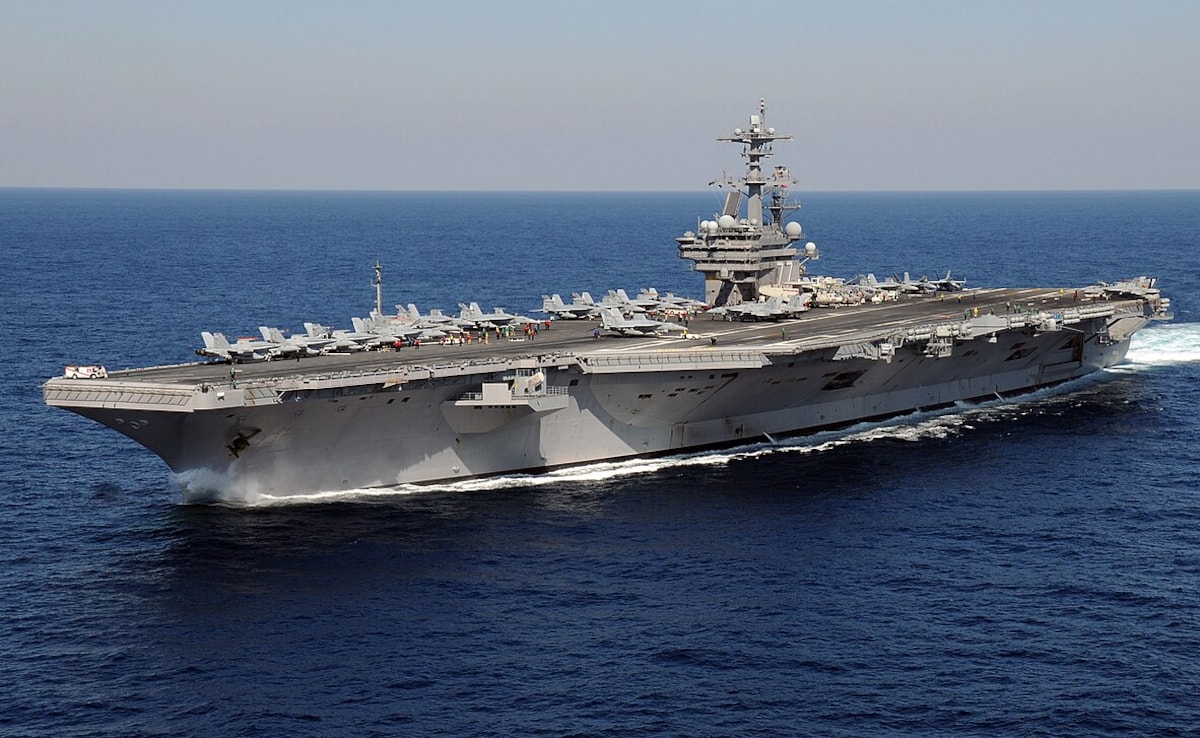
The United States has maintained a consistent naval presence in the Middle East as part of a broader strategy to deter regional conflict, according to official statements from the U.S. Department of Defense. Following public discourse regarding potential shifts in U.S. foreign policy toward Iran, the deployment and rotation of carrier strike groups remain a central component of Central Command (CENTCOM) operations in the region. These movements are designed to support maritime security and provide a rapid response capability, as documented in various official press releases from U.S. Central Command.
The USS George H.W. Bush (CVN 77), a Nimitz-class nuclear-powered aircraft carrier, has frequently served as a key asset in these power-projection efforts. Its presence is often highlighted by military analysts when tensions rise, serving as a visible signal of U.S. commitment to its regional partners. While specific mission details are often classified for operational security, the deployment of such vessels involves thousands of personnel and a full complement of carrier air wing aircraft, all operating under the umbrella of Department of Defense mission parameters.
Strategic Deterrence and Regional Stability
The U.S. military utilizes carrier strike groups as a primary tool for “integrated deterrence,” a concept emphasized in the 2022 National Defense Strategy. By positioning a nuclear-powered carrier in proximity to sensitive maritime chokepoints, such as the Strait of Hormuz, the U.S. aims to discourage state and non-state actors from disrupting global energy supplies or threatening international shipping lanes. This posture is not a static event but a continuous cycle of deployments overseen by the Pentagon to ensure that no single region remains without a high-end naval response option.

The USS George H.W. Bush is equipped with an array of offensive and defensive capabilities, including F/A-18 Super Hornets and E-2D Advanced Hawkeye early-warning aircraft. According to the U.S. Navy fact sheet, these ships are designed to operate in high-threat environments, providing the President and combatant commanders with a flexible range of options, from humanitarian assistance to high-intensity combat operations.
Evaluating the Context of Diplomatic Pressures
Discussions regarding “pressure” on Iran often center on the intersection of economic sanctions and military posturing. While the incoming administration of President-elect Donald Trump has signaled a return to a “maximum pressure” approach, the actual deployment of naval assets is managed by the transition of command between outgoing and incoming defense officials. The U.S. policy toward Iran remains a subject of intense debate, with stakeholders looking to both the U.S. Department of State and the Department of Defense for indications of how these military assets will be utilized in the coming months.
Observers note that the presence of a carrier strike group sends a message that is often interpreted differently by various regional actors. For the U.S., it is a defensive measure meant to stabilize the region; for Iranian officials, such deployments are frequently characterized as escalatory acts of interference. This disconnect in perception is a hallmark of the long-standing geopolitical friction in the Persian Gulf, a dynamic that Congressional Research Service reports describe as a persistent security challenge.
What Happens Next for Naval Deployments
Future naval deployments will be determined by the official transition of power in Washington and the subsequent appointment of new leadership within the Department of Defense. The U.S. Navy maintains a rolling schedule of deployments, known as the Optimized Fleet Response Plan, which dictates when ships are maintained, trained, and deployed. Readers interested in tracking these movements can monitor the official U.S. Navy news portal for updates on strike group locations and mission rotations.

As the administration prepares for its formal start in January 2025, military analysts suggest that the focus will remain on maintaining a “steady state” presence while preparing for potential shifts in policy priorities. There is no public schedule for specific carrier movements beyond standard operational rotations, and the Pentagon has not released any changes to the current force posture in response to the political transition. We encourage our readers to share their thoughts and perspectives on these developments in the comments section below, as we continue to track the evolving situation in the Middle East.