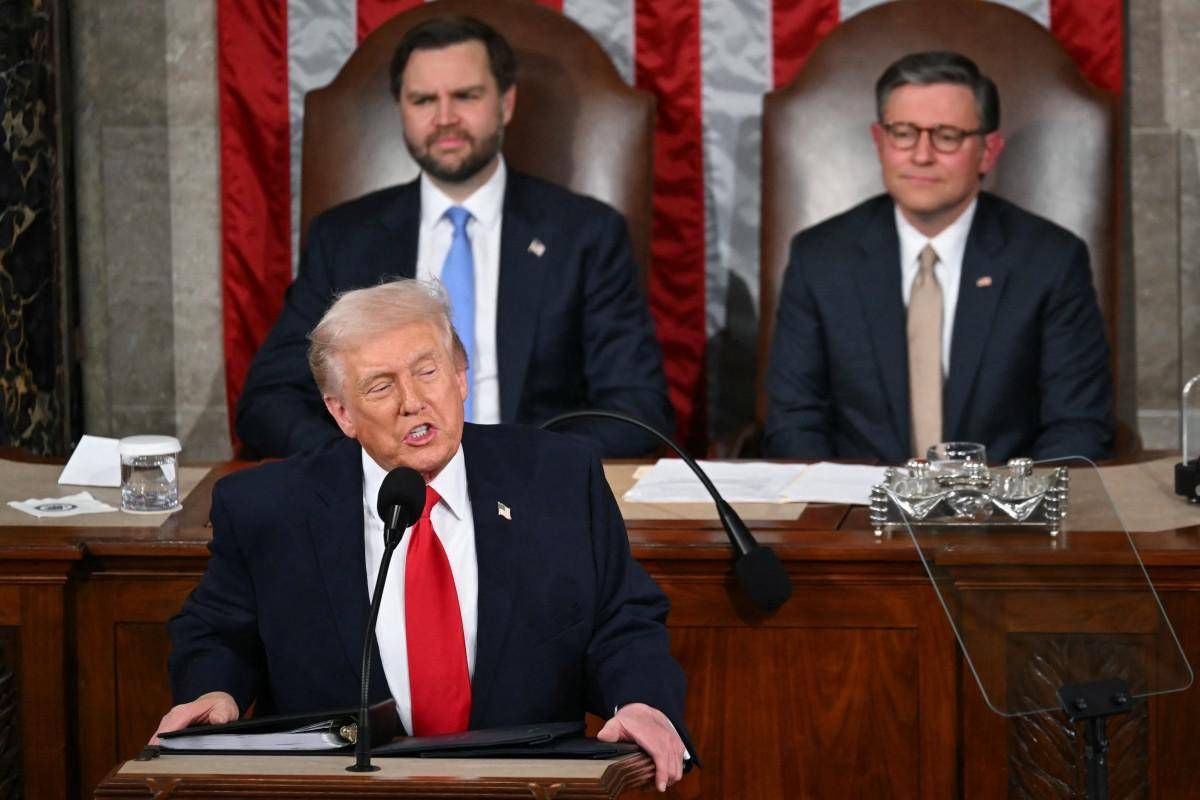
“America is Back, This is a Golden Age”: Trump Delivers Lengthy State of the Union Address
In a speech lasting nearly two hours, President Donald Trump delivered his second State of the Union address of his current term, painting a picture of a resurgent United States and outlining his vision for the future. Speaking before a joint session of Congress on Tuesday night, February 24, 2026, Trump touted economic successes, asserted a strengthened global standing for the U.S. and addressed key policy areas ranging from immigration to foreign relations. The address, the longest ever delivered during a State of the Union, came as the President faces declining poll numbers and internal divisions within his party, making the speech a critical opportunity to rally support and set the agenda for the coming year.
“Our nation is back. Stronger, better, richer, and more powerful than ever before,” Trump declared, opening his address with a bold assertion of American renewal. He further proclaimed that the U.S. Is entering a “golden age,” suggesting a period of unprecedented prosperity and influence. This optimistic tone permeated much of the speech, as the President highlighted what he characterized as significant achievements during his time in office. The address also occurred just months before the planned celebration of the 250th anniversary of American independence, a milestone Trump emphasized as a moment of national pride and future potential.
A Divided House and Protests
The atmosphere within the Capitol was not entirely celebratory. During the address, Democratic Representative Al Green was escorted from the chamber after displaying a sign reading “Blacks are not monkeys,” a direct response to a recently shared video by Trump that depicted former President Barack Obama and former First Lady Michelle Obama as primates. This incident underscored the deep political divisions that continue to characterize American politics and the contentious relationship between the President and his political opponents. The incident highlights the ongoing racial tensions within the country and the sensitivity surrounding the President’s rhetoric.
Immigration Remains a Central Focus
Immigration was a prominent theme throughout the address, with Trump reiterating his commitment to securing the border and restricting illegal immigration. He claimed that there have been “no entries at the border for 9 months,” a statement that requires independent verification. The President called for a renewed focus on prioritizing the needs of American citizens, stating, “The first mission of the United States is to defend its citizens, not illegal immigrants.” He urged members of Congress to stand in support of this principle, and openly criticized Democrats who remained seated, telling them, “Try to be ashamed.” This rhetoric reflects the President’s long-standing hardline stance on immigration and his appeal to a base of voters concerned about border security.
Economic Optimism and Questionable Claims
Trump dedicated a significant portion of his speech to outlining the perceived successes of his economic policies. He asserted that the U.S. Economy is “roaring” and that inflation has fallen, with gasoline prices decreasing. He also claimed that his administration has secured $18 trillion in foreign investment and that thousands of new companies are being formed. He highlighted an increase in domestic oil production and a new partnership with Venezuela, which has reportedly provided over 80 million barrels of oil. However, some of the President’s claims regarding economic performance have been challenged by fact-checkers. For example, Trump stated that “100% of the jobs created under my administration are in the private sector,” a claim that has been deemed inaccurate by multiple media outlets. Despite these discrepancies, the President maintained a consistently optimistic outlook on the state of the American economy.
The President also lauded the recent success of the U.S. National hockey team at the 2026 Winter Olympics in Milan Cortina, praising their victory over Canada. He announced that both the men’s and women’s teams would be invited to the White House, celebrating their achievements on the international stage.
Tariffs and Trade Policy
Trump reaffirmed his commitment to using tariffs as a tool to negotiate favorable trade deals and protect American industries. He stated that “almost all countries want to maintain the agreements already made,” believing they recognize that new agreements could result in less advantageous terms. Despite a recent Supreme Court ruling that struck down a significant portion of his previously imposed tariffs, Trump indicated his intention to reintroduce tariffs through new legislation. He even suggested that tariffs paid by foreign countries could eventually replace the current income tax system, a proposal that has drawn criticism from economists and trade experts. The President’s continued reliance on tariffs reflects his “America First” trade policy and his belief in protecting domestic industries.
Foreign Policy and Global Assertiveness
Turning to foreign policy, Trump claimed to have “resolved 8 wars,” a statement disputed by Democratic Representative Rashida Tlaib, who shouted “That’s a lie!” from the House floor. He highlighted perceived successes in the Middle East, claiming that an agreement had been reached in Gaza that “no one thought was possible.” He offered only a brief comment on the ongoing war in Ukraine, stating that “25,000 soldiers die every month” and suggesting the conflict would not have started had he remained in office. This claim requires further investigation and independent verification.
Trump devoted considerable attention to Iran, asserting that his administration had “destroyed the Iranian nuclear program” through an operation dubbed “Midnight Hammer.” He warned that Iran remains a significant threat, accusing the regime of sponsoring terrorism and developing missiles capable of reaching Europe and the United States. He stated that Iran has been warned against rebuilding its nuclear program and that negotiations are ongoing, but he insisted that he will not allow Iran to acquire a nuclear weapon. This strong stance against Iran reflects the President’s commitment to confronting what he views as a major threat to American security.
The President’s claim of destroying Iran’s nuclear program with “Operation Midnight Hammer” has not been independently confirmed by international observers or intelligence agencies. While the U.S. Has engaged in cyber operations against Iran’s nuclear infrastructure in the past, the extent and impact of such operations remain classified. Reuters provides a detailed overview of the history of the Iranian nuclear program and U.S. Efforts to contain it.
Looking Ahead
President Trump’s State of the Union address presented a vision of a revitalized America, characterized by economic strength, global respect, and a resolute defense of national interests. However, the speech was also marked by contentious rhetoric, questionable claims, and deep political divisions. As the nation approaches the 250th anniversary of its independence, the challenges facing the United States remain significant, and the path forward remains uncertain. The next key event to watch will be the upcoming budget negotiations between the White House and Congress, which will likely be a major test of the President’s ability to deliver on his promises and navigate the complex political landscape.
What are your thoughts on President Trump’s State of the Union address? Share your comments below and join the conversation.
Related reading
- Andrew Burnham: Führt er Grossbritannien zurück in die EU? – NZZ
- North Carolina physical therapist disappears in the Caribbean as husband pleads for ‘safe return’ – New York Post
- Rescission Packages, Explained: The Route Trump Bypassed (daybreakwire.com)
- Chattanooga FC vs Philadelphia Union II Result: Carolina Core FC Dominant Win (archyde.com)