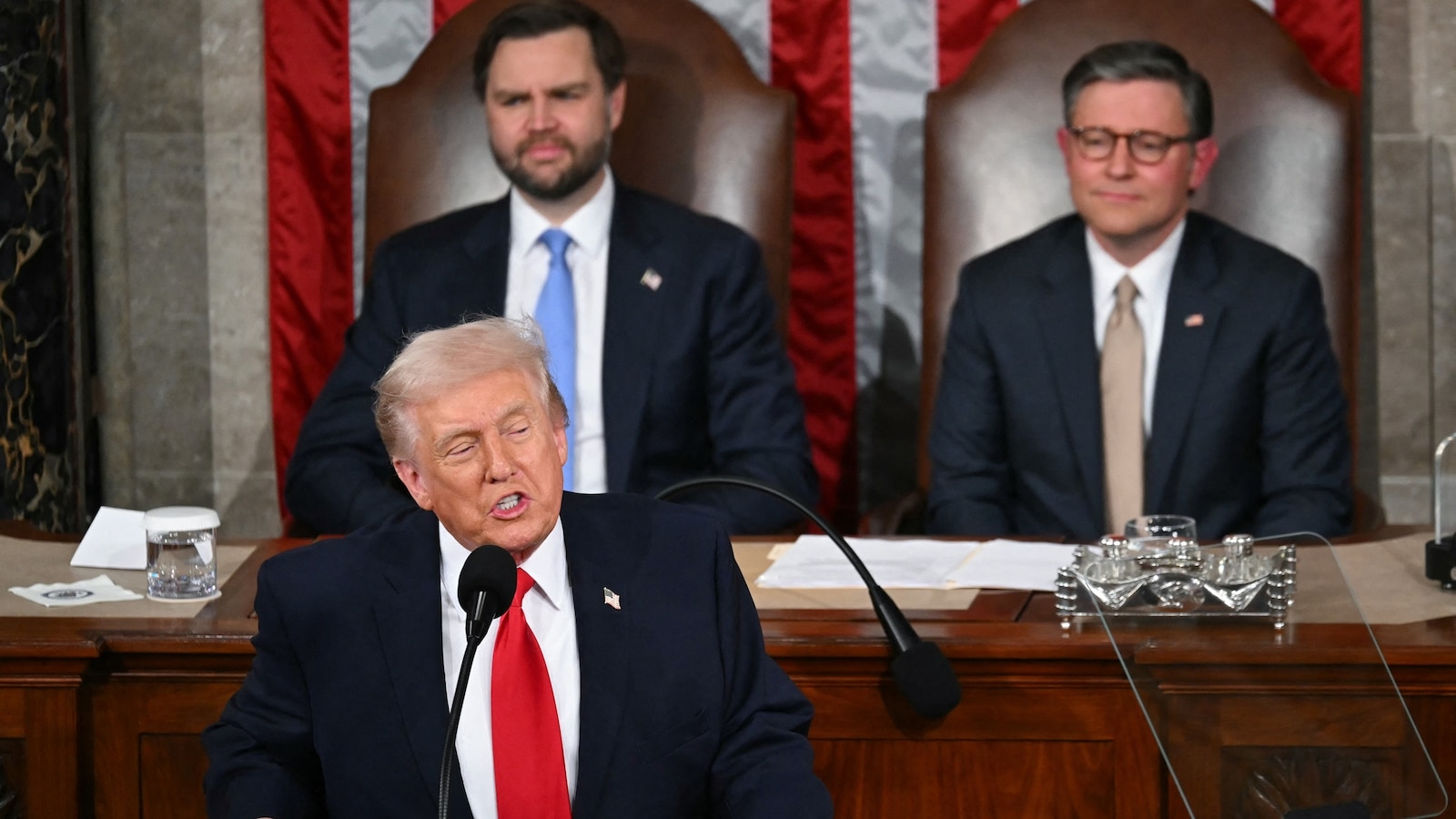
Washington D.C. – President Donald Trump delivered his State of the Union address Tuesday evening, outlining his administration’s accomplishments and future agenda amidst a deeply polarized political landscape. The speech, delivered before a joint session of Congress, touched on key policy areas including immigration, the economy, and international relations, particularly with Iran. As the president enters the second year of his second term, scrutiny of his claims remains high, with fact-checkers working to assess the accuracy of his statements. The address comes as the nation prepares for crucial midterm elections, where control of Congress hangs in the balance, and with ongoing concerns about the president’s approval ratings.
Throughout his address, President Trump emphasized his administration’s successes, particularly in curbing illegal immigration and bolstering the U.S. Economy. He touted a decrease in border crossings and highlighted recent economic indicators as evidence of his policies’ effectiveness. However, independent analysis reveals a more nuanced picture, with some claims requiring further context and verification. The president’s speech also addressed ongoing tensions with Iran, reaffirming his commitment to a strong stance against what he characterized as Iranian aggression. The overall tone of the address was assertive, reflecting the president’s continued commitment to his “America First” agenda.
A recent ABC News/Washington Post/Ipsos poll indicated a 60% disapproval rating for President Trump, a high point during his second term. This backdrop of public skepticism adds weight to the need for rigorous fact-checking of his statements. The midterm elections loom large, with both parties vying for control of Congress, and the president’s address served as a key opportunity to rally support and shape the narrative ahead of November. The stakes are high, as the outcome of the elections will significantly impact the president’s ability to advance his legislative agenda in the remaining years of his term.
Immigration and Border Security: Examining the President’s Claims
President Trump asserted that “in the past nine months, zero illegal aliens have been admitted to the United States.” This claim is demonstrably false. While the number of illegal border crossings has decreased significantly under the Trump administration, it has not reached zero. Data from Customs and Border Protection (CBP) show a substantial drop from over 1.5 million encounters in 2024, the last full year of the previous administration, to just under 28,000 in 2025, the first full year of Trump’s second term. CBP statistics confirm this downward trend, but also demonstrate that attempts to cross the border continue. This proves impossible to definitively state that zero individuals have entered the country illegally, as some may have evaded detection. The administration’s restrictive policies, including increased border security measures and stricter enforcement of immigration laws, have undoubtedly contributed to the decline in crossings, but the claim of zero illegal admissions is inaccurate.
Economic Performance and Inflation: A Closer Gaze at the Numbers
The President stated that his administration has “driven core inflation down to the lowest level in more than five years.” This claim is partially accurate, but requires careful consideration. While core inflation has indeed decreased, the overall economic picture is more complex. When President Trump took office, inflation stood at 3%. As of February 2026, it has fallen to 2.4%. However, this decrease in inflation has not necessarily translated into lower prices for everyday goods. Data from the Bureau of Labor Statistics show that prices for certain items, such as coffee, have actually increased. Ground coffee prices, for example, are up 34% in the past year. The president’s tariffs have contributed to higher costs for some products, including fresh produce and beef. Rising energy costs, driven in part by the energy demands of data centers powering artificial intelligence technologies, are impacting household budgets, with energy costs up 6.3 percent from January 2025 to January 2026.
Gas Prices: A Point of Accuracy
President Trump correctly stated that gas prices have decreased during his time in office. According to Gas Buddy, the national average gas price is currently 19.5 cents per gallon lower than it was a year ago, despite a recent slight increase of 2.8 cents per month. GasBuddy’s data confirms this trend, indicating a positive development for consumers at the pump. However, it’s important to note that gas prices are subject to various factors, including global oil markets, geopolitical events, and seasonal demand, and can fluctuate significantly.
The Impact of Tariffs on Consumer Costs
The President’s trade policies, particularly the imposition of tariffs on imported goods, have had a complex impact on the U.S. Economy. While intended to protect domestic industries, tariffs have also led to higher prices for some consumer products. As noted earlier, the cost of goods like coffee and beef has increased, partially due to the tariffs imposed on these items. This highlights the trade-offs inherent in protectionist policies, as benefits to certain sectors may reach at the expense of higher costs for consumers. The long-term effects of these tariffs on the U.S. Economy remain a subject of debate among economists.
Tensions with Iran: A Delicate Balance
President Trump reiterated his administration’s firm stance against Iran, citing concerns about its nuclear program and regional destabilizing activities. He emphasized the need for a strong deterrent to prevent Iran from acquiring nuclear weapons and warned of potential consequences for any aggressive actions. The situation in the Middle East remains volatile, and the president’s approach to Iran is a key element of his foreign policy. The administration has imposed sanctions on Iran and withdrawn from the Iran nuclear deal, a move that has drawn criticism from some international allies. The ongoing tensions with Iran pose a significant challenge to regional stability and require careful diplomatic maneuvering.
Key Takeaways
- President Trump’s claim of “zero illegal aliens” entering the U.S. In the past nine months is inaccurate, despite a significant decrease in border crossings.
- While core inflation has decreased, it hasn’t resulted in lower prices across the board, with some goods experiencing price increases due to tariffs and other factors.
- Gas prices have indeed fallen during President Trump’s second term, providing some relief to consumers.
- The President’s trade policies have had a mixed impact, with tariffs leading to higher costs for some consumer goods.
- Tensions with Iran remain high, and the administration’s approach to the country is a key aspect of its foreign policy.
As the nation moves forward, continued scrutiny of the President’s statements and policies will be crucial. The upcoming midterm elections will serve as a critical test of public opinion and will shape the political landscape for the remainder of his term. The next key event to watch will be the release of the next Consumer Price Index report in March, which will provide further insight into the state of the U.S. Economy. We encourage readers to share their thoughts and engage in constructive dialogue in the comments section below.
Worth a look