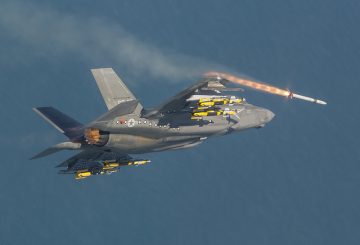
The future of aerial combat is rapidly evolving, and Lockheed Martin is at the forefront of integrating artificial intelligence into its flagship F-35 fighter jet. Recent testing has demonstrated a significant leap forward in the F-35’s ability to identify and categorize potential threats, moving beyond simply presenting pilots with more data to actively synthesizing information and providing actionable intelligence. This advancement, known as Project Overwatch, marks the first time a tactical AI model has been used in flight to generate an independent combat identification, displayed directly to the pilot. The implications of this technology are far-reaching, promising to reduce pilot workload, accelerate decision-making, and ultimately enhance the effectiveness of the F-35 in complex combat scenarios.
For years, the trend in combat identification has been to increase the volume of data available to pilots. Even as more information can be valuable, it likewise creates a cognitive burden, requiring pilots to spend precious seconds – or even minutes – sifting through data to determine friend from foe. Lockheed Martin’s approach with Project Overwatch flips this paradigm, leveraging the power of AI to distill complex information into a clear and concise assessment. This isn’t about replacing the pilot, but augmenting their capabilities, allowing them to focus on strategic decision-making rather than data processing. The F-35, already a sophisticated platform, is now taking a crucial step towards becoming a truly intelligent fighting machine.
The successful flight test, conducted at Nellis Air Force Base in Nevada, involved a model of artificial intelligence/machine learning developed and trained by Lockheed Martin. This AI was able to resolve ambiguities in identifying emitters – radio frequency sources that can indicate the presence of aircraft, vehicles, or other systems – improving situational awareness and reducing the time it takes for pilots to make critical decisions. According to Lockheed Martin, the system demonstrated the ability to quickly classify new emitters, retrain the AI model to recognize these new types within minutes, and upload the updated model for subsequent flights, all within the same mission planning cycle. This rapid adaptability is crucial in a dynamic threat environment where adversaries are constantly evolving their tactics and technologies.
Project Overwatch: A Sixth-Generation Leap for a Fifth-Generation Platform
Lockheed Martin is framing Project Overwatch as a demonstration of “sixth-generation technology integrated on a fifth-generation platform.” The F-35, widely considered a fifth-generation fighter due to its advanced stealth, sensor fusion, and networking capabilities, is now benefiting from AI advancements typically associated with the next generation of combat aircraft. Jake Wertz, Vice President of F-35 Combat Systems at Lockheed Martin Aeronautics, emphasized the importance of the system’s ability to be reprogrammed on the ground and have those updates available for the next sortie. “That’s a critical step to maintaining a tactical advantage in a rapidly evolving threat landscape,” Wertz stated, as reported by Lockheed Martin. Lockheed Martin’s official website provides further details on the project.
This capability to rapidly update and deploy AI models is a significant departure from traditional software development cycles, which can often take months or even years to implement new features. Lockheed Martin has demonstrated a similar ability to rapidly deploy software updates to the U.S. Navy’s Aegis Combat System, enabling quick countermeasures against advanced threats like drones and missiles in the Red Sea, as noted in a Breaking Defense report from April 2025. This agility is becoming increasingly vital as potential adversaries develop more sophisticated electronic warfare capabilities.
The F-35’s Expanding Global Footprint and the Need for Enhanced Combat ID
The F-35 Lightning II is currently operated by 12 nations, with over 1,300 aircraft in service. This widespread adoption underscores the importance of ensuring the F-35 remains at the cutting edge of combat technology. As the number of potential adversaries equipped with advanced air defenses and electronic warfare systems grows, the ability to quickly and accurately identify threats becomes paramount. The F-35’s role isn’t simply about air-to-air combat; it’s also about providing critical intelligence, surveillance, and reconnaissance (ISR) capabilities, and supporting ground forces. Accurate combat identification is essential for all of these missions.
The integration of AI into the F-35’s combat identification system addresses a fundamental challenge in modern warfare: the increasing complexity of the electromagnetic spectrum. Modern battlefields are saturated with radio frequency signals, making it difficult to distinguish between friendly and hostile emitters. Project Overwatch’s AI model is trained to analyze these signals, identify patterns, and autonomously determine the source, providing pilots with a clearer picture of the battlespace. This represents particularly important in contested environments where jamming and deception tactics are employed.
How Project Overwatch Works: AI-Powered Threat Assessment
The core of Project Overwatch lies in its ability to learn and adapt. The AI model is trained on a vast dataset of emitter signatures, allowing it to recognize known threats. But, its true strength lies in its ability to identify and classify *new* emitters, even those it hasn’t encountered before. Engineers utilize an automated tool to classify these new signals, retrain the AI model, and upload the updated version for the next flight. This continuous learning process ensures that the system remains effective against evolving threats. The speed at which this retraining and redeployment can occur – within the same mission planning cycle – is a key differentiator.
This rapid adaptation is crucial because adversaries are constantly developing new electronic warfare techniques and technologies. By leveraging AI, the F-35 can stay one step ahead, proactively identifying and mitigating emerging threats. The system doesn’t simply rely on pre-programmed rules; it learns from experience, constantly refining its ability to distinguish between friend and foe. This capability is particularly valuable in scenarios involving asymmetric warfare, where adversaries may employ unconventional tactics and technologies.
Lockheed Martin’s strategy, as articulated by Wertz, centers on evolving its product lines through the integration of next-generation performance, continuous software modernization, and AI-driven decision-making. This approach aims to equip armed forces with the ability to anticipate and address emerging challenges. The company’s commitment to innovation extends beyond the F-35, with similar AI-powered capabilities being explored for other platforms and systems.


Looking ahead, Lockheed Martin plans to continue refining this capability, expanding the training dataset for the AI model to further improve its reliability and accuracy. The company is also exploring the potential of integrating AI into other aspects of the F-35’s mission systems, including sensor fusion, targeting, and electronic warfare. The next major milestone will likely involve further flight testing and evaluation, with a focus on validating the system’s performance in realistic operational scenarios. The U.S. Air Force is expected to provide an update on the program’s progress during the next quarterly defense industry briefing, scheduled for May 2026.
The integration of AI into the F-35 represents a significant step towards realizing the full potential of this advanced fighter jet. By augmenting the pilot’s capabilities and accelerating decision-making, Project Overwatch promises to enhance the F-35’s effectiveness in an increasingly complex and contested battlespace. What are your thoughts on the role of AI in modern warfare? Share your comments below, and be sure to share this article with your network.