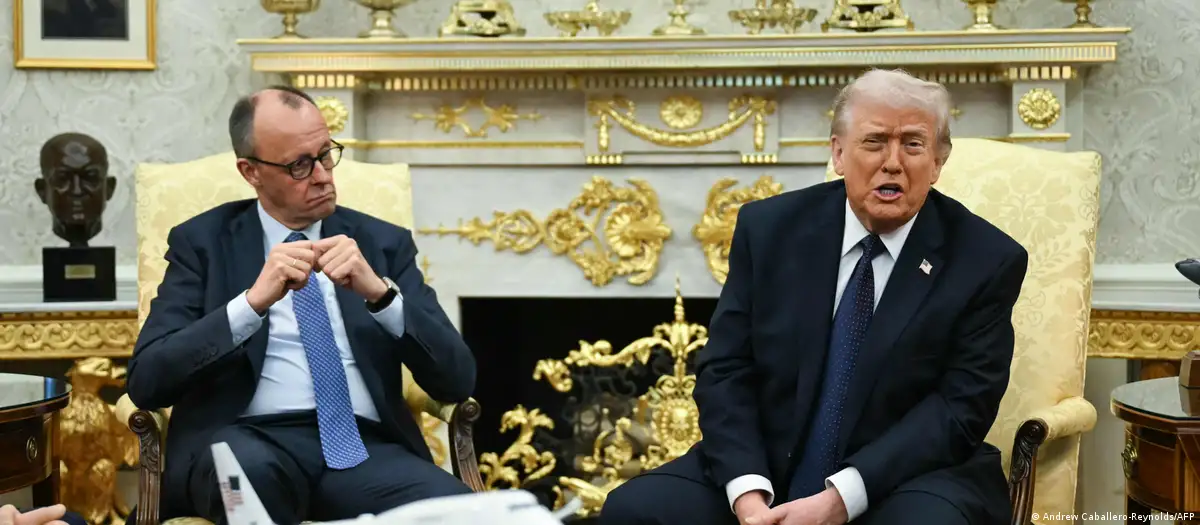
Washington D.C. – In a sharp escalation of transatlantic tensions, former U.S. President Donald Trump has threatened to impose a full trade embargo on Spain, citing the Spanish government’s refusal to allow the United States to utilize Spanish military bases for potential operations against Iran. The announcement, made during a meeting with German Chancellor Friedrich Merz at the White House on Tuesday, has sparked immediate concern among European allies and raised questions about the future of U.S.-Spain relations.
Trump’s declaration, reported by multiple news outlets including the BBC, DW, and the Associated Press, came after Spain indicated it would not permit U.S. Aircraft to utilize bases in Morón and Rota as staging points for military action against Tehran. This stance, according to Trump, demonstrates a lack of cooperation and has led him to consider severing all commercial ties with the European nation. The move also appears linked to ongoing disagreements over defense spending within the North Atlantic Treaty Organization (NATO), with Trump repeatedly criticizing European members for not meeting agreed-upon targets.
Escalating Tensions and the Iran Factor
The immediate catalyst for Trump’s threat appears to be the recent series of attacks involving U.S. And Israeli forces against targets in Iran. While the specifics of these operations remain closely guarded, the Spanish government’s decision to withhold access to its military facilities has been interpreted by Trump as a sign of non-alignment with U.S. Foreign policy objectives. “Spain has been terrible, so we’re going to cut off all trade with them. We don’t want to have anything to do with them,” Trump reportedly stated, according to the BBC. He further characterized Spain as lacking “great leadership” and suggested the country had little to offer the U.S. Beyond its people.
The situation is further complicated by broader geopolitical concerns surrounding Iran’s nuclear program and its regional influence. The U.S. Has long maintained a hardline stance against Iran, and the recent military actions suggest a willingness to escalate pressure on the Iranian government. Spain’s reluctance to participate in potential military operations reflects a broader European desire for a diplomatic solution and a cautious approach to further conflict in the Middle East. The differing approaches to Iran underscore a growing divergence in transatlantic policy.
Spanish Response and Defense of Sovereignty
The Spanish government has swiftly responded to Trump’s threats, defending its position as a key member of NATO and a reliable trading partner. In a statement released to Spanish media, the government asserted that any changes to the commercial relationship between the U.S. And Spain must respect international law, the autonomy of private companies, and existing bilateral agreements between the European Union and the United States.
Madrid emphasized its commitment to collective defense within the NATO framework and highlighted its significant contributions to European security. “Spain is a key member of NATO and fulfills its commitments and contributes prominently to the defense of European territory,” the statement read. The government also pointed to Spain’s role as a major exporter within the EU, maintaining commercial relationships with 195 countries, including the United States, describing the relationship as “historically beneficial” to both nations. Spanish Prime Minister Pedro Sánchez is scheduled to address the nation on Wednesday to provide further details on the situation, according to reports.
Potential Economic Ramifications
The prospect of a full trade embargo between the U.S. And Spain raises significant economic concerns for both countries. While Trump suggested Spain has “nothing we necessitate, except great people,” the reality is more nuanced. According to data from the Office of the United States Trade Representative, in 2023, the total (exports and imports) trade in goods and services between the U.S. And Spain amounted to $36.4 billion. U.S. Exports to Spain included machinery, vehicles, and agricultural products, while imports from Spain consisted of vehicles, pharmaceuticals, and agricultural goods.
An embargo could disrupt these trade flows, impacting businesses and consumers in both countries. Spanish exporters, particularly those in the automotive and agricultural sectors, would likely face significant challenges in accessing the lucrative U.S. Market. U.S. Companies that rely on Spanish suppliers could also experience disruptions to their supply chains. The impact on the Spanish economy, already grappling with the effects of global economic uncertainty, could be substantial. The imposition of an embargo could set a dangerous precedent for future trade disputes and undermine the principles of free and fair trade.
NATO Alliances and Transatlantic Relations
Trump’s actions also raise broader questions about the future of the NATO alliance and transatlantic relations. His repeated criticisms of European allies for not meeting defense spending targets have strained relationships and fueled concerns about the U.S. Commitment to collective security. The current dispute with Spain is likely to exacerbate these tensions and could encourage other European nations to reassess their reliance on the U.S. For defense and security.
The German Chancellor, Friedrich Merz, who was present during Trump’s announcement, has not yet publicly commented on the situation. Yet, Germany, as a leading member of the EU and NATO, is likely to play a key role in mediating the dispute and seeking a diplomatic resolution. The EU as a whole is expected to express its support for Spain and to defend the principles of international law and multilateralism. The incident underscores the fragility of transatlantic alliances and the need for continued dialogue and cooperation to address shared security challenges.
The Morón and Rota Bases: Strategic Importance
The U.S. Military maintains a significant presence in Spain, with key facilities at Morón Air Base and Naval Station Rota. Morón Air Base serves as a critical logistics hub for U.S. Operations in Europe and Africa, while Rota is home to the Sixth Fleet and plays a vital role in naval operations in the Mediterranean Sea. The refusal to allow U.S. Forces to use these bases for operations against Iran represents a significant strategic setback for the U.S. Military.
The bases have been a source of contention in the past, with Spain occasionally restricting U.S. Access in response to concerns about the use of the facilities for military interventions. However, Trump’s threat to impose a full trade embargo represents a significant escalation of the dispute and raises questions about the long-term future of the U.S. Military presence in Spain. The bases are strategically important for rapid deployment and power projection in the region.
Key Takeaways
- Former U.S. President Donald Trump has threatened a full trade embargo against Spain over its refusal to allow U.S. Military access to its bases for potential operations against Iran.
- The Spanish government has defended its position, citing its commitment to NATO and international law.
- The dispute raises concerns about the future of transatlantic relations and the stability of the NATO alliance.
- The potential economic ramifications of an embargo could be significant for both the U.S. And Spain.
- The incident highlights the growing divergence in approaches to Iran between the U.S. And its European allies.
As of Wednesday, March 4, 2026, Prime Minister Sánchez is expected to address the Spanish Parliament to outline the government’s response to Trump’s threats. The situation remains fluid, and further developments are anticipated in the coming days. World Today Journal will continue to monitor the situation closely and provide updates as they become available. We encourage readers to share their thoughts and perspectives on this developing story in the comments section below.
Related reading