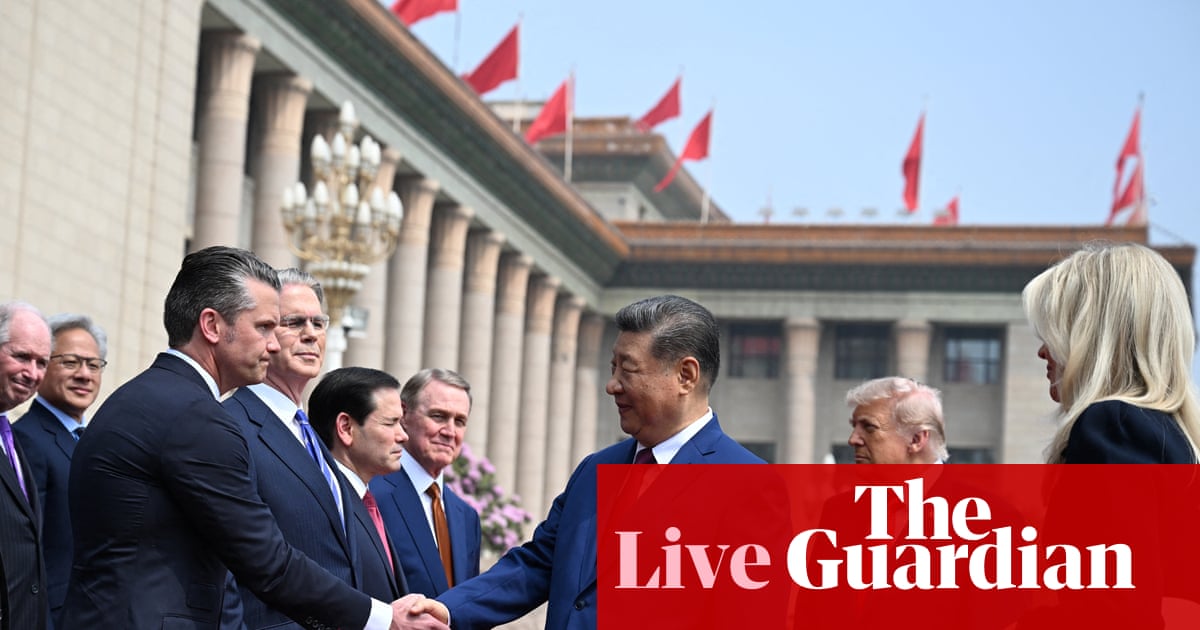
BEIJING, May 14, 2026 — U.S. President Donald Trump and Chinese President Xi Jinping have begun their two-day summit in Beijing, marking the first presidential trip to China in nearly a decade and setting the stage for negotiations that could reshape global trade, security in the Taiwan Strait, and the escalating conflict in Iran. With the world watching, the two leaders are tackling issues that have strained bilateral relations while seeking to stabilize what Trump described as a relationship that will be “better than ever before.”
The summit, which began with a ceremonial welcome at Beijing’s Great Hall of the People, comes against the backdrop of a fragile trade truce, growing tensions over Taiwan’s sovereignty, and mounting concerns about the potential spillover of the Iran war into regional supply chains and military alliances. Analysts are closely monitoring whether the talks will produce concrete agreements on tariffs, rare earth minerals, and artificial intelligence—three areas where U.S.-China competition has intensified in recent years.
In a rare display of diplomatic protocol, Trump’s delegation included U.S. Business leaders, signaling the administration’s focus on economic cooperation alongside geopolitical concerns. Xi, in his opening remarks broadcast by state media, framed the discussions as a test of whether the two nations could avoid the “Thucydides Trap”—a historical reference to the inevitable conflict between rising and established powers. Harvard professor Graham Allison, who popularized the concept, told CNBC’s Squawk Box Asia that stabilization, not breakthrough deals, may be the most realistic outcome of this summit.
U.S. President Donald Trump is greeted by Chinese President Xi Jinping at the Great Hall of the People in Beijing, May 14, 2026. Credit: China Pool/Getty Images News/Getty Images
Key Issues at the Trump-Xi Summit
- Trade Stabilization: Formalization of the informal trade truce reached in South Korea last fall, with focus on tariff reductions and rare earth minerals supply chains.
- Taiwan Security: Discussions on U.S. Arms sales to Taiwan amid China’s military drills and rising tensions in the Strait.
- Iran War Dynamics: Coordination to prevent regional escalation, including potential impacts on oil markets and global supply chains.
- Artificial Intelligence: Bilateral cooperation frameworks to address ethical concerns and prevent strategic competition in AI development.
- Diplomatic Signaling: Avoidance of the “Thucydides Trap” through structured dialogue on great-power relations.
Trade Talks: Can the U.S.-China Truce Survive?
The centerpiece of the summit is expected to be trade, where Trump and Xi are under pressure to convert their informal agreement—reached during a meeting in South Korea last November—into a formalized deal. The two sides have been locked in a prolonged trade war since 2018, with tariffs on hundreds of billions of dollars in goods remaining in place.
While both leaders have expressed optimism, the roadblocks remain significant. The U.S. Is demanding reductions in Chinese tariffs on American agricultural products, particularly soybeans and pork, while China seeks relief on technology exports and intellectual property protections. Rare earth minerals—critical for defense and green energy technologies—are also expected to feature prominently, as the U.S. Pushes for diversified supply chains to reduce dependence on Chinese exports.
Trump’s inclusion of U.S. Business leaders, including executives from tech and manufacturing sectors, underscores the administration’s dual approach: leveraging corporate interests to pressure China on trade while maintaining a hardline on security issues. However, analysts warn that any breakthrough will require compromise from both sides, particularly on sensitive issues like forced technology transfers and state-subsidized industries.
Taiwan: The Elephant in the Room
While trade dominates public statements, Taiwan remains the most sensitive issue between the two nations. China considers the self-governing island a provincial territory and has ramped up military exercises near its waters in response to increased U.S. Support for Taipei. Trump’s administration has approved several arms sales to Taiwan, including advanced missile defense systems, further straining relations.
During the summit, both leaders are expected to engage in indirect discussions about Taiwan’s status, though neither is likely to make public concessions. The U.S. Maintains its “One China” policy but has strengthened unofficial ties with Taiwan under Trump’s second term. China, in turn, has accelerated military modernization in the region, including hypersonic missile tests and naval patrols.
What happens next? The summit’s success on Taiwan will be measured by whether the two sides can agree to a “no escalation” framework—preventing further military provocations while avoiding formal recognition of Taiwan’s independence. Any misstep could trigger a rapid deterioration in relations, with potential consequences for global supply chains and semiconductor production.
Iran War: Preventing a Regional Spillover
The conflict in Iran has emerged as an unexpected but critical topic for the Trump-Xi talks. While neither nation is directly involved in the war, both have strategic interests in preventing regional destabilization. The U.S. Is concerned about Iranian-backed proxy groups in the Middle East, while China fears disruptions to its energy imports and maritime trade routes through the Strait of Hormuz.
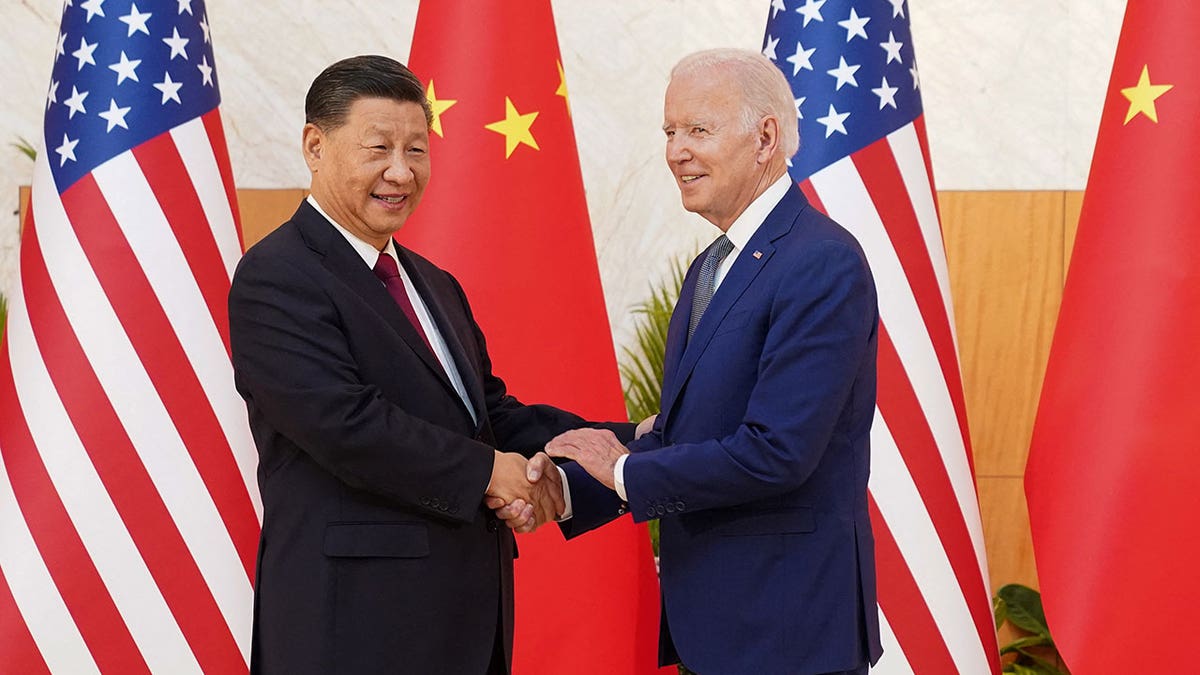
Discussions are likely to focus on three areas:
- Oil Market Stability: Ensuring that Iranian oil sanctions do not trigger a global price shock, particularly as both nations are major importers.
- Proxy Group Coordination: Preventing Iranian-backed militias from targeting U.S. Or Chinese interests in the Gulf.
- Humanitarian Corridors: Potential cooperation on food and medical aid to Iran, though this remains politically contentious in both capitals.
Trump’s administration has taken a cautious approach to the Iran war, avoiding direct military intervention but maintaining sanctions pressure. China, meanwhile, has increased its diplomatic engagement with Tehran, including investments in Iranian infrastructure. The summit may see the two nations explore joint initiatives to de-escalate tensions, though any public agreement is unlikely given their competing interests.
Artificial Intelligence: Cooperation or Competition?
Artificial intelligence has emerged as a new frontier in U.S.-China relations, with both nations vying for dominance in next-generation technologies. The Trump administration has imposed restrictions on Chinese access to advanced AI chips and research, while China has accelerated its own development programs, including state-backed labs and partnerships with foreign firms.
During the summit, the two leaders are expected to discuss:
- Ethical Standards: Potential joint frameworks for AI governance, though differences on data privacy and military applications remain.
- Supply Chain Security: Preventing the misuse of AI in cyber warfare or autonomous weapons systems.
- Talent Exchange: Limited cooperation on research collaborations, despite broader restrictions.
While cooperation on AI is unlikely to produce major breakthroughs, the talks may set the stage for future dialogue. The U.S. Is particularly concerned about China’s military applications of AI, including facial recognition and drone swarms, while China views American restrictions as an attempt to stifle its technological rise.
What to Watch For: Live Updates and Next Steps
The summit’s first day concluded with a working dinner, where Trump and Xi are expected to exchange private assessments of their relationship. Key moments to watch include:
- Joint Press Conference: Scheduled for Friday afternoon, where both leaders may release limited details on progress.
- Trade Announcements: Any formalization of the trade truce, including tariff reductions or new market access agreements.
- Taiwan Statements: Subtle signals on whether the U.S. Will continue arms sales and whether China will ease military pressure.
- Iran Coordination: Unofficial channels for managing the fallout from the war, particularly on oil and shipping.
The next major checkpoint will be the G7 Summit in Italy (June 10–12, 2026), where Trump is expected to discuss China strategy with European allies. Meanwhile, the U.S. State Department will release a detailed readout of the Beijing talks by May 17, 2026, including any bilateral agreements reached.
Why This Summit Matters
This summit is more than a diplomatic formality—it represents a pivotal moment in 21st-century geopolitics. The U.S. And China are locked in a decades-long competition for global influence, with outcomes shaping everything from semiconductor dominance to climate policy. The ability of Trump and Xi to manage their differences without triggering a broader conflict will determine whether the world avoids the “Thucydides Trap” or descends into a new Cold War.
For readers, the stakes are personal: trade policies affect the cost of goods, security agreements influence global stability, and technological cooperation (or rivalry) will shape the future of work and innovation. As the summit unfolds, World Today Journal will provide real-time analysis and verified updates on the negotiations.
FAQ: Trump-Xi Summit 2026
Q: What is the “Thucydides Trap,” and why does it matter?
A: Coined by Harvard professor Graham Allison, the “Thucydides Trap” describes the historical pattern where a rising power (like China) and an established power (like the U.S.) often go to war. Xi and Trump are testing whether structured dialogue can prevent this outcome. Learn more about the concept.
Q: Will there be a trade deal announced today?
A: Unlikely. While tariff discussions are ongoing, any formal agreement will require months of negotiation. Today’s talks are focused on setting parameters for future deals.
Q: How does Taiwan fit into these discussions?
A: Taiwan is the most sensitive issue. The U.S. Will not recognize Chinese sovereignty claims, while China demands an end to U.S. Arms sales. Expect vague language on “peaceful resolution” rather than concrete steps.
Q: What role does Iran play in this summit?
A: Indirectly, Iran is a concern for both nations. The U.S. Wants to prevent Iranian proxies from targeting American interests, while China seeks stable oil supplies. No direct Iran policy changes are expected, but backchannel coordination may occur.
Q: Where can I find official updates?
A: The White House and Chinese Foreign Ministry will release readouts. For real-time analysis, follow World Today Journal.
Closing Thought: As Trump and Xi navigate these high-stakes talks, the world watches to see whether diplomacy can outpace the forces of competition. The next 48 hours will determine whether this summit becomes a turning point—or just another chapter in an ongoing rivalry.
What do you think will be the biggest outcome of this summit? Share your predictions in the comments below.
Worth a look