Trump-Xi Summit 2026: Xi’s ‘Thucydides Trap’ Warning and Trump’s Measured Response
By Maria Petrova | Editor, World | World Today Journal | Sofia, Bulgaria
BEIJING — In a summit that has sent global markets into flux and analysts scrambling for context, U.S. President Donald Trump and Chinese President Xi Jinping met today for their first in-person talks since 2017, with Xi’s explicit invocation of the “Thucydides Trap” setting the stage for a diplomatic encounter that could redefine U.S.-China relations for years to come.
The two leaders convened at the Great Hall of the People in Beijing, where Xi opened proceedings by warning that the world’s two largest economies risked falling into the historical pattern described by the ancient Greek historian Thucydides: when a rising power (China) challenges an established one (the United States), conflict becomes inevitable. Trump’s response, delivered in closed-door sessions, has been described by administration sources as “calibrated” — acknowledging the risks while signaling Washington’s unwillingness to concede on core issues.
This meeting, the first between sitting U.S. And Chinese leaders since Xi’s 2017 visit to Mar-a-Lago, arrives amid escalating tensions over Taiwan, semiconductor restrictions and a stalled trade relationship. With global supply chains still reeling from the pandemic and geopolitical fault lines deepening, today’s discussions carry outsized stakes for economies and security alliances worldwide.
U.S. President Donald Trump arrives at Beijing Capital International Airport on May 13, 2026, ahead of his three-day visit to China. (Image: Reuters)
The ‘Thucydides Trap’ and Its Geopolitical Weight
Xi’s reference to the “Thucydides Trap” — a concept popularized by Harvard professor Graham Allison in his 2017 book The Thucydides Trap: Are the U.S. And China Headed for War? — carries particular weight given its frequent use by Beijing to frame its relationship with Washington. The warning, delivered during Xi’s opening remarks, served as a diplomatic overture aimed at tempering what many analysts describe as an increasingly confrontational U.S. Stance under Trump’s second term.
“The question before us is whether the United States and China will fall into the Thucydides Trap, or whether we will have the wisdom and courage to break free from its historical determinism. I believe we must choose cooperation over conflict, dialogue over confrontation.”
Allison’s framework, which draws parallels between 5th-century BCE Athens and Sparta and modern U.S.-China relations, has become a staple of Chinese state media commentary. Xi’s invocation today marks the highest-level Chinese leader to explicitly use the term in a direct address to a U.S. President, signaling Beijing’s intent to frame this summit as a pivotal moment in avoiding what many strategists warn could be an inevitable clash.
Trump’s administration, however, has signaled it will not be cowed by historical references. According to people familiar with the planning process, the U.S. Delegation entered the summit with three “red lines”: no concessions on Taiwan’s sovereignty, no rollback of semiconductor export controls, and no weakening of sanctions on Chinese military entities. The White House has described today’s talks as focused on “managing competition” rather than “resetting” the relationship.
Five Core Issues on the Table: What’s at Stake?
While Xi’s opening remarks set the rhetorical tone, the closed-door negotiations are expected to focus on five critical areas where U.S.-China tensions have reached boiling points. Analysts describe these as the “non-negotiables” that will determine whether this summit produces tangible outcomes or merely symbolic gestures.
- Taiwan’s Status: With China’s military drills near Taiwan’s coasts increasing in frequency and the U.S. Approving a record $140 billion in arms sales to Taipei since 2023, Taiwan has emerged as the most contentious issue. Beijing has framed any U.S. Support for Taiwan’s independence as a direct challenge to its sovereignty, while Washington insists it remains committed to the “One China” policy.
- Semiconductor and AI Restrictions: The U.S. Chip export ban, implemented in October 2022 to curb China’s access to advanced semiconductor technology, remains a major point of contention. Chinese officials have accused the U.S. Of “technology warfare,” while American officials argue it’s necessary to protect national security.
- Trade and Tariffs: The Trump administration has maintained many of the tariffs imposed during his first term, citing unfair trade practices. China has retaliated with its own tariffs on U.S. Agricultural products, creating a stalemate that has cost both economies billions in lost trade.
- Rare Earth Elements: Control over critical minerals like gallium and germanium — essential for defense and tech industries — has become a new battleground. The U.S. Is pushing for diversified supply chains, while China dominates over 80% of global production.
- Market Access for U.S. Firms: American companies continue to face restrictions in China’s financial sector, including limits on foreign ownership in securities firms and insurance companies. Beijing has accused Washington of using market access as a political tool.
Trump’s Response: Between Diplomacy and Defiance
While Xi’s public remarks carried the weight of historical warning, Trump’s response has been characterized by administration officials as “strategically ambiguous.” Sources close to the negotiations describe Trump as adopting a two-pronged approach: publicly acknowledging the need for dialogue while privately reinforcing U.S. Demands on sensitive issues.
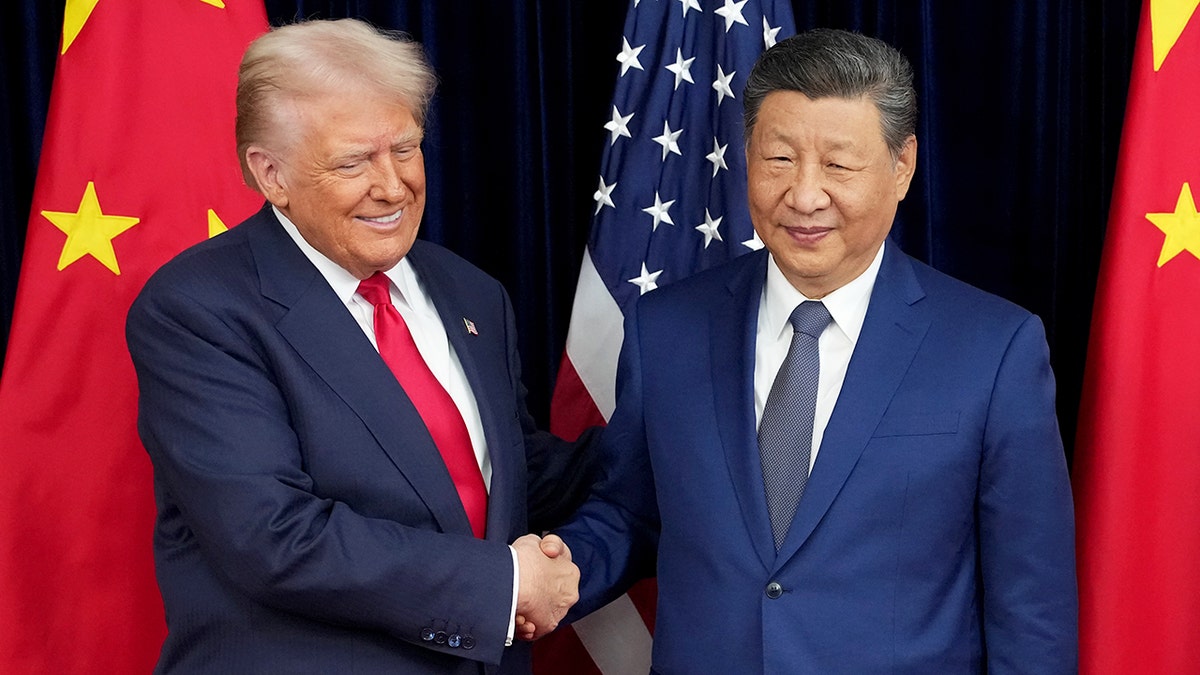
During a brief press interaction following the welcome ceremony, Trump declined to comment directly on Xi’s Thucydides Trap reference but emphasized economic cooperation:
“We’re here to talk about trade, technology, and security. There are challenges, but there are also opportunities. The American people want results, not just meetings. We’ll see what happens over the next two days.”
Behind the scenes, however, the U.S. Delegation — which includes CEOs from Apple, Tesla, Nvidia, and BlackRock — is reportedly pushing for concrete commitments from China on market access and intellectual property protections. The inclusion of tech leaders signals Trump’s intent to use corporate leverage as a bargaining chip, a strategy that has drawn mixed reactions from Capitol Hill.
Senator Marco Rubio (R-FL), a vocal critic of China’s trade practices, told reporters: “The president’s approach is pragmatic, but we must ensure that any concessions we make don’t come at the expense of American security. The Thucydides Trap isn’t just about economics — it’s about power, and China is playing the long game.”
Global Markets React: Volatility Amid Uncertainty
Financial markets have responded to the summit with cautious optimism, though analysts warn that any positive momentum could evaporate quickly if negotiations stall. The Dow Jones Industrial Average rose 0.8% on pre-summit hopes, while Chinese tech stocks saw modest gains. However, the yuan weakened slightly against the dollar, reflecting lingering skepticism about whether Beijing will make meaningful concessions.
In Asia, South Korea’s semiconductor manufacturers — heavily reliant on U.S.-China relations — saw their shares dip as investors await clarity on potential export restrictions. Meanwhile, Taiwan’s stock market remained volatile, with defense contractors like Aerospace Industrial Development Corporation (AIDC) gaining 2.1% as traders priced in the possibility of continued U.S. Military support.
Stock markets react to the Trump-Xi summit, with tech and defense sectors showing the most volatility. (Data: Bloomberg Terminal)
What Happens Next? The Road Ahead
The next 48 hours will be critical as Trump and Xi engage in bilateral talks, followed by a state dinner and a visit to the Temple of Heaven. Analysts expect any breakthroughs to be announced in a joint statement tomorrow, though sources suggest the most contentious issues — particularly Taiwan and semiconductors — may be deferred to lower-level talks.
Beyond the immediate summit, three key developments will shape the U.S.-China relationship in the coming months:
- Semiconductor Talks: Negotiations between the U.S. Commerce Department and Chinese tech firms are expected to resume in June, with reports suggesting Beijing may offer limited concessions on AI research restrictions in exchange for eased export controls.
- Taiwan Military Aid: The U.S. Congress is poised to vote on a $140 billion defense package for Taiwan in July, which could further strain U.S.-China relations if approved. Chinese state media has already warned of “severe consequences” if the package moves forward.
- Trade Working Groups: Both sides have agreed to reconvene trade working groups by September, with a focus on reducing tariffs on agricultural products and automotive goods.
Key Takeaways from the Trump-Xi Summit
- Diplomatic Tension: Xi’s Thucydides Trap reference signals Beijing’s intent to frame this summit as a pivotal moment in avoiding conflict, while Trump’s administration remains focused on “managing competition” rather than resetting relations.
- Economic Leverage: The inclusion of U.S. CEOs in the delegation underscores Trump’s strategy of using corporate interests as a bargaining tool, though Capitol Hill remains skeptical of any concessions.
- Taiwan as the Wild Card: With military drills and arms sales escalating, Taiwan remains the most contentious issue, and any breakthrough on other fronts is unlikely without progress here.
- Market Cautious Optimism: While stocks reacted positively to the summit, volatility in tech and defense sectors reflects deep uncertainty about whether economic cooperation can outweigh geopolitical divisions.
- Next Steps: Lower-level talks on semiconductors and trade are expected to resume in June and September, respectively, with Taiwan’s defense package looming as a potential flashpoint.
How This Summit Could Reshape Global Trade
The outcomes of this summit could have ripple effects far beyond U.S.-China relations. Three industries in particular stand to be reshaped:
- Semiconductors: Any easing of U.S. Export controls could accelerate China’s semiconductor ambitions, while maintaining restrictions could push more production to Southeast Asia, benefiting countries like Malaysia and Vietnam.
- Renewable Energy: With both nations investing heavily in green technology, cooperation on standards and supply chains could accelerate the global energy transition — or deepen divisions if one side seeks to dominate.
- Agriculture: A reduction in tariffs on U.S. Soybeans and Chinese rare earths could stabilize global food and tech supply chains, though political tensions may limit any immediate progress.
For businesses operating in this environment, the message is clear: flexibility and scenario planning are essential. Companies with supply chains spanning both nations are already preparing for multiple contingencies, from tariff hikes to sudden export bans.
Expert Reactions: From Pessimism to Cautious Hope
Analysts offer a mixed assessment of the summit’s potential outcomes. On one end of the spectrum, former U.S. Ambassador to China Max Baucus remains skeptical:
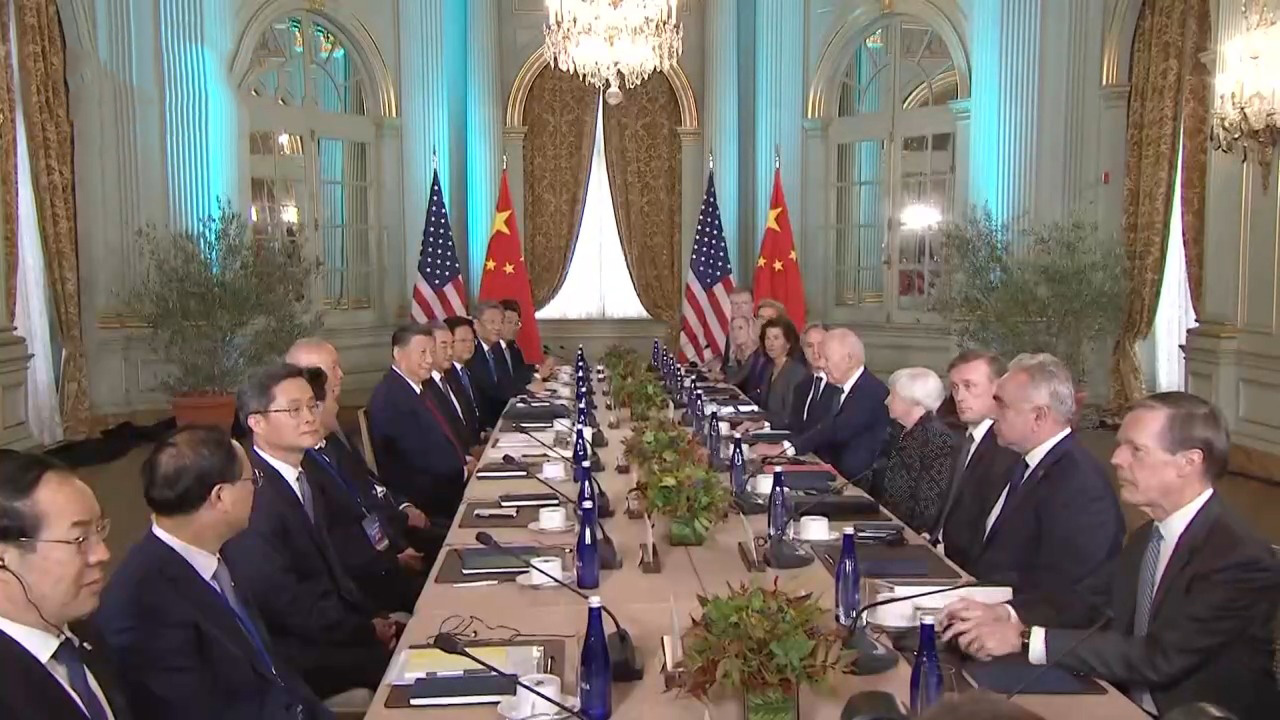
“The Thucydides Trap isn’t a warning — it’s a description of where we already are. The question is whether Trump and Xi can find enough common ground to avoid the worst outcomes, or whether this summit will be remembered as the beginning of the end for U.S.-China engagement.”
Others, like Yale Professor Paul Kennedy, see an opportunity for pragmatic diplomacy:
“History shows that great powers can cooperate even in periods of intense rivalry. The challenge for Trump and Xi is to find areas where their economic interdependence outweighs their strategic competition.”
In Beijing, Chinese Foreign Ministry spokesperson Wang Wenbin struck a more optimistic tone during a press briefing:
“We believe that both sides share an interest in maintaining stability and promoting cooperation. The Thucydides Trap is not inevitable — it is a choice. Today’s summit is an opportunity to make the right choice.”
What to Watch For Over the Next 72 Hours
As the summit unfolds, here are the key moments to monitor:
- May 14 (Today): Bilateral talks conclude with a joint press statement expected in the evening. Look for language on Taiwan, trade, and technology.
- May 15: State dinner at the Great Hall of the People, followed by a visit to the Temple of Heaven. Symbolic gestures here could signal progress.
- May 16: Trump’s departure from China. Any last-minute agreements will likely be announced during his farewell press conference.
For real-time updates, follow:
Closing Thoughts: A Summit with Global Consequences
As the clock ticks toward the end of today’s proceedings, one thing is clear: the Trump-Xi summit is more than a bilateral meeting — it is a geopolitical event with consequences for every nation that relies on stable U.S.-China relations. Whether this encounter becomes a turning point toward cooperation or another chapter in an escalating rivalry will depend on the choices made in the coming days.
For now, the world watches and waits. The next official update will come following tomorrow’s state dinner, when we expect to see whether the leaders can bridge their differences or whether the Thucydides Trap will continue to cast its long shadow over global affairs.
What do you think? Will this summit lead to meaningful cooperation, or are we witnessing the beginning of a new Cold War? Share your thoughts in the comments below.
Keep reading