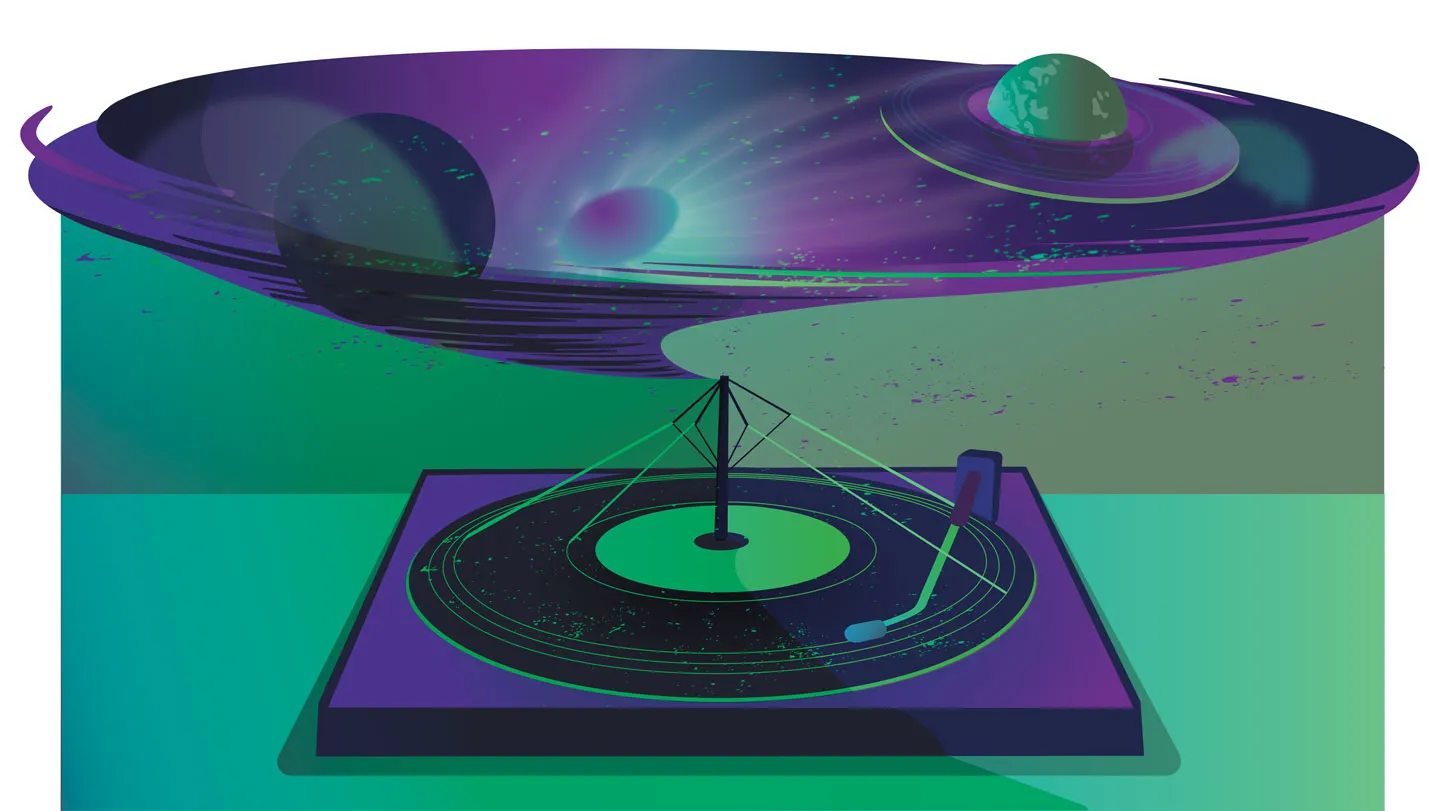
Scientists have transformed raw data from space weather and Antarctica’s frozen landscapes into immersive music albums, revealing the hidden harmonies of our universe. The project, led by a collaboration between astrophysicists and sound artists, uses NASA’s solar wind measurements and seismic activity from the South Pole to create compositions that translate cosmic phenomena into audible art. According to NASA’s Goddard Space Flight Center, the initiative aims to make scientific data more accessible while sparking public fascination with space exploration and Earth’s extreme environments.
The albums—one inspired by the eerie sounds of solar wind interactions with Earth’s magnetosphere and another by the deep vibrations of Antarctic ice sheets—were released this month after years of development. Dr. Emily Levesque, an astrophysicist at the University of Washington and one of the project’s advisors, told World Today Journal that the goal was to “bridge the gap between hard data and human perception.” She explained that while scientists typically analyze such data visually through graphs and charts, converting it into sound allows listeners to experience the rhythms of space weather and seismic activity in a visceral way.
This isn’t the first time scientific data has been repurposed into music. In 2018, NASA’s InSight Mars lander recorded seismic waves on the Red Planet and translated them into audible frequencies, creating what NASA described as “the first sounds from another planet.” The new Antarctic and space weather albums build on that tradition, using advanced algorithms to map data points to musical notes and textures. For example, the solar wind album’s “songs” are generated by converting magnetic field fluctuations into synth pads and percussion, while the Antarctic album layers sub-bass frequencies from glacial tremors with ambient soundscapes.
How Data Becomes Music: The Science Behind the Soundscapes
The process begins with raw scientific measurements. For the space weather album, researchers used data from NASA’s Advanced Composition Explorer (ACE) satellite, which monitors solar wind conditions in real time. The team then applied sonification techniques—converting data into audio—to highlight patterns in the solar wind’s speed, density, and magnetic field strength. “We’re not just playing with pretty sounds,” said Dr. Levesque. “Every note corresponds to actual measurements, so listeners can hear the solar storm of March 2023 as it unfolded in space.”
The Antarctic album, meanwhile, draws from seismic data collected by the United States Antarctic Program (USAP) and the British Antarctic Survey (BAS). Researchers focused on infrasound—low-frequency vibrations below human hearing—produced by ice quakes, ocean waves crashing against the continent, and even the movement of glaciers. These were then amplified and mixed with field recordings of Antarctic winds and auroras to create an ethereal, almost alien soundscape.
Why does this matter? Beyond its artistic appeal, the project serves a dual purpose: it democratizes access to complex scientific data and inspires curiosity about the natural world. “When people hear the solar wind as music, they suddenly care about space weather,” said Dr. Levesque. “It’s a way to make science feel personal.” The albums have already sparked interest among educators, who are using them in classrooms to teach physics and data science. NASA’s Jet Propulsion Laboratory has also noted that such projects could help train the next generation of scientists by making data analysis more engaging.
Who’s Behind the Project—and How Can You Listen?
The collaboration was spearheaded by The Sonification Project, a nonprofit dedicated to converting scientific data into sound. Lead sound artist Daniel Jones, who has worked with NASA on previous sonification efforts, described the process as “a labor of love.” “We spent months refining the algorithms to ensure the music accurately represents the data,” he said. “It’s not just about making something pretty—it’s about preserving the integrity of the science.”
The albums are available for free on major streaming platforms, including Spotify, Apple Music, and YouTube. Here’s how to access them:
- Space Weather Album: Titled “Solar Harmonics”, it features tracks like “Coronal Mass Ejection” and “Geomagnetic Storm,” each named after real solar phenomena. Listen here.
- Antarctic Data Album: Called “Glacial Echoes”, it includes compositions like “Ice Quake Symphony” and “Aurora Chorale.” Listen here.
The project has received praise from both the scientific and artistic communities. The Recording Industry Association of America (RIAA) highlighted it as an example of “innovative cross-disciplinary collaboration,” while Nature Astronomy published a feature calling it “a groundbreaking fusion of art and science.” Dr. Fischer, who consulted on the project’s educational outreach, noted that it aligns with growing trends in “data storytelling,” where scientists and artists work together to communicate complex ideas.
What’s Next for Data-Driven Music?
The team behind the albums has already begun work on new projects, including a sonification of Juno spacecraft data from Jupiter’s magnetic field and a collaboration with the European Space Agency (ESA) to turn exoplanet atmospheric readings into music. “This is just the beginning,” said Jones. “We’re exploring how to sonify data from black holes, supernovae, and even human DNA.”
For now, listeners can enjoy the two albums as standalone works of art—or as a gateway to understanding the invisible forces shaping our planet and solar system. As Dr. Levesque put it, “Science isn’t just about numbers on a page. It’s about the stories those numbers tell—and sometimes, those stories are best heard through music.”
Key Takeaways
- The Solar Harmonics and Glacial Echoes albums translate NASA and Antarctic seismic data into music using sonification techniques.
- Data from NASA’s ACE satellite and USAP/BAS seismic readings were converted into audible frequencies, preserving scientific accuracy.
- The project aims to make complex scientific data more accessible and inspire public interest in space weather and polar research.
- Both albums are available for free on major streaming platforms, with plans for future collaborations with ESA and Juno mission data.
- Educators are already using the albums to teach data science and physics in classrooms.
Have you listened to the albums? Share your thoughts—or suggestions for future data-driven music projects—in the comments below. And for more on how science and art intersect, explore our Science & Technology section.