A Tiny Twist, Giant Magnetic Potential: New Research Unlocks Control of Magnetic Textures in 2D Materials
The world of two-dimensional materials is rapidly evolving, with researchers constantly discovering new ways to manipulate their properties at the atomic scale. A recent breakthrough published in Nature Nanotechnology demonstrates that even a slight twist between layers of certain materials can dramatically alter their magnetic behavior, creating magnetic patterns far larger and more complex than previously anticipated. This discovery, centered around twisted chromium triiodide (CrI3), opens up exciting possibilities for the development of low-power spintronic devices and a deeper understanding of fundamental magnetism. The ability to engineer magnetism through geometry alone represents a significant step forward in materials science and could pave the way for a new generation of energy-efficient technologies.
For years, scientists have explored “moiré engineering” – a technique that involves stacking atomically thin crystals with a small angular mismatch – to transform electronic properties and design novel quantum materials. Now, researchers at the University of Edinburgh, in collaboration with international partners, have shown that this approach extends to magnetism as well. Their work reveals that twisting antiferromagnetic layers doesn’t simply replicate the moiré pattern, but instead allows for the emergence of unexpectedly large, topological magnetic structures stretching across hundreds of nanometers. This challenges conventional assumptions about how magnetic order arises in these systems and introduces the concept of “super-moiré spin order,” where twist engineering operates across multiple scales.
The team’s findings center on twisted double-bilayer chromium triiodide (CrI3). Using a technique called scanning nitrogen-vacancy magnetometry, which allows for imaging magnetic fields with nanoscale resolution, they observed magnetic textures reaching up to approximately 300 nanometers in size – an order of magnitude larger than the underlying moiré wavelength. What we have is particularly remarkable since the size of these magnetic textures doesn’t simply correlate with the degree of twist; instead, it peaks at a specific angle of around 1.1 degrees before diminishing at larger angles. This counterintuitive behavior suggests a complex interplay of magnetic forces at play.
Unraveling the Physics Behind Super-Moiré Spin Order
The observed magnetic behavior isn’t a simple consequence of the moiré pattern. Instead, it arises from a delicate balance between several competing interactions: exchange interactions, magnetic anisotropy, and the Dzyaloshinskii–Moriya interaction (DMI). These interactions, all sensitive to the relative rotation of the layers, collectively determine the formation of topological magnetic textures. Large-scale atomistic Monte Carlo simulations, conducted by Dr. Elton Santos and his team at the University of Edinburgh, corroborated this interpretation, revealing the stabilization of extended, Néel-type antiferromagnetic skyrmions spanning multiple moiré cells. Nature Nanotechnology published the full details of the research on February 2, 2026.
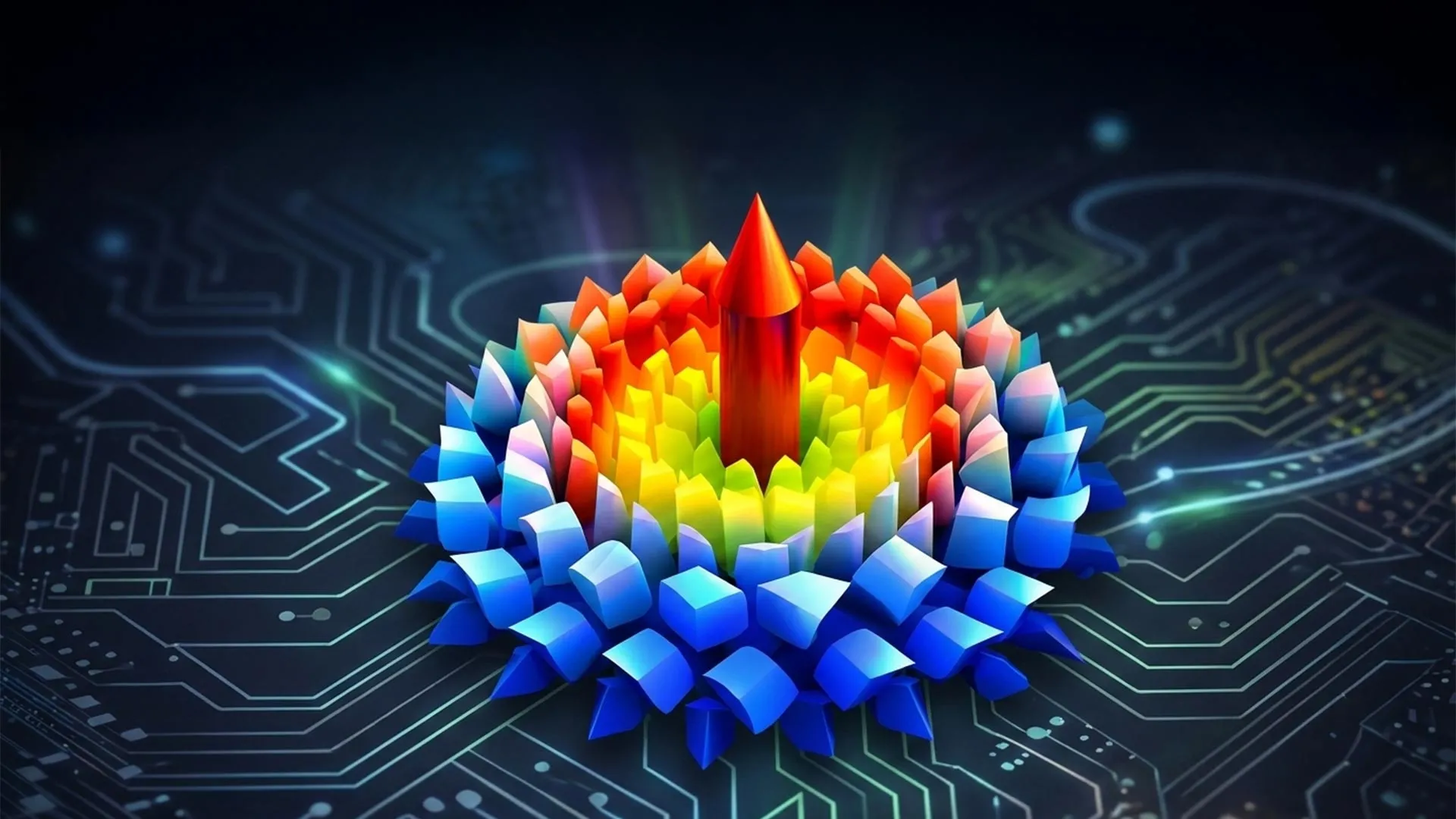
Skyrmions are nanoscale magnetic whirls that hold significant promise for future information technologies. Their small size, stability, and topological protection make them ideal candidates for data storage and processing. Crucially, skyrmions can be moved with very little energy, offering the potential for ultra-low-power devices. The ability to create these skyrmions simply by adjusting the twist angle – without relying on lithography, heavy metals, or strong electric currents – represents a clean and geometrically driven approach to spintronics. This contrasts with traditional methods that often require complex fabrication processes and significant energy input.
Moiré Engineering and the Future of Spintronics
Moiré engineering, initially focused on electronic properties, has rapidly become a cornerstone of quantum materials design. The technique leverages the interference pattern created when two crystal lattices are slightly misaligned, resulting in a new, periodic structure with unique properties. As ScienceDaily reported on March 2, 2026, this discovery extends the power of moiré engineering into the realm of magnetism, opening up new avenues for controlling and manipulating magnetic states.
The implications of this research extend beyond fundamental physics. The large and robust Néel-type skyrmionic textures observed in twisted CrI3 are particularly well-suited for integration into devices. Their larger size makes them easier to detect and manipulate, while their topological protection and the insulating nature of the host material suggest extremely low energy loss during operation. This combination of properties could lead to the development of energy-efficient, post-CMOS computing technologies, addressing the growing demand for sustainable and scalable computing solutions.
Dr. Elton Santos, Reader in Theoretical/Computational Condensed Matter Physics at the University of Edinburgh, emphasized the significance of the findings: “This discovery shows that twisting is not just an electronic knob, but a magnetic one. We’re seeing collective spin order self-organize on scales far larger than the moiré lattice. It opens the door to designing topological magnetic states simply by controlling angle, which is a remarkably simple handle with profound practical consequences.” The University of Edinburgh’s news release, published on February 12, 2026, details the research and Dr. Santos’s insights.
Challenges and Future Directions
While the initial results are promising, several challenges remain. Controlling the twist angle with extreme precision is crucial for achieving the desired magnetic properties. Further research is needed to explore the behavior of other twisted van der Waals magnets and to optimize the materials and device architectures for practical applications. Understanding the precise mechanisms governing the interplay between the various magnetic interactions will also be essential for designing more sophisticated and efficient spintronic devices.
Researchers are now focusing on exploring the potential of this technique for creating other types of topological magnetic textures and for manipulating skyrmions with even greater control. The development of new characterization techniques will also be critical for probing the magnetic structure of these materials at the nanoscale. The ultimate goal is to translate these fundamental discoveries into real-world technologies that can address the growing demand for energy-efficient and high-performance computing.
Key Takeaways
- Twist-Controlled Magnetism: A slight twist between layers of 2D materials can dramatically alter their magnetic properties.
- Super-Moiré Spin Order: Magnetic textures can extend far beyond the expected moiré scale, reaching hundreds of nanometers.
- Skyrmion Creation: Adjusting the twist angle provides a simple and energy-efficient way to create and manipulate magnetic skyrmions.
- Spintronic Potential: This discovery opens up new avenues for developing low-power spintronic devices and post-CMOS computing technologies.
The research team plans to continue investigating the relationship between twist angle, magnetic texture, and device performance. Further studies will focus on exploring the scalability of this approach and on developing prototype devices that demonstrate the potential of twist-controlled magnetism for real-world applications. The next phase of research, expected to yield further insights by late 2026, will involve exploring different stacking configurations and material combinations to optimize the magnetic properties and device performance.
This groundbreaking work represents a significant step forward in our understanding of magnetism and its potential for technological innovation. As scientists continue to unravel the mysteries of two-dimensional materials, we can expect even more exciting discoveries that will shape the future of computing and beyond. Share your thoughts on this exciting development in the comments below, and be sure to share this article with your network!
Worth a look