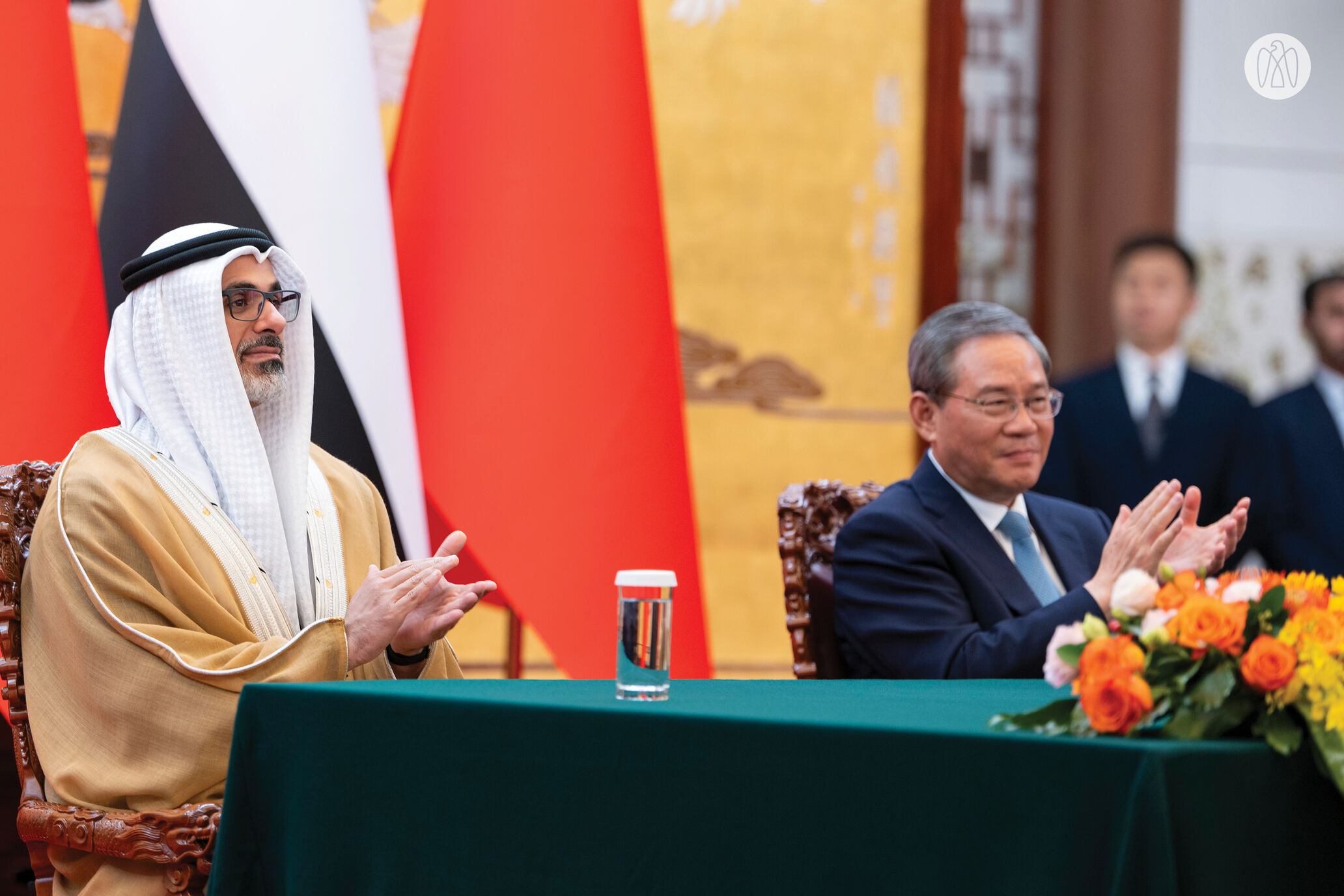
The diplomatic landscape between the United Arab Emirates and the People’s Republic of China has entered a new phase of intensity, characterized by high-level state visits and a deepening economic interdependence. The recent arrival of Sheikh Khalid bin Mohammed bin Zayed Al Nahyan, the Crown Prince of Abu Dhabi, in Beijing underscores a concerted effort to expand the UAE-China strategic partnership and explore new horizons for cooperation across priority sectors.
This diplomatic momentum is not an isolated event but the culmination of four decades of evolving ties. From the establishment of formal relations in the mid-1980s to the current status of a “comprehensive strategic partnership,” the relationship has shifted from basic diplomatic recognition to a multifaceted alliance involving logistics, energy and massive trade volumes. This evolution reflects a shared strategic vision to integrate the UAE’s logistical capabilities with China’s global economic ambitions.
At the heart of this relationship is a robust economic engine. In 2023, the volume of non-oil foreign trade between the UAE and China reached 296 billion dirhams, approximately $81 billion, representing a growth rate of 4.2% compared to 2022 according to reported trade data. China has maintained its position as the UAE’s primary trading partner in non-oil sectors, accounting for 12% of the nation’s total non-oil trade.
Four Decades of Diplomatic Evolution
The foundation of the current partnership was laid on November 1, 1984, when the two nations officially established diplomatic relations. This initial step was rapidly followed by the physical establishment of diplomatic missions: China opened its embassy in Abu Dhabi in April 1985, and the UAE opened its embassy in Beijing on March 19, 1987 as documented in bilateral archives.
The year 2024 serves as a pivotal milestone, marking the 40th anniversary of these diplomatic ties. During high-level discussions in Beijing on May 30, 2024, Chinese President Xi Jinping emphasized that this anniversary represents a turning point for the two nations to build upon past achievements and advance their future cooperation via official state communications. President Xi described the UAE as an “important comprehensive strategic partner,” noting that the trajectory of their development serves as a model for relations between China and Arab nations in the modern era.
The Belt and Road Initiative and Logistical Synergy
A critical pillar of the UAE-China strategic partnership is the UAE’s role within the “Belt and Road Initiative” (BRI). Launched by President Xi Jinping in 2013, the BRI is a global infrastructure development strategy designed to enhance regional connectivity. The UAE has positioned itself as a strategic partner in this initiative, leveraging its world-class ports and logistical hubs to serve as a crucial node for Chinese trade flowing into the Middle East, Africa, and Europe.
The synergy between the two nations is driven by complementary strengths: China’s massive manufacturing and industrial capacity paired with the UAE’s strategic location and advanced logistics infrastructure. This alignment has allowed the UAE to become a decisive point in the success of the BRI, facilitating the movement of goods and services across continents while diversifying the UAE’s own economic base away from hydrocarbon reliance.
High-Level Leadership and Strategic Alignment
The depth of the partnership is further evidenced by the frequency and level of leadership engagement. In addition to the recent visit by the Crown Prince of Abu Dhabi, President Xi Jinping held extensive talks with UAE President Sheikh Mohamed bin Zayed Al Nahyan in Beijing on May 30, 2024. These discussions focused on maintaining a “healthy momentum” for development and ensuring that the comprehensive strategic partnership is managed from a long-term strategic perspective.
The focus of these leadership meetings typically extends beyond trade, encompassing cultural ties and historical bonds. Both nations have expressed a commitment to strengthening the “comprehensive” nature of their partnership, which implies cooperation not only in economics but also in political consultation and strategic alignment on global issues.
Key Milestones in UAE-China Relations
| Year | Event/Milestone | Significance |
|---|---|---|
| 1984 | Establishment of Diplomatic Relations | Formal beginning of bilateral ties (Nov 1). |
| 1985-1987 | Embassy Openings | Physical diplomatic presence in Abu Dhabi and Beijing. |
| 2013 | Launch of Belt and Road Initiative | UAE becomes a strategic partner in China’s global infrastructure plan. |
| 2023 | Trade Peak | Non-oil trade reaches $81 billion (296 billion dirhams). |
| 2024 | 40th Anniversary | Renewal of the comprehensive strategic partnership. |
What This Means for Global Trade
The strengthening of ties between Abu Dhabi and Beijing has implications that extend far beyond the two borders. As the UAE continues to diversify its economy, its reliance on Chinese technology, investment, and trade provides a blueprint for other Gulf nations. Conversely, for China, the UAE offers a stable and sophisticated gateway to the broader Arab world, reducing risks associated with global supply chain disruptions.

The focus on non-oil trade is particularly telling. By growing non-oil trade by 4.2% in a single year, the two nations are signaling a shift toward a more sustainable, diversified economic relationship. This includes cooperation in technology, renewable energy, and logistics, moving the partnership from a buyer-seller dynamic to one of mutual strategic investment.
As the UAE and China continue to align their long-term visions, the world can expect further integration in digital infrastructure and financial systems. The commitment expressed by both President Xi and the UAE leadership suggests that the “comprehensive” nature of the partnership will only expand in scope and depth.
The next phase of this relationship will likely be defined by the implementation of the agreements discussed during the recent high-level visits to Beijing, with a particular focus on expanding the horizons of cooperation in priority fields.
We invite our readers to share their perspectives on the shifting dynamics of Middle Eastern and Asian strategic alliances in the comments section below.
Worth a look