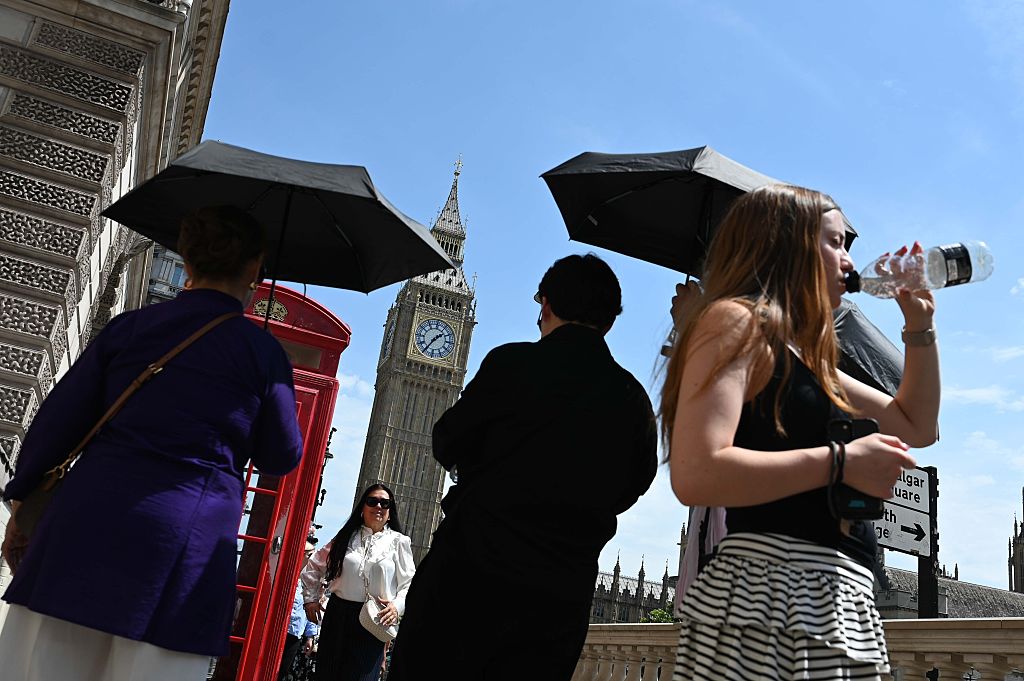
A June heat wave in the United Kingdom cost the national economy an estimated £1.15 billion (over $1.5 billion) in lost output during a single week, according to an analysis by the Grantham Research Institute on Climate Change and the Environment and the Euro-Mediterranean Center on Climate Change (CMCC). The economic hit resulted from reduced working hours and total absences across a workforce of 34.4 million people.
The weather event, which lasted from June 18 to July 1, produced England’s warmest June since records began in 1884. A provisional national record for June was set on June 26, when a high of 37.7°C (99.86°F) was recorded at Lingwood, Strumpshaw Hill in Norfolk. The extreme temperatures caused widespread disruption, including the closure of schools, offices, and shops, as well as cancelled and delayed train services.
Elizabeth Robinson, director of the Grantham Research Institute, and Shouro Dasgupta, an environmental economist at the CMCC and visiting senior fellow at the Grantham Research Institute, conducted a survey of 1,950 U.K. adults to quantify the impact. The researchers measured factors including working hours, effort while working, health, ability to sleep, changes to how they got to work or their place of work, and their working environment to calculate the total loss in economic productivity.
Labor Productivity and Lost Working Hours
The survey found that the average reduction in hours worked during the week of June 22 was 0.47 hours per person. When scaled to the general working population, this represents approximately 16 million lost hours. The impact was not uniform across all sectors; workers in agriculture and construction, or those in other physically demanding and high-exposure roles, reduced their hours more significantly than office workers in low-exposure environments.
Beyond reduced hours, 3.6% of survey respondents reported they did not work at all during that week due to the heat. This percentage equates to approximately 1.25 million workers across the total population who were entirely absent from the workforce during the peak of the heat wave.
Robinson described the £1.15 billion figure as a conservative estimate. She noted that the current methodology does not account for a reduction in effort—or productivity per hour—among those who did continue to work, which would likely increase the total economic cost.
Infrastructure Vulnerability and Adaptation Gaps
The findings highlight a systemic lack of preparation for high-temperature events in the U.K. Robinson stated that the country is “woefully under-adapted to the changing climate,” noting that U.K. housing and infrastructure were designed to retain heat in a cold climate rather than cool buildings down during [what feels like] Mediterranean weather.
Adaptation measures showed varying levels of success in mitigating losses. According to the survey data, 49% of workers had access to air conditioning. Additionally, 27% of respondents reported that their employers implemented changes to the work environment, such as increasing ventilation, providing shade, or installing air conditioning.
Robinson observed that there is clear evidence that these adaptation measures protect worker health and reduce the number of hours lost to heat. She argued that the data provides a financial incentive for governments and employers to invest in climate adaptation, as the intensity and frequency of such heat waves are expected to increase.
Proposed Regulatory Changes for Heat Safety
Shouro Dasgupta suggested that the current effects are too significant to be left alone.
Dasgupta advocated for the creation of specific regulations to ensure widespread heat adaptation. These proposed measures include the establishment of maximum temperature thresholds in workplaces, mandatory rest breaks, and additional requirements for hydration breaks during extreme heat events.
The analysis suggests that without such regulations and structural investments in cooling infrastructure, the U.K. economy will remain vulnerable to recurring productivity losses as global temperatures rise.
We welcome your thoughts on how your workplace handles extreme weather. Share your experience in the comments below.