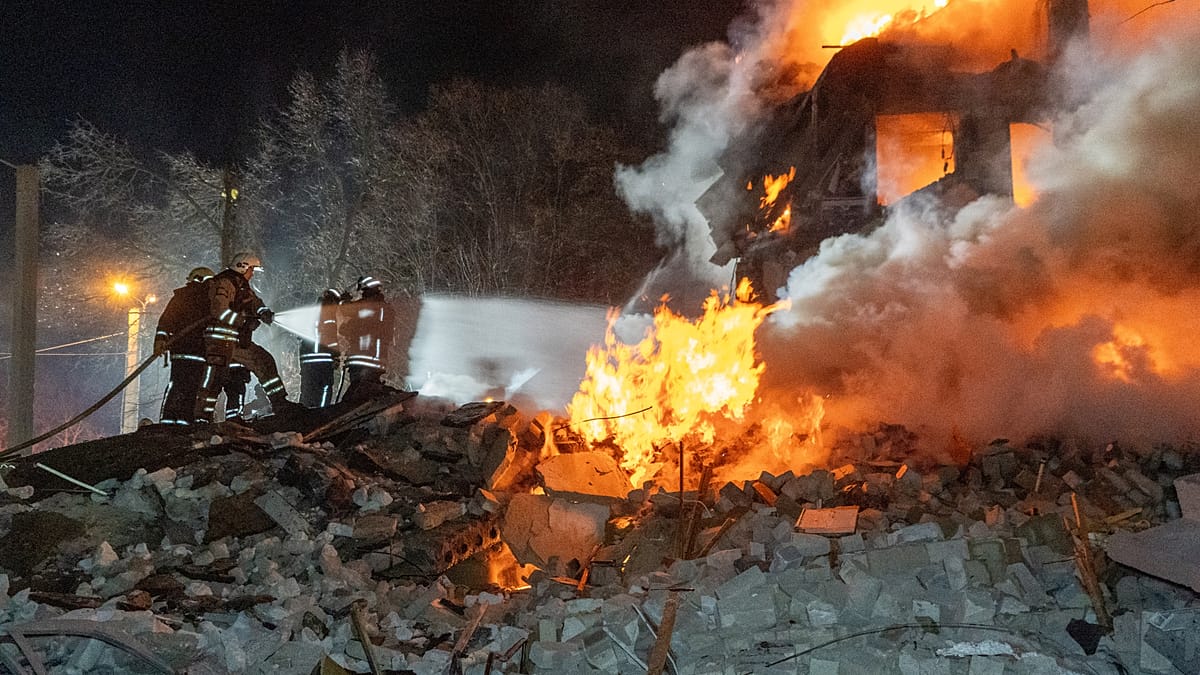
Kharkiv, Ukraine – A devastating Russian missile strike on Saturday, March 7, 2026, has left at least ten people dead, including two children, and sixteen injured in Ukraine’s second-largest city. The attack, which directly hit a five-story residential building, is the latest in a series of escalating assaults targeting civilian infrastructure across the country, prompting renewed calls for international support from Ukrainian President Volodymyr Zelenskyy.
The strike on Kharkiv represents a significant escalation in the ongoing conflict, highlighting the continued vulnerability of Ukrainian cities to Russian aggression. As the war enters its fifth year, the relentless bombardment of urban centers raises serious concerns about the protection of civilians and the long-term viability of Ukraine’s infrastructure. The attack underscores the urgent need for increased air defense capabilities and sustained international assistance to help Ukraine defend itself against these attacks.
According to Ukrainian officials, Russia launched a massive overnight attack utilizing 29 missiles, nearly half of which were ballistic, and 480 drones, the majority of which were Iranian-designed Shaheds. While Ukrainian air defense systems managed to intercept a significant portion of the incoming projectiles – reportedly downing 19 missiles and 453 drones – a substantial number still reached their targets, causing widespread damage and casualties. The sheer scale of the attack demonstrates Russia’s willingness to employ increasingly destructive tactics in its pursuit of military objectives.
Deadly Strike on Kharkiv Apartment Building
The ballistic missile strike on the residential building in Kharkiv caused a catastrophic collapse, trapping residents under the rubble. Rescue workers have been tirelessly sifting through the debris, searching for survivors. Kharkiv Mayor Igor Terekhov reported that among the wounded were two boys, aged six and eleven, and a seventeen-year-old girl. Oleh Syniehubov, the Kharkiv regional governor, confirmed that two children were also among those killed. The Associated Press reported that rescuers were still working to extract individuals trapped beneath the wreckage as of Saturday afternoon.
Beyond the immediate devastation in Kharkiv, the overnight attacks extended to other regions of Ukraine. Zelenskyy stated that energy infrastructure in Kyiv, the Khmelnytskyi and Chernivtsi regions, and railway infrastructure in the Zhytomyr region were also targeted. Damage to railway infrastructure led to changes in routes in the central-western part of the country, according to Ukrainian state railway operator Ukrzaliznytsia. In the Kyiv region, debris from downed rockets and drones caused damage in three districts.
Widespread Attacks and Ukrainian Response
The Ukrainian military reported intercepting a significant number of the incoming missiles and drones, but acknowledged that some managed to penetrate air defenses. According to preliminary data, nine missiles and 26 attack drones hit 22 locations across the country. Deutsche Welle reported that Russia utilized a combination of missile and drone attacks, demonstrating a multifaceted approach to targeting Ukrainian infrastructure.
In addition to the Kharkiv tragedy, one person was killed in the eastern region of Dnipropetrovsk, and three were wounded in Kyiv. A 24-year-old man died in the Sumy region after his car was struck by a Russian drone. In the southern Odessa region, firefighters responded to major fires at infrastructure facilities following a multi-drone attack, with 80 firefighters deployed to contain the blazes.
International Condemnation and Calls for Support
President Zelenskyy vehemently condemned the attacks, describing them as “savage strikes against life” and imploring international partners to provide increased support to Ukraine. He emphasized Russia’s continued attempts to destroy residential and critical infrastructure, arguing that sustained assistance is crucial for Ukraine’s defense. Zelenskyy took to X (formerly Twitter) to express his frustration and call for a stronger response from allies.
Росія не відмовилася від спроб знищити українську житлову та критичну інфраструктуру, тому підтримка має тривати. Очікуємо активної роботи з Європейським Союзом для посилення захисту наших людей. Вдячний усім, хто допомагає зміцнювати нашу оборону. 🇺🇦
— Володимир Зеленський (@ZelenskyyUa) March 7, 2026
The attacks have also prompted responses from neighboring countries. Poland scrambled military jets to protect its airspace in regions bordering Ukraine, a standard procedure during large-scale Russian strikes. This demonstrates the regional security implications of the conflict and the potential for escalation beyond Ukraine’s borders.
Broader Geopolitical Context
The timing of these attacks is particularly noteworthy, coinciding with increased tensions in the Middle East. Zelenskyy revealed that he had received a request from the United States for support in defending against Iranian drones in the Middle East and has ordered the provision of equipment and Ukrainian specialists. This request highlights Ukraine’s expertise in countering drone warfare, developed through years of experience defending against Russian attacks. However, the escalating conflict in the Middle East has also diverted international attention and resources from Ukraine, leading to the postponement of planned US-brokered talks between Russia and Ukraine.
Since initiating its full-scale invasion four years ago, Russia has deployed tens of thousands of Iranian-designed Shahed drones against Ukraine. The increasing reliance on drones reflects a shift in Russian military strategy, prioritizing cost-effectiveness and the ability to overwhelm Ukrainian air defenses. The parallel deployment of Iranian drones by Iran in the Middle East, in response to joint US-Israeli strikes, adds another layer of complexity to the geopolitical landscape.
Key Takeaways
- A Russian missile strike on Kharkiv killed at least ten people, including two children, and injured sixteen.
- Russia launched a massive overnight attack involving 29 missiles and 480 drones, targeting multiple regions of Ukraine.
- President Zelenskyy has called for increased international support to defend against Russian aggression.
- The conflict in Ukraine is occurring alongside escalating tensions in the Middle East, diverting international attention and resources.
Looking ahead, the situation in Ukraine remains highly volatile. The ongoing attacks underscore the urgent need for continued international assistance, including air defense systems, financial aid, and humanitarian support. The postponement of peace talks highlights the challenges in finding a diplomatic resolution to the conflict. Further developments are expected in the coming weeks as Ukraine continues to defend its territory and seek a path towards a sustainable peace. The international community will be closely monitoring the situation and assessing the potential for further escalation.
Please share your thoughts and reactions to these events in the comments below. Your engagement helps us continue to provide comprehensive and timely coverage of this critical situation.
Related reading