EU Pledges Continued Support for Ukraine Despite Funding Hurdles
Kyiv, Ukraine – Despite ongoing political obstacles, the European Union remains committed to providing substantial financial aid to Ukraine, with EU Commission President Ursula von der Leyen reaffirming the bloc’s intent to deliver a planned €90 billion ($106 billion) loan. The pledge came during a visit to Kyiv on February 24, 2026, marking the fourth anniversary of Russia’s full-scale invasion, and amidst concerns over Hungary’s continued opposition to the aid package. This commitment underscores the EU’s long-term support for Ukraine’s economic stability and its eventual path toward EU membership, a goal increasingly emphasized by Ukrainian President Volodymyr Zelenskyy.
Von der Leyen’s visit, alongside European Council President Antonio Costa, served as a powerful symbol of solidarity with Ukraine as the conflict enters its fifth year. The EU’s financial assistance is crucial for Ukraine to maintain essential government services, rebuild infrastructure devastated by the war, and address the immense humanitarian needs of its population. The situation is particularly poignant as Ukraine continues to grapple with the daily realities of war, including air raid sirens, energy shortages, and widespread displacement.
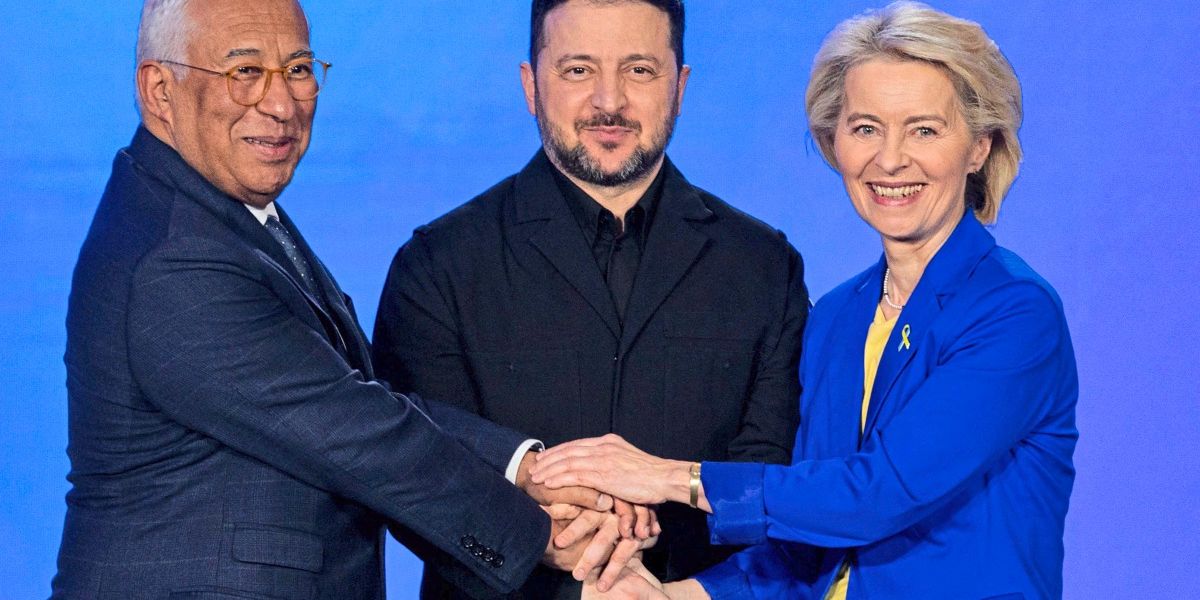
European Council President Antonio Costa (L), Ukraine’s President Volodymyr Zelensky (C) and the President of the European Commission Ursula von der Leyen (R) posing for a photo during a press conference in Kyiv on February 24, 2026, as Ukraine marks the fourth anniversary of Russia’s invasion. EU chief Ursula von der Leyen said on February 24, 2026 the bloc would make good on a 90-billion-euro ($106-billion) loan for Ukraine despite the Kremlin-friendly leader of Hungary, Viktor Orban, blocking the measure. (Photo by Tetiana DZHAFAROVA / AFP)
Hungary’s Opposition and the Path Forward
The primary obstacle to releasing the €90 billion aid package remains Hungarian Prime Minister Viktor Orbán, who has repeatedly voiced concerns and blocked the disbursement of funds. Orbán’s stance is widely seen as politically motivated, reflecting his close ties with Moscow and his skepticism towards providing substantial aid to Ukraine. Despite this opposition, Von der Leyen expressed confidence that a solution would be found, stating the EU would “make good” on its financial commitment. The exact mechanism for circumventing Hungary’s veto remains unclear, but discussions are reportedly underway regarding alternative funding arrangements.
The situation highlights the complexities of EU decision-making, particularly when dealing with sensitive geopolitical issues. The EU operates on a principle of unanimity in certain areas, meaning that a single member state can block a proposal. This has created a deadlock regarding Ukraine aid, forcing the EU to explore creative solutions to ensure continued support for Kyiv. According to reports, potential options include utilizing existing EU funds or establishing a separate financial mechanism outside the traditional EU budget.
Zelenskyy’s Push for EU Membership
Alongside the financial aid discussions, President Zelenskyy continues to advocate for a clear timeline for Ukraine’s accession to the European Union. He has repeatedly stressed the strategic importance of integrating Ukraine into the EU, arguing that it would strengthen both Ukraine and the bloc as a whole. While the EU has granted Ukraine candidate status, the path to full membership is expected to be lengthy and challenging, requiring significant reforms in areas such as rule of law, anti-corruption measures, and economic governance.
The Economist recently reported that while the United States continues to be a vital partner for Ukraine, the ongoing political debates in Washington regarding further aid packages have created uncertainty. This has led to a renewed focus on European support, making the EU’s commitment even more critical.
The Druzhba Pipeline and Ukraine’s Energy Security
In a related development, President Zelenskyy has indicated that Ukraine does not intend to repair the Druzhba pipeline, a key oil pipeline that transports Russian oil to Europe. This decision reflects Ukraine’s broader strategy of reducing its reliance on Russian energy sources and diminishing Russia’s economic leverage. Blue News reported on this stance, highlighting Ukraine’s determination to sever economic ties with Russia. The decision could potentially impact oil supplies to some European countries, prompting them to seek alternative sources.
Ukraine’s energy security has been a major concern since the start of the conflict, with Russia repeatedly targeting energy infrastructure in an attempt to cripple the country’s economy and disrupt supplies to Europe. The country is actively working to diversify its energy sources, including increasing its reliance on renewable energy and importing gas from alternative suppliers.
Davos 2026 and International Support
President Zelenskyy recently addressed the World Economic Forum in Davos, Switzerland, where he reiterated Ukraine’s urgent need for continued international support. The World Economic Forum reported on his address, emphasizing his calls for increased military aid, financial assistance, and diplomatic pressure on Russia. Zelenskyy’s appearance at Davos underscored Ukraine’s ongoing efforts to maintain international attention and secure the resources necessary to defend itself and rebuild its economy.
The international community’s response to the conflict in Ukraine remains a critical factor in determining the country’s future. Continued support from the EU, the United States, and other allies is essential for Ukraine to withstand Russian aggression and ultimately achieve a lasting peace. The challenges are significant, but the commitment to Ukraine’s sovereignty and territorial integrity remains strong among many nations.
Key Takeaways
- The EU is committed to delivering a €90 billion ($106 billion) loan to Ukraine despite opposition from Hungary.
- President Zelenskyy is actively seeking a clear timeline for Ukraine’s accession to the European Union.
- Ukraine has decided not to repair the Druzhba pipeline, reducing its reliance on Russian energy.
- International support, particularly from the EU and the United States, remains crucial for Ukraine’s defense and economic stability.
The situation surrounding Ukraine’s financial aid and EU membership continues to evolve. The next key development to watch will be the EU’s efforts to overcome Hungary’s veto and finalize the disbursement of the €90 billion loan. Readers are encouraged to follow updates from official EU sources and reputable news organizations for the latest information. Share your thoughts and perspectives on this critical issue in the comments below.
Worth a look
- Is It Wrong to Send Your Kid to Private School? The Moral Dilemma of Public vs. Private Education
- Agenzia delle Entrate ad agosto: perché arrivano lettere e avvisi (e chi rischia)
- Dublin Killer Freed After 45 Years: 63-Year-Old Released From Prison (archyworldys.com)
- Iran Demands US Concessions to Reopen Strait of Hormus, Boosting Oil Prices (archynewsy.com)