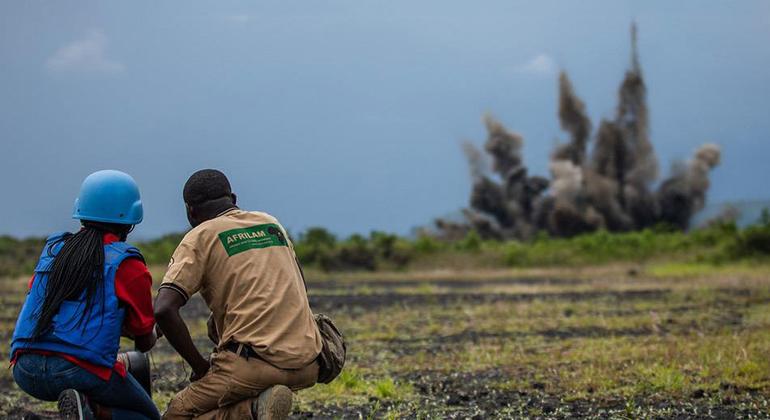
The landscape of modern conflict is undergoing a dangerous transformation as the technology used to deploy landmines evolves faster than the tools available to remove them. In current conflict zones, particularly in Ukraine, the emergence of high-tech, remotely deployed explosives is creating a precarious “arms race” between military developers and the humanitarian experts tasked with saving lives.
According to Paul Heslop, Head of the UN Mine Action Service (UNMAS) in Ukraine, the pace of innovation in landmine technology is setting a precedent for a novel era of warfare. This shift is making landmine detection a significantly more complicated and dangerous task, forcing deminers to innovate rapidly to avoid being left behind by the very technology they are fighting to neutralize.
The challenge is no longer just about finding buried explosives, but about contending with “smart” weapons designed to defeat detection efforts. As the international community prepares to mark the International Day for Mine Awareness and Assistance in Mine Action on April 4, the urgency for new clearance solutions has never been higher.
The Rise of 3D Printing and Remote Deployment
One of the most significant shifts in landmine warfare is the localization and speed of production. In the Ukraine conflict, 3D printers are now being used to produce basic landmine models close to the battlefield. These components can be quickly assembled, filled with explosives, and deployed with minimal lead time.
the method of delivery has shifted away from traditional manual planting. The majority of mines currently deployed in Ukraine are laid remotely. This is achieved through a variety of delivery systems, including:
- Drones
- Artillery
- Rockets
- Helicopters
This shift toward remote deployment changes the nature of the threat. Since many of these mines are dropped or fired into an area rather than buried by hand, they often do not penetrate the surface of the ground, which provides a potential point of exploitation for mine action groups seeking new ways to identify and clear contaminated areas.
The Danger of High-Tech and ‘Smart’ Mines
Beyond the methods of deployment, the internal technology of the mines themselves has grow more sophisticated. Heslop warns that “high-tech” landmines are now being deployed with sensors capable of detecting the approach of a deminer, whether they are on foot or operating a vehicle.
Perhaps most concerning is the introduction of magnetic influence capabilities. These mines are designed to detonate when they are exposed to a magnetic field—the very field generated by the detectors deminers use to locate them. This creates a lethal paradox where the primary piece of technology used to ensure a deminer’s safety can actually act as the trigger for the mine’s detonation.
This technological leap transforms the act of clearance into a high-stakes gamble, as traditional detection methods may now be the catalyst for an explosion. The goal for UNMAS and other mine action groups is to win the race to clear these hazards faster than the technology to prevent their clearance is developed.
Innovating for Civilian Protection
To counter these threats, deminers are shifting their focus toward prevention and the identification of systemic weaknesses in how these new mines are deployed. By understanding the patterns of remote deployment and the specific triggers of sensor-based mines, experts hope to reduce the damage landmine contamination inflicts on civilian communities.
The focus remains on protecting non-combatants who are most at risk when high-tech weaponry is left behind after active hostilities cease. The ability to innovate at the same pace as military technology is not merely a technical requirement but a humanitarian necessity to prevent long-term displacement and loss of life in post-conflict zones.
For those seeking more information on global mine action efforts and safety guidance, updates are regularly provided via the United Nations Department of Political and Peacebuilding Affairs.
The next major global checkpoint for this issue is the International Day for Mine Awareness and Assistance in Mine Action on April 4, which serves as a critical moment for renewing international commitment to mine clearance and victim assistance.
Do you believe international law should evolve to specifically ban sensor-based landmines? Share your thoughts in the comments below.
Keep reading