
Dark pools—private trading venues where large institutional investors execute massive stock orders away from public exchanges—account for roughly 40% of all U.S. equity trading volume, according to the U.S. Securities and Exchange Commission (SEC). These opaque platforms, often operated by banks, brokerages, and hedge funds, have long sparked debate over market fairness, transparency, and potential conflicts of interest. While proponents argue they reduce volatility and execution costs for big players, critics warn they can distort price discovery and create hidden risks for retail investors.
Institutional investors—including pension funds, mutual funds, and hedge funds—routinely use dark pools to trade billions of dollars’ worth of shares daily without revealing their orders to the broader market. The practice has evolved alongside regulatory scrutiny, with the SEC and other global watchdogs increasingly probing whether these venues give insiders an unfair edge. Understanding how dark pools function, their benefits, and their controversies is essential for investors, traders, and policymakers navigating today’s fragmented financial markets.
This guide breaks down what dark pools are, how they operate, their role in modern trading, and the ongoing debates surrounding their use—backed by verified data from regulators, industry reports, and market participants.
What Are Dark Pools, and How Do They Work?
Dark pools are private, off-exchange trading platforms where participants—typically institutional investors—buy and sell securities without their orders being publicly displayed until after execution. Unlike traditional stock exchanges (such as the NYSE or Nasdaq), where orders are visible in real time, dark pools operate in darkness, hence the name. This lack of transparency is intentional: it allows large traders to move significant positions without triggering market moves or attracting unwanted attention from other market participants.
Key features of dark pools include:
- No order visibility: Trades are executed internally or matched with other participants without being broadcast to public exchanges.
- Anonymity: Buyers and sellers remain unidentified until after the trade is completed.
- Reduced market impact: Large orders (e.g., $10 million+ trades) can be split and executed without causing price slippage.
- Customized pricing: Some dark pools allow participants to negotiate terms, such as fees or execution priority.
Dark pools are typically accessed through broker-dealers, such as Bloomberg, ITG, or Posit, which act as intermediaries. The largest dark pool by volume is Liquidnet, which handles an estimated 15–20% of U.S. equity trading volume, according to its 2023 transparency report.
Why Do Institutional Investors Use Dark Pools?
Institutional investors—including asset managers, hedge funds, and corporate treasuries—rely on dark pools for several strategic reasons:
1. Avoiding Price Impact
When a large investor (e.g., a pension fund) attempts to buy or sell millions of shares on a public exchange, the sheer size of the order can move the stock price against them—a phenomenon known as market impact. Dark pools mitigate this by allowing trades to be executed in smaller chunks or matched with other large participants without exposing the full order to the market.
For example, a study by the Financial Times found that institutional traders using dark pools reduced their execution costs by 10–30% compared to public exchanges, particularly for high-frequency trading strategies.
2. Reducing Volatility
Publicly visible large orders can trigger algorithmic trading programs to react, leading to sudden price swings. Dark pools eliminate this risk by keeping orders hidden until execution. This is especially critical for block trades—orders of 10,000+ shares—where visibility could destabilize a stock.
Data from the Nasdaq shows that dark pool participation has grown alongside the rise of passive investing (e.g., ETFs), as fund managers seek to rebalance portfolios without disrupting markets.
3. Access to Liquidity
Dark pools aggregate liquidity from multiple participants, including other institutions, market makers, and even retail brokers (via some platforms). This creates a deeper pool of potential counterparties for large trades, improving execution quality.
According to a 2014 SEC report, dark pools accounted for 30% of all U.S. equity trading volume by 2013, a figure that has since risen as retail trading has declined relative to institutional activity.
How Dark Pools Compare to Public Exchanges
The choice between dark pools and public exchanges depends on an investor’s goals, order size, and tolerance for risk. Below is a side-by-side comparison of key differences:
| Feature | Dark Pools | Public Exchanges (NYSE, Nasdaq) |
|---|---|---|
| Order Visibility | Hidden until execution | Publicly displayed in real time |
| Transparency | Limited (post-trade reporting required) | High (all orders and trades are recorded) |
| Market Impact | Minimal (orders split or matched internally) | Higher risk (large orders can move prices) |
| Fees | Variable (often negotiated) | Standardized exchange fees |
| Participant Base | Primarily institutions | Institutions, retail traders, algorithms |
| Regulation | Overseen by SEC but less stringent | Strict regulatory oversight |
Note: While dark pools offer advantages for large traders, their lack of transparency has led to regulatory scrutiny. The SEC requires dark pools to disclose certain trade details, but critics argue these disclosures are insufficient to prevent abuse.
Controversies and Regulatory Scrutiny
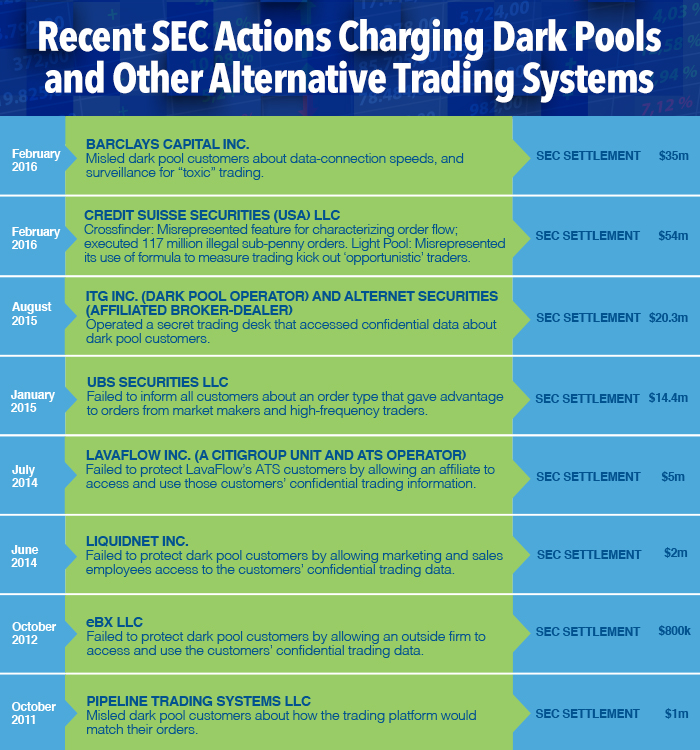
Despite their benefits, dark pools have faced persistent criticism over potential conflicts of interest, market manipulation risks, and unfair advantages for insiders. Key controversies include:
1. Insider Trading Risks
Because dark pools operate in private, there is a risk that participants—particularly those with access to non-public information—could exploit the system. For example, a 2014 Department of Justice case involved traders using dark pools to profit from confidential corporate transactions.
The SEC has since tightened rules, requiring dark pools to:
- Publish post-trade data (e.g., price, size, timestamp) within 60 minutes.
- Disclose whether they are “lit” (connected to public exchanges) or “dark” (fully private).
- Prevent “payment for order flow” schemes where brokers profit from routing orders to dark pools.
2. Price Discovery Concerns
Critics argue that dark pools can distort price discovery—the process by which market participants determine the fair value of a stock. If too many trades occur in private, public prices may not reflect true supply and demand, leading to inefficiencies.
A 2016 Brookings Institution study found that stocks with high dark pool activity exhibited wider bid-ask spreads—a sign of reduced liquidity—compared to those traded primarily on public exchanges.
3. Retail Investor Exclusion
Dark pools are largely inaccessible to retail investors, who must rely on public exchanges or broker-dealer platforms that connect to them. This raises questions about market fairness, as institutions may gain an informational edge by trading in private.
Some brokerages, such as Interactive Brokers, offer retail clients limited access to dark pools, but participation remains restricted to high-net-worth individuals and professional traders.
Recent Developments and Future Outlook
The debate over dark pools continues to evolve, with regulators, market participants, and policymakers grappling with how to balance efficiency with transparency. Recent developments include:
1. SEC Proposals for Greater Transparency
In 2023, the SEC proposed new rules to enhance dark pool disclosures, including:
- Mandating real-time pre-trade transparency for certain orders.
- Requiring dark pools to publish more detailed trade data, such as the identity of the executing broker.
- Limiting the ability of dark pools to engage in “predatory” practices, such as routing orders to affiliated market makers.
The proposal is still under review, but industry analysts expect it to reduce the opacity of dark pools while preserving their utility for large traders.
2. Growth of Alternative Trading Systems (ATS)
Dark pools are part of a broader category of Alternative Trading Systems (ATS), which also include electronic communication networks (ECNs) and crossing networks. The SEC estimates that ATSs now handle over 40% of all U.S. equity trading volume, up from just 5% in 2005.
This fragmentation has led to calls for a more unified market structure, with some advocating for a consolidated tape (a single feed of all trades) to improve transparency.
3. Technological Innovations
Advances in artificial intelligence and blockchain are beginning to reshape dark pools. For example:
- Some platforms now use AI to match orders more efficiently, reducing execution times.
- Blockchain-based dark pools (e.g., T0) aim to provide immutable audit trails for trades.
However, these innovations have also raised concerns about systemic risks, as private trading systems become increasingly complex.
Key Takeaways for Investors
For institutional investors, dark pools remain a critical tool for executing large trades efficiently. For retail investors, understanding their role in markets is essential for assessing risks. Here’s what to remember:
- Dark pools are not illegal but operate under stricter regulatory oversight than in the past.
- They benefit large traders by reducing costs and market impact but may exclude retail investors.
- Transparency is improving, but risks of abuse (e.g., insider trading) persist.
- Public exchanges still dominate for most retail trading, though dark pool volume continues to grow.
- Regulatory changes are coming, so investors should monitor SEC updates closely.
What Happens Next?
The SEC’s proposed dark pool reforms are expected to be finalized by mid-2025, with new rules likely taking effect in 2026. Market participants should watch for:
- Finalized transparency requirements for dark pools.
- Potential consolidation of fragmented trading venues.
- Further adoption of AI and blockchain in private trading.
For the latest updates, follow the SEC’s market structure initiatives and FINRA’s regulatory alerts.
Your Turn: Share Your Thoughts
Do you think dark pools benefit or harm market fairness? Should retail investors have greater access? Share your perspective in the comments below—or tag us on Twitter to join the discussion.
Keep reading