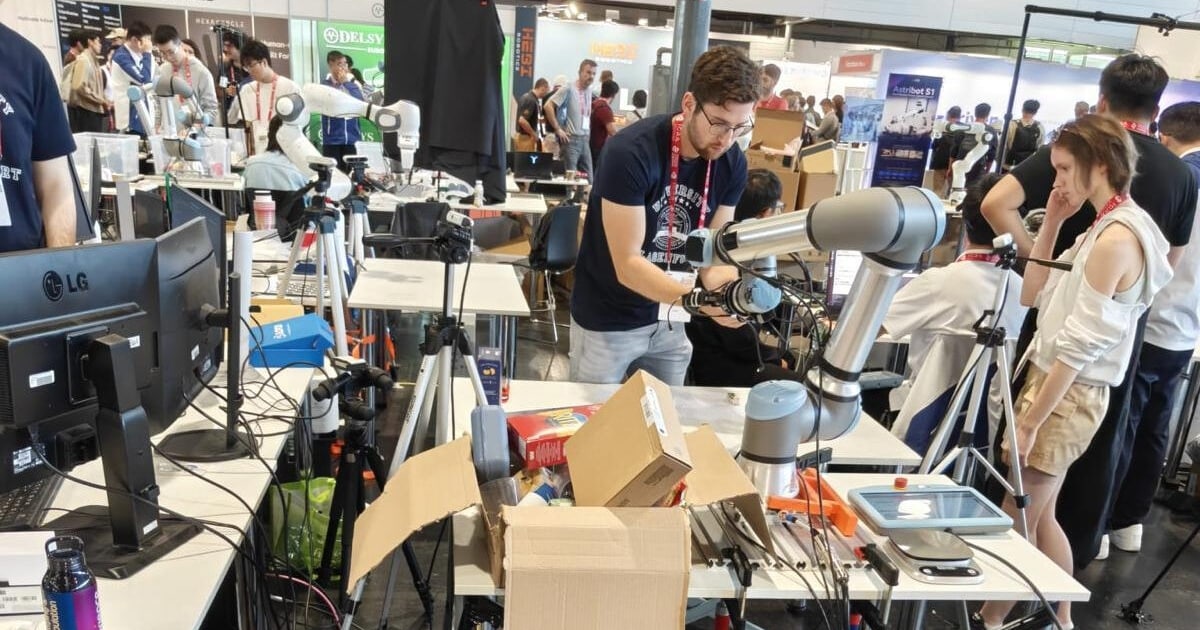
In the rapidly evolving field of autonomous systems, the pursuit of seamless human-robot interaction remains one of the most complex challenges for researchers. A student team from the University of Klagenfurt has recently demonstrated significant progress in this arena, distinguishing themselves as a top-ranked entrant for a high-stakes competition at one of the world’s most prominent robotics gatherings. Their work, which focuses on the intricate mechanics of object manipulation, highlights the growing importance of precision engineering in artificial intelligence.
The team, led by Nadezhda Varzonova, has qualified for the Robotic Grasping and Manipulation Competition, a key event held during the IEEE International Conference on Robotics and Automation (ICRA), scheduled from June 2 to June 4, 2026. By achieving the highest overall score in the qualification round, the Klagenfurt group has positioned itself as a favorite in the category dedicated to “human-to-robot handovers,” an area that demands both technical rigor and adaptive software architecture. University of Klagenfurt official coverage of the competition qualification provides further insight into the team’s preparations.
Engineering Precision in Human-Robot Interaction
The core of the team’s research involves developing systems capable of receiving and manipulating objects with unknown physical properties. In real-world environments, a robot must contend with variables such as varying mass, material stiffness, and contents, as well as optical challenges like reflections and transparency. Successfully navigating these conditions is essential for the future of collaborative robotics, where machines are expected to operate safely alongside humans in dynamic settings.
Nadezhda Varzonova, who began her studies in Robotics and Artificial Intelligence at the University of Klagenfurt in 2023, organized the team from the ground up. The group includes students Daniel Bugelnig, Markus Kräuter, Valerian Pichler, and Christoph W. Rauter. Under the guidance of Hubert Zangl’s Smart Systems Technology research group, the students have focused on defining system architecture and implementing custom technologies that allow their robotic systems to perform complex tasks with high accuracy.
Why Robotic Manipulation Matters
The ability for a robot to “hand over” an object to a human is more than a technical milestone; This proves a fundamental requirement for service robotics, manufacturing, and assistive technologies. When a machine can reliably identify and handle previously unseen objects, it bridges the gap between pre-programmed industrial tasks and the unpredictable nature of domestic or professional assistance.
The competition at ICRA serves as a global stage for these advancements. By testing systems against realistic scenarios—such as occlusions and varying lighting conditions—the event pushes the boundaries of what is possible in computer vision and tactile sensing. For the Klagenfurt team, this represents the culmination of months of coordination, from recruiting team members to refining the final system implementation.
Academic Excellence and Research Focus
The University of Klagenfurt’s involvement in such high-level international competitions underscores the institution’s commitment to research-led education. Varzonova, who previously moved to Austria to pursue a stronger focus on research, has been recognized for her contributions, including a Best Performer Award from the Faculty of Technical Sciences and a nomination for the Best Paper Award at the Simultech conference. This environment of academic inquiry provides a foundation for the team’s ongoing development of autonomous systems.
As the robotics community continues to refine the interaction between humans and machines, the work being done in research groups like those at the University of Klagenfurt offers a glimpse into the future of automated assistance. The integration of advanced sensor technology and robust software architecture remains the primary driver of these innovations.
Key Takeaways from the ICRA 2026 Participation
- International Recognition: The University of Klagenfurt team achieved the highest qualification score for the Robotic Grasping and Manipulation Competition.
- Technical Focus: The team is specializing in “human-to-robot handovers,” tackling challenges like transparency, object mass, and unknown physical properties.
- Collaborative Effort: Led by Nadezhda Varzonova, the team consists of five students working within the Smart Systems Technology research group.
- Global Venue: The competition takes place at the IEEE International Conference on Robotics and Automation (ICRA), which runs from June 2 to June 4, 2026.
As the competition concludes, the findings from this event will likely influence future research into how robots process sensory data and interact with their surroundings. The team’s ability to build and implement these technologies independently marks a significant achievement for the students involved. For those interested in the latest developments from the ICRA conference, official updates can be monitored through the IEEE robotics community portals.

We invite our readers to share their thoughts on the future of human-robot collaboration in the comments below. What domestic or professional tasks would you most like to see robots handle with this level of precision?