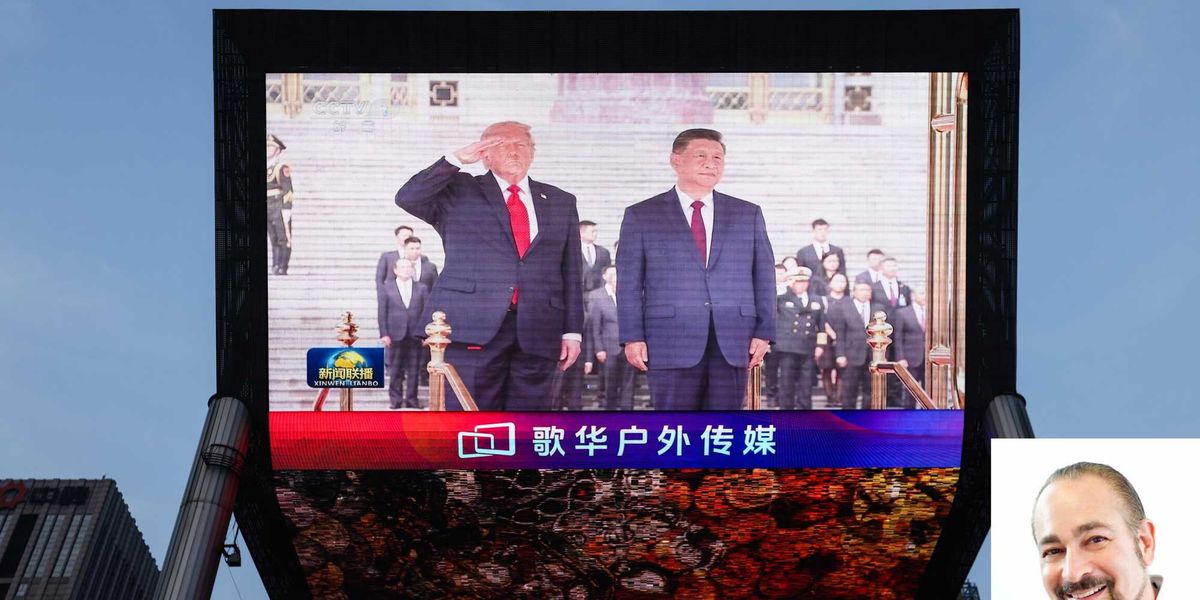
In the corridors of power from Washington to Beijing, a singular, daunting question dominates the geopolitical landscape: Can the world’s two most powerful nations coexist in peace, or are they locked in an inevitable descent toward confrontation? As the era of unbridled globalization gives way to a period of intense strategic competition, the relationship between the United States and the People’s Republic of China has become the primary axis upon which global stability rotates. For the billions of people living in the shadow of this rivalry, the outcome of this tension is not merely a matter of diplomatic maneuvering; We see a determinant of global economic health, environmental survival, and international security.
The current state of US-China relations is characterized by a profound paradox. On one hand, there is an escalating race for technological supremacy, a tightening of security alliances, and a concerted effort by Western powers to “de-risk” their economies from Chinese dependence. The two nations remain inextricably linked through a web of trade, finance, and shared existential threats that make total decoupling a logistical and economic impossibility. This delicate dance between competition and cooperation defines the modern age, forcing policymakers to seek a “managed competition” that avoids the catastrophic pitfalls of a direct kinetic conflict.
To understand whether peaceful coexistence is a viable goal or a utopian fantasy, one must analyze the structural drivers of the rivalry. The friction points are no longer confined to traditional military posturing; they have migrated into the very foundations of the 21st-century economy—semiconductors, artificial intelligence, and the critical minerals required for the green energy transition. As the world watches, the central challenge for both Washington and Beijing is to build “guardrails” that allow for fierce competition in the marketplace and the laboratory, while preventing that friction from igniting a fire in the Taiwan Strait or the South China Sea.
The Economic Paradox: From Interdependence to De-risking
For decades, the prevailing wisdom in international relations suggested that economic integration would act as a stabilizer. The theory was simple: if the United States and China were too economically entwined to afford conflict, peace would be maintained by the sheer cost of war. While this interdependence remains a massive reality, the strategic landscape has shifted. The focus has moved from maximizing efficiency and low costs to prioritizing “resilience” and “national security.”
In recent years, the term “de-risking” has replaced the much more radical concept of “decoupling” in the lexicon of Western policymakers. While decoupling implies a total severance of economic ties, de-risking seeks a more surgical approach. The objective is to reduce vulnerabilities in critical supply chains—particularly regarding semiconductors, pharmaceutical ingredients, and rare earth elements—without dismantling the broader framework of global trade. This shift is driven by the recognition that economic dependencies can be weaponized in times of geopolitical crisis.
The economic implications of this shift are vast. As companies seek to diversify their manufacturing bases away from China, many are looking toward Southeast Asia, India, and Mexico. However, the sheer scale of the Chinese industrial complex means that any attempt to reduce dependence is a slow, multi-year process that carries significant inflationary risks. According to various analyses of global trade flows, the transition toward more fragmented, “friend-shored” supply chains represents a fundamental restructuring of the global economy that will affect everything from the price of consumer electronics to the stability of international financial markets.
Despite these tensions, the sheer volume of bilateral trade remains a powerful tether. The economic cost of a full-scale trade war or a blockade in the Pacific would be felt globally, potentially triggering a recession that neither nation’s leadership is prepared to manage. This “economic mutual assured destruction” remains one of the strongest, albeit fragile, arguments for continued coexistence.
Geopolitical Flashpoints and the Security Dilemma
While economics provides a tether, security concerns provide the most significant pressure toward conflict. The “security dilemma”—a classic concept in international relations where one state’s efforts to increase its own security are perceived as a threat by another—is acutely visible in the Indo-Pacific region. As the United States strengthens its alliances through frameworks like AUKUS and expanded cooperation with Japan and the Philippines, Beijing views these moves as an attempt at “containment.”
The most critical flashpoint remains the Taiwan Strait. For Beijing, the “reunification” with Taiwan is a core national interest and a matter of sovereign integrity. For Washington, the status quo is maintained through a policy of “strategic ambiguity,” aimed at deterring any unilateral change to the region by force. The risk of miscalculation in this theater is higher than at any point in the last forty years. A single accidental collision between military aircraft or naval vessels could rapidly escalate into a crisis that neither side may be able to easily de-escalate.
Beyond Taiwan, the South China Sea continues to be a source of friction. China’s expansive maritime claims and the construction of artificial features have led to frequent standoffs with other claimants and the regular presence of U.S. Freedom of navigation operations. These encounters are a constant test of nerves, requiring high levels of professional military communication to prevent local incidents from spiraling into broader confrontations.
To mitigate these risks, the establishment of “military-to-military” communication channels has become a top priority for diplomats. These channels are not intended to solve the underlying political disputes, but rather to provide a mechanism for clarifying intentions and managing crises in real-time. The ability to talk during a crisis is the difference between a managed incident and an unintended war.
The Imperative of Cooperation: Shared Existential Threats
If the competition is driven by security and technology, the necessity for cooperation is driven by survival. There are several “non-zero-sum” issues—areas where both nations must work together because a failure in one area results in a loss for both. These issues transcend national sovereignty and ideological differences.
- Climate Change Mitigation: As the world’s two largest emitters of greenhouse gases, no global climate solution is possible without the coordinated efforts of the U.S. And China. While they compete for dominance in the green technology market, their ability to set global standards and meet emissions targets is essential for the stability of the planet.
- Artificial Intelligence Governance: The race for AI supremacy is intense, but the risks associated with autonomous weapons and uncontrolled AI development are universal. Collaborative efforts to establish “guardrails” for AI safety are becoming a critical area of diplomatic engagement.
- Global Health and Pandemic Preparedness: The lessons of the early 2020s have underscored that pathogens do not respect borders. Cooperation in biotechnology, disease surveillance, and vaccine distribution remains a fundamental necessity for global health security.
- Economic and Financial Stability: In an interconnected financial system, a major economic collapse in either the U.S. Or China would have devastating ripple effects across the globe. Maintaining stability in international markets requires a baseline of functional communication between the two central banks and financial regulators.
The challenge for leaders is to decouple these cooperative imperatives from the broader strategic rivalry. The goal is to create a “compartmentalized” relationship: competing fiercely in the realms of military power and high-tech dominance, while maintaining functional, even if transactional, partnerships in the realms of climate, health, and global economic stability.
The Technological Frontier: A New Era of Competition
The competition between the U.S. And China has entered a new, more intense phase centered on “frontier technologies.” Here’s no longer just about who can build the fastest computer, but about who will control the digital architecture of the future. The “tech war” focuses on several key domains:
Semiconductors: Often described as the “new oil,” advanced semiconductors are the lifeblood of modern military and civilian technology. The U.S. Has implemented significant export controls aimed at limiting China’s access to the most advanced chip-making equipment, a move designed to protect national security interests. China, in response, has accelerated its drive for “technological self-reliance,” investing heavily in domestic chip manufacturing and searching for workarounds to Western restrictions.
Artificial Intelligence: AI is viewed as the ultimate “force multiplier” in both economic productivity and military capability. The competition involves not just compute power, but the data used to train models and the talent required to develop them. The race is on to define the ethical and technical standards that will govern how AI is deployed globally.
Quantum Computing and Biotechnology: These emerging fields represent the next wave of disruption. Control over quantum computing could render current encryption methods obsolete, while breakthroughs in biotechnology could reshape the very essence of human health and security. Both nations are pouring billions into these sectors, recognizing that the leader in these fields will hold a profound advantage in the decades to come.
This technological competition risks creating a “bifurcated” world, where different regions operate on entirely different technological stacks, standards, and internet architectures. Such a split would increase costs for global businesses and complicate international cooperation on everything from cybersecurity to digital trade.
Key Takeaways: The State of US-China Relations

| Dimension | Primary Driver of Competition | Primary Driver of Cooperation |
|---|---|---|
| Economics | De-risking, supply chain resilience, and tech supremacy. | Massive trade volume and financial interdependence. |
| Security | Taiwan Strait, South China Sea, and military alliances. | Need for crisis management and “guardrails” to prevent war. |
| Technology | Semiconductor controls and AI dominance. | Setting global standards and managing existential AI risks. |
| Global Issues | Ideological differences and regional influence. | Climate change, pandemic prevention, and global stability. |
Conclusion: The Path Toward Managed Competition
The question of whether the U.S. And China can coexist in peace does not have a simple “yes” or “no” answer. Instead, it is a question of management. The era of cooperative integration is likely over, replaced by an era of systemic rivalry. However, rivalry does not have to equal conflict.
The most likely path forward is one of “managed competition”—a state where both nations accept the reality of their competition in technology, security, and influence, but work aggressively to prevent that competition from de-stabilizing the global order. This requires a level of diplomatic sophistication and strategic restraint that has rarely been tested in modern history. It requires both sides to recognize that while they are competitors, they are also partners in the management of a shared, fragile planet.
As we move into the mid-2020s, the success or failure of this management will be tested by upcoming high-level summits, the implementation of new trade policies, and the ability of both nations to navigate the most sensitive flashpoints in the Indo-Pacific. The world is watching, and the stakes could not be higher.
Next Checkpoint: Watch for upcoming high-level bilateral meetings between U.S. And Chinese officials, as well as official statements regarding semiconductor export controls and maritime security protocols in the South China Sea.
What do you think is the most critical factor in preventing a conflict between the U.S. And China? Share your thoughts in the comments below and join the conversation.