
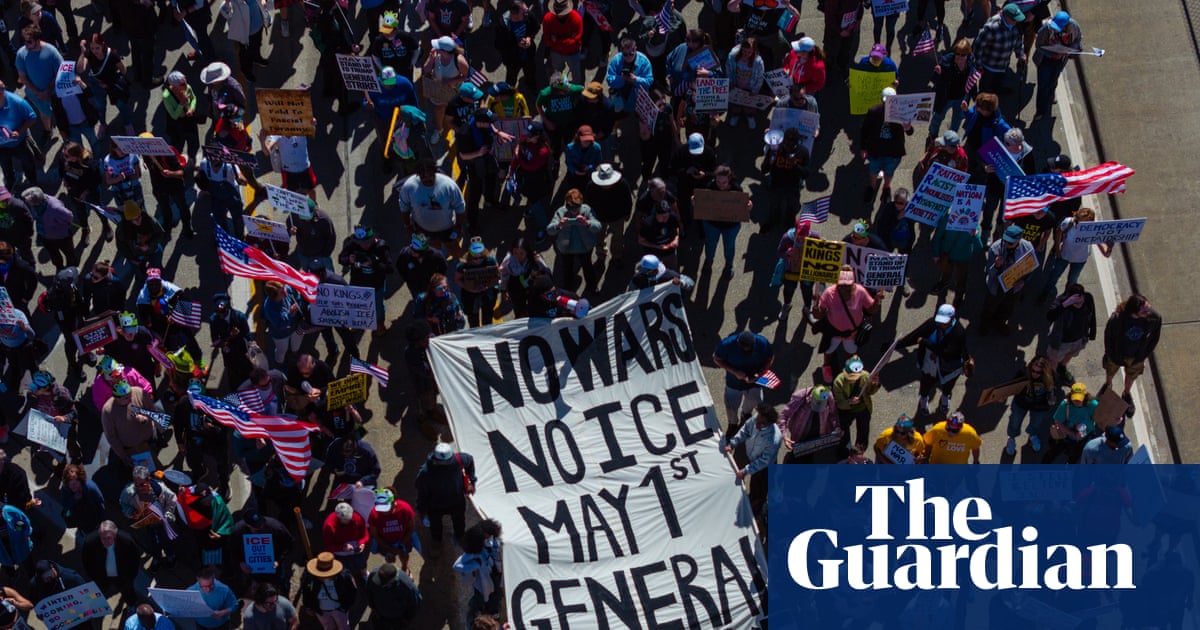
Across the United States today, Friday, May 1, 2026, thousands of workers, students, and activists are participating in a coordinated economic blackout
designed to disrupt the nation’s financial machinery. The movement, organized under the banner of “May Day Strong,” is calling for a nationwide general strike centered on the mantra no school, no function, no shopping
to protest the policies of President Donald Trump and the influence of billionaires on American governance.
This massive mobilization serves as a direct escalation from the “No Kings” protest series held in late March, which organizers estimate drew approximately 8 million people across 3,000 protests in all 50 states. While previous demonstrations focused on street marches, today’s action seeks to exert economic pressure by urging a total cessation of labor and consumer spending for 24 hours.
The “May Day Strong” coalition, comprising roughly 500 labor and community organizations, has scheduled more than 3,000 demonstrations nationwide. The organizers are demanding a systemic shift in priorities, specifically calling for the abolition of Immigration and Customs Enforcement (ICE), higher taxes on the wealthiest Americans, and the expansion of democratic protections over corporate power.
The ‘Economic Blackout’ Strategy: Beyond the March
Unlike traditional May Day rallies, the “economic blackout” is a strategic attempt to demonstrate the collective power of the working class by removing them from the economy entirely for a single day. By encouraging people to stay home from work, keep children out of school, and avoid all non-essential shopping, the movement aims to create a visible and measurable dip in economic activity.
The strategy is rooted in the history of International Workers’ Day, which commemorates the 1886 struggle for the eight-hour workday. Organizers argue that in the current political climate, simply marching in the streets is insufficient. The goal is to shift the movement from talking about what’s next
to executing a tangible disruption of the “billionaire agenda.”
In cities like Tucson, Arizona, the impact is being felt at the local business level. Reports indicate that local businesses are preparing for closures as part of the national effort to prioritize workers over billionaires
. Chris Mazzarella, Director of Tucson Business Development for Local First Arizona, has expressed concerns regarding the potential financial impact of these closures on small businesses across southern Arizona .
Regional Flashpoints: From Seattle to Los Angeles
While the economic boycott is nationwide, several urban centers have develop into focal points for physical demonstrations and campus takeovers.
In Washington state, thousands are expected to rally and march, with a significant gathering at Cal Anderson Park in Seattle’s Capitol Hill neighborhood. These protesters are focusing heavily on the administration’s immigration crackdown and are calling for the dismantling of ICE .
In Los Angeles, the “No Kings” movement has transitioned into a massive “Workers Over Billionaires” rally at MacArthur Park. This event follows a weekend of tension in downtown Los Angeles, where authorities reported that 74 protesters were arrested during previous demonstrations .
In Tucson, the mobilization has taken a multi-pronged approach. Beyond the general economic blackout, specific actions include:
- A rally and march at El Presidio Plaza.
- A campus-based event at the University of Arizona Mall, organized by the United Campus Workers of Arizona (CWA 7065), focusing on the creation of a sanctuary campus and the implementation of free college for all students .
What So for the US Labor Landscape
The scale of the “May Day Strong” movement reflects a growing intersection between labor rights, immigrant protections, and anti-authoritarian political activism. By linking the “No Kings” political sentiment with the economic leverage of a general strike, the organizers are attempting to build a broad-based coalition that transcends traditional union lines.
For the average citizen, the “economic blackout” manifests as a call to sign a commitment pledge to abstain from the economy for the day. For the government, it represents a challenge to the stability of the workforce and a public rejection of current federal policies. The success of the movement will likely be measured not by the number of people in the streets, but by the degree to which businesses and schools actually experience a shutdown.
Key Demands of the May Day Strong Coalition
| Category | Primary Demand | Targeted Outcome |
|---|---|---|
| Fiscal Policy | Tax the Rich | Redirect wealth from billionaires to public families |
| Immigration | Abolish ICE | End the use of a “private army” for federal power |
| Governance | Expand Democracy | Defend free and fair elections against corporate power |
| Education | Free College | Remove financial barriers to higher education |
As the day progresses, the focus will shift toward whether this “day of power” can be sustained beyond a single date. The organizers have indicated that May 1 is not an end point, but a demonstration of the collective muscle that can be flexed to defeat the current administration’s agenda.
The next major checkpoint for the movement will be the evaluation of the economic impact of today’s blackout, with organizers expected to release data on participation rates and business closures in the coming days.
World Today Journal encourages readers to share their experiences of today’s events in the comments below and share this report to keep the global community informed.