
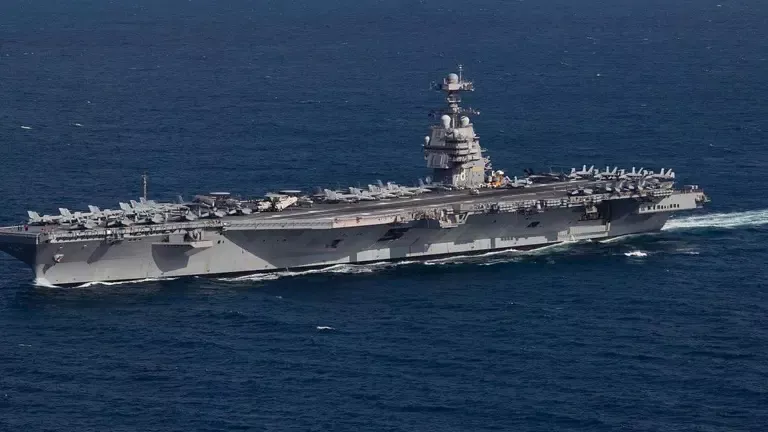
The United States Navy’s most advanced aircraft carrier, the USS Gerald R. Ford, has begun its journey home, marking the conclusion of an extensive operational deployment in the Middle East. The USS Gerald Ford return to USA follows a period of high-tempo naval activity in a region characterized by persistent geopolitical volatility.
Recent intelligence and visual data confirm that the nuclear-powered carrier is currently traversing the Mediterranean Sea. The movement signals a transition in U.S. Naval posture in the region as the vessel concludes its long-term presence and begins the final leg of its voyage back to its home port.
The return of the Ford-class carrier is not merely a routine rotation but a significant logistical event, given the ship’s role as the centerpiece of U.S. Power projection. As the largest aircraft carrier ever constructed, its deployment typically serves as a primary deterrent and a flexible response platform for the Department of Defense.
Satellite Imagery Tracks Transit Near Malta
The vessel’s current position was confirmed via high-resolution satellite imagery captured on May 3, 2026. Analysis of data from the European Sentinel-2 satellite placed the carrier approximately 145 kilometers northeast of the island of Malta. The imagery shows the nuclear-powered carrier moving in a westward direction, consistent with a trajectory toward the Atlantic Ocean and the United States.
The USS Gerald R. Ford is not sailing alone. Visual analysis indicates that the carrier is accompanied by two smaller military escort vessels. Based on their size, silhouette, and operational context, these accompanying ships are believed to be Arleigh Burke-class destroyers, which provide critical air-defense and anti-submarine capabilities to the carrier strike group during transit.
The presence of a visible wake in the satellite imagery confirms that the vessel was actively underway at the time of documentation, moving steadily away from the Eastern Mediterranean theater.
Concluding a Long-Term Middle East Deployment
While the specific operational details of the mission remain classified, the deployment is described as a “long deployment in the Middle East.” The carrier strike group’s presence in the region typically involves a variety of missions, including maritime security operations, supporting regional allies, and maintaining freedom of navigation in critical waterways.

The USS Gerald Ford return to USA comes after months of sustained operations. For the crew, the return marks the end of a grueling schedule of flight operations and strategic patrols. For U.S. Strategists, the rotation of the Ford-class carrier allows for necessary maintenance and the preparation of the vessel for future deployments.
The Mediterranean transit is a critical phase of the journey, as the ship passes through one of the world’s most monitored maritime corridors. The coordination between the carrier and its Arleigh Burke-class escorts ensures a secure passage as the fleet exits the European theater.
The Strategic Significance of the Ford Class
The USS Gerald R. Ford represents a generational leap in naval aviation. Unlike previous Nimitz-class carriers, the Ford utilizes the Electromagnetic Aircraft Launch System (EMALS) and the Advanced Arresting Gear (AAG), which reduce wear and tear on aircraft and allow for a more flexible launch and recovery cycle.
The ability of the U.S. To deploy such a massive asset to the Middle East for an extended period serves as a primary tool of diplomacy and deterrence. The carrier’s return typically coincides with the arrival or repositioning of other naval assets to ensure there is no gap in regional security coverage.
The logistical scale of returning a carrier strike group is immense, involving complex coordination with international partners and the management of thousands of personnel. The movement from the central Mediterranean toward the west is the final major milestone before the fleet enters the Atlantic.
Key Deployment Details
- Primary Vessel: USS Gerald R. Ford (Nuclear-powered aircraft carrier)
- Escort Vessels: Two suspected Arleigh Burke-class destroyers
- Last Verified Location: 145 km northeast of Malta (May 3, 2026)
- Observation Method: Sentinel-2 Satellite Imagery
- Direction of Travel: Westward toward the United States
As the fleet continues its westward progress, naval observers will be watching for the carrier’s entry into the Atlantic and its eventual arrival at its home port on the U.S. East Coast. The return of the ship provides an opportunity for the Navy to evaluate the performance of the Ford’s advanced systems after a prolonged operational cycle in a high-stress environment.

The next confirmed checkpoint for the vessel will be its official arrival and docking at its home base, where the crew will begin the process of decommissioning the deployment and entering a maintenance phase.
We invite our readers to share their perspectives on the role of carrier strike groups in modern geopolitics in the comments below.