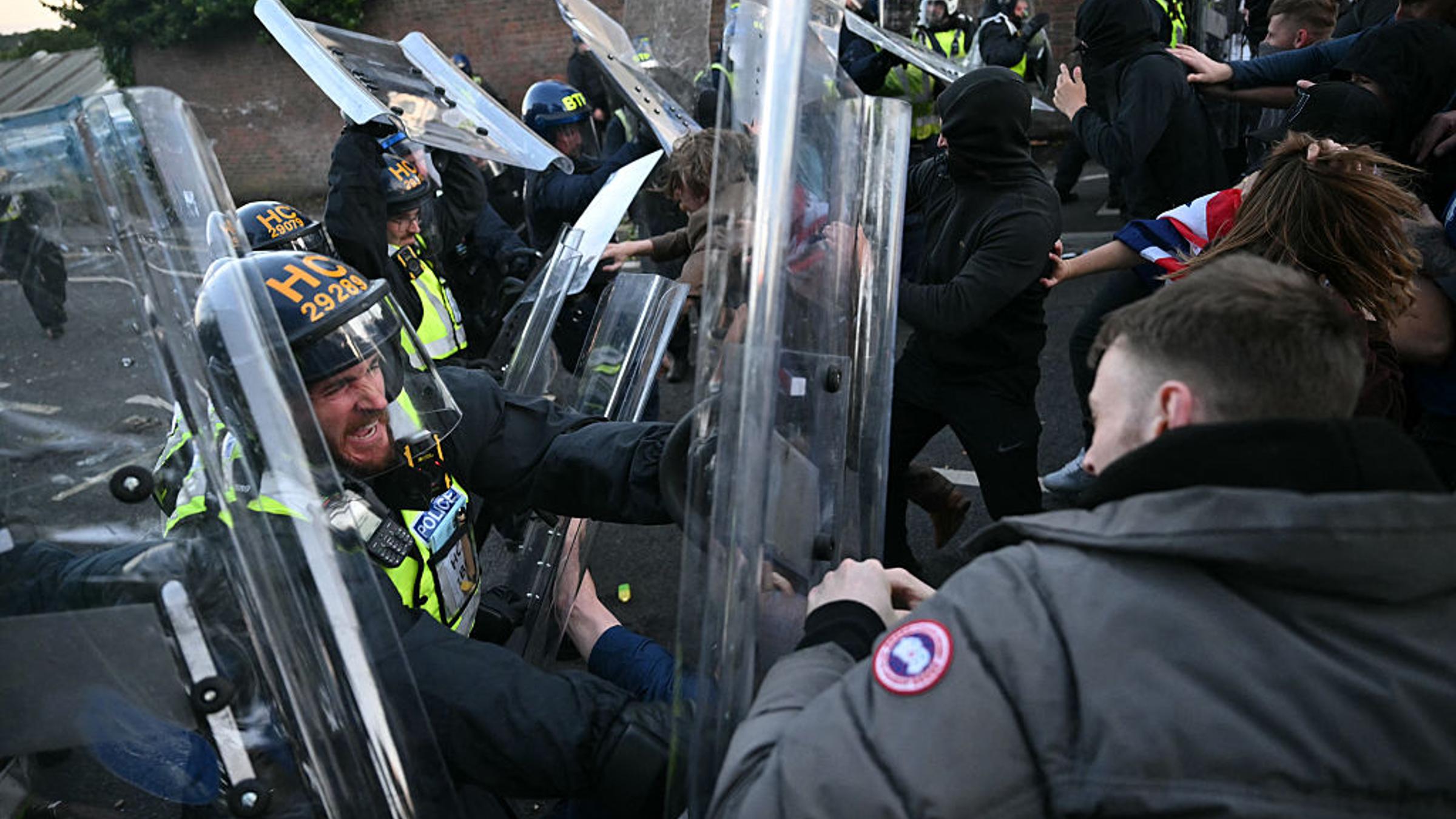
British Prime Minister Keir Starmer has publicly condemned the violent protests that erupted in Southampton following the release of police body-worn camera footage related to the death of 18-year-old Henry Nowak. The unrest, which saw 11 police officers sustain injuries and significant damage to local property, has intensified national debate regarding police accountability and the handling of sensitive public order incidents. The Prime Minister, addressing the House of Commons, labeled the scenes as “disgraceful and completely unacceptable,” while acknowledging that the footage has raised legitimate questions about the conduct of officers during the arrest of the teenager in December 2025.
The incident centers on the death of Henry Nowak, who was fatally stabbed by 23-year-old Vickrum Digwa. Following the attack, police apprehended Nowak while he was already suffering from severe injuries. Newly released footage indicates that officers placed Nowak in handcuffs despite his explicit pleas that he had been stabbed and was struggling to breathe. Digwa, who had initially claimed he was the victim of a racially motivated attack—an assertion later proven false—was sentenced on Monday to a minimum of 21 years in prison for the murder of Nowak, according to official court sentencing records. The Crown Prosecution Service has confirmed the conviction and the details of the sentencing.
The intensity of the public response has been compounded by the release of the body-worn video, which has prompted widespread scrutiny of Hampshire and Isle of Wight Constabulary. While the Independent Office for Police Conduct (IOPC) is actively investigating the officers’ contact with Nowak, the situation has been further polarized by political rhetoric. As the community in Southampton grapples with the aftermath, the incident has reignited complex, long-standing debates regarding the legal status of the kirpan—a ceremonial blade carried by practicing Sikhs—and the broader implications of community-led security concerns.
The Context of the Southampton Unrest
On the night of Tuesday, June 2, 2026, tensions escalated near the Portswood Police Station in Southampton, resulting in violent confrontations between protesters and law enforcement. According to official reports from the Hampshire and Isle of Wight Constabulary, the disorder involved the use of makeshift weapons, the throwing of bottles at officers, and targeted damage to residential vehicles and homes. Chief Constable Alexis Boon confirmed that two arrests were made in connection with the violence, with further investigations ongoing to identify additional participants.
Prime Minister Starmer’s intervention in Parliament sought to balance the public’s right to demand accountability with the necessity of maintaining civil order. He explicitly rejected claims from political figures, including Reform UK leader Nigel Farage, who suggested that the police response was influenced by a “two-tier” system based on ethnicity. Starmer emphasized that the family of Henry Nowak had explicitly requested that their son’s death not be exploited to fuel further division or racial tension, calling any such efforts “unforgivable.”
Police Conduct and the Investigation
The central point of contention for many observers remains the interaction between the responding officers and the victim. While police have stated that officers initiated CPR within minutes of their arrival, the body-worn footage showing the interaction has caused significant public distress. Hampshire Police’s Deputy Chief Constable Robert France issued a statement expressing “deep sorrow” that Nowak could not be saved and acknowledging the distress caused by the fact that he was handcuffed while losing consciousness. The investigation into these specific actions is being handled independently by the Independent Office for Police Conduct (IOPC), which is currently treating the officers involved as witnesses rather than suspects.
Pathological evidence presented during the court proceedings indicated that the severity of the injuries sustained by Nowak meant that, tragically, even immediate medical intervention might not have altered the outcome of the attack. However, this forensic clarity has not dampened the public demand for a thorough review of police training and the protocols governing the detention of injured individuals.
The Debate Over Religious Articles and Public Safety
The murder has triggered a secondary, highly contentious debate regarding the legal exemptions for Sikhs to carry a kirpan in public. During the sentencing hearing, Judge William Mousley K.C. Noted that while the kirpan is a required article of faith for practicing Sikhs, the weapon carried by the perpetrator was a “large Sikh dagger” that fell outside the scope of traditional, smaller, and concealed religious articles. This distinction has become a flashpoint for political debate, with some right-wing figures calling for a total repeal of the legal exemption that allows the carrying of such blades.


Conversely, community leaders and lawmakers, such as Tanmanjeet Singh Dhesi, have argued that politicizing the faith of the Sikh community is both dangerous and factually misleading, noting that the kirpan itself was not the instrument of the crime in this instance. Representatives from the Sikh community have expressed a “collective feeling of grief, worry, and fear,” particularly as the violent protests in Southampton occurred in the vicinity of a local gurdwara. There is a growing concern that the rhetoric surrounding the case could lead to retaliatory harassment or violence against innocent members of the Sikh community.
Looking Ahead: Accountability and Next Steps
The situation remains fluid as the city of Southampton attempts to return to a state of normalcy. The primary focus for the coming weeks will be the ongoing IOPC investigation into the police’s handling of the incident. This investigation is expected to provide a comprehensive report on whether the officers followed established protocols regarding medical emergencies and the use of force. The Home Secretary, Shabana Mahmood, has reiterated that those involved in the recent violent disorder will face the full extent of the law, signaling a zero-tolerance approach to public rioting.
For those following the case, official updates regarding the IOPC investigation and any future court proceedings related to the civil unrest will be published through the official portals of the U.K. Home Office and the local constabulary. As the nation processes these events, the call from the victim’s family for unity over division remains the guiding sentiment for many who are closely watching how the authorities navigate these complex social and legal challenges.
As Here’s a developing story, we will continue to provide verified updates as information from the IOPC and the courts becomes available. We welcome your thoughts and engagement on this critical issue in the comments section below.
Related reading
- Mystery Scooter Shooter Targets Two Restaurants in Lyon’s Part-Dieu District
- Police Intervention Involving Cyclists on B1 in Asten, Linz-Land
- Rectal Cancer Surgery: Good Radiation Therapy Response May Allow Omission of Lateral Lymph Node Dissection (world-today-news.com)
- Incident Response Analyst Job at Cisco in Austin, Texas (news-usa.today)