
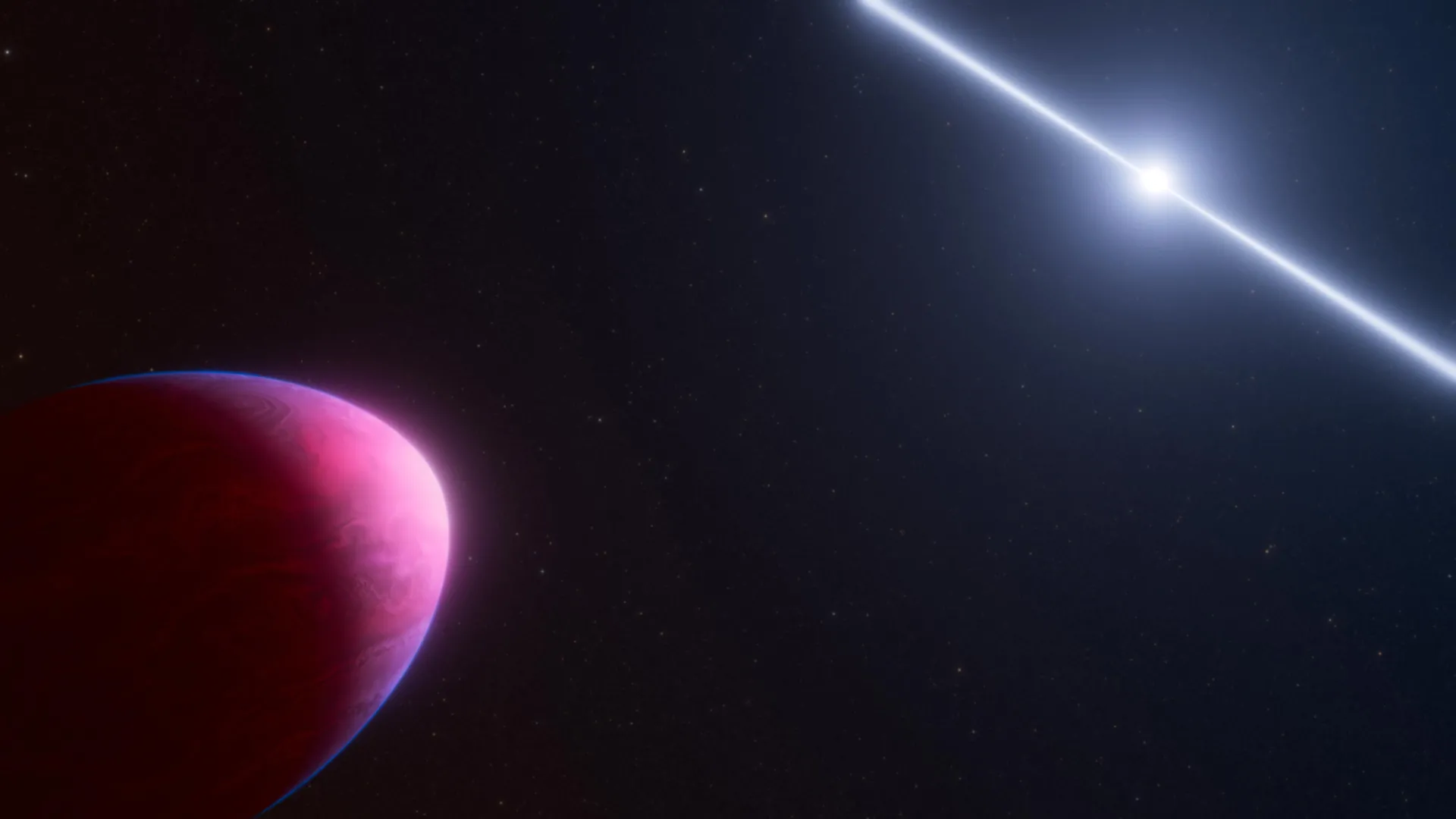
A Diamond-Rich Exoplanet Challenges planetary Formation Theories
A newly discovered exoplanet, PSR J2322-2650b, is rewriting our understanding of planetary formation and atmospheric composition. Orbiting a rapidly spinning pulsar,this unique world boasts an atmosphere saturated with molecular carbon,hinting at the potential for vast diamond deposits beneath its surface. The finding, made possible by the unparalleled capabilities of the James Webb Space Telescope (JWST), presents a compelling mystery for astronomers and promises to unlock new insights into the extreme environments where planets can form.
For decades, the search for exoplanets – planets orbiting stars beyond our Sun – has revealed a stunning diversity of worlds. However,PSR J2322-2650b stands apart.Located approximately 1.4 billion light-years away,this planet orbits a pulsar,the incredibly dense remnant of a collapsed star. Unlike typical exoplanet observations hampered by the glare of their host stars, this system offers a remarkably clear view. “We don’t see the host star at all,” explains maya Beleznay, a Stanford University graduate student involved in the research. “So we get a really pristine spectrum,allowing us to study this system in more detail than is usually possible.”
An Atmosphere Unlike Any Other
The true shock came with the analysis of the planet’s atmospheric signature. Instead of the expected molecules like water,methane,and carbon dioxide,researchers detected significant quantities of molecular carbon – specifically C3 and C2. this finding immediately sparked intense debate and speculation.
“It’s very hard to imagine how you get this extremely carbon-enriched composition,” states lead researcher Dr. Zhang.”It seems to rule out every known formation mechanism.” The extreme pressure within the planet, estimated to be immense, suggests that this carbon could be crystallizing, possibly forming diamonds deep within its interior. While the presence of diamonds is tantalizing, the basic question remains: how did this planet accumulate such an remarkable carbon abundance?
A Planet Sculpted by a Pulsar’s Embrace
PSR J2322-2650b’s unusual characteristics are inextricably linked to its proximity to its host pulsar, PSR J2322-2650. The planet orbits at a mere 1 million miles – a fraction of the distance between Earth and the Sun (93 million miles). This close orbit results in an incredibly rapid year, with the planet completing one revolution around the pulsar in just 7.8 hours.
The intense gravitational forces exerted by the massive pulsar are also dramatically shaping the planet. By meticulously analyzing subtle variations in the planet’s brightness, researchers steadfast that the pulsar is stretching PSR J2322-2650b into a distinctly lemon-like shape.
This system bears a striking resemblance to “black widow” systems, where a fast-spinning pulsar gradually consumes its companion. in typical black widow systems, material stripped from a companion star feeds the pulsar, accelerating its spin and generating powerful radiation.however, PSR J2322-2650b is officially classified as an exoplanet, not a star, adding another layer of complexity to the puzzle.
“Did this thing form like a normal planet? No, because the composition is entirely different,” Dr. Zhang emphasizes. “Did it form by stripping the outside of a star,like ‘normal’ black widow systems are formed? Probably not,because nuclear physics doesn’t readily produce pure carbon.”
A Leading Theory and the Promise of Further Discovery
Roger Romani, a leading expert on black widow systems at Stanford University and the Kavli Institute for Particle Astrophysics and Cosmology, proposes a compelling, though still debated, description. he suggests that as the planet cools, carbon and oxygen within its interior crystallize. The pure carbon crystals then rise to the surface, mixing with helium, creating the observed atmospheric signature. However, a key challenge remains: explaining how oxygen and nitrogen are prevented from contaminating the carbon-rich atmosphere.
Despite the unanswered questions, the scientific community is energized by this discovery. “But it’s nice to not know everything,” Romani remarks.”I’m looking forward to learning more about the weirdness of this atmosphere. It’s great to have a puzzle to go after.”
The JWST: A Game Changer in Exoplanet Research
The breakthrough observation of PSR J2322-2650b would have been unfeasible without the James Webb Space Telescope. JWST’s extraordinary infrared sensitivity, coupled with its unique observing location - approximately one million miles from Earth – allows it to detect faint signals obscured by terrestrial heat.





