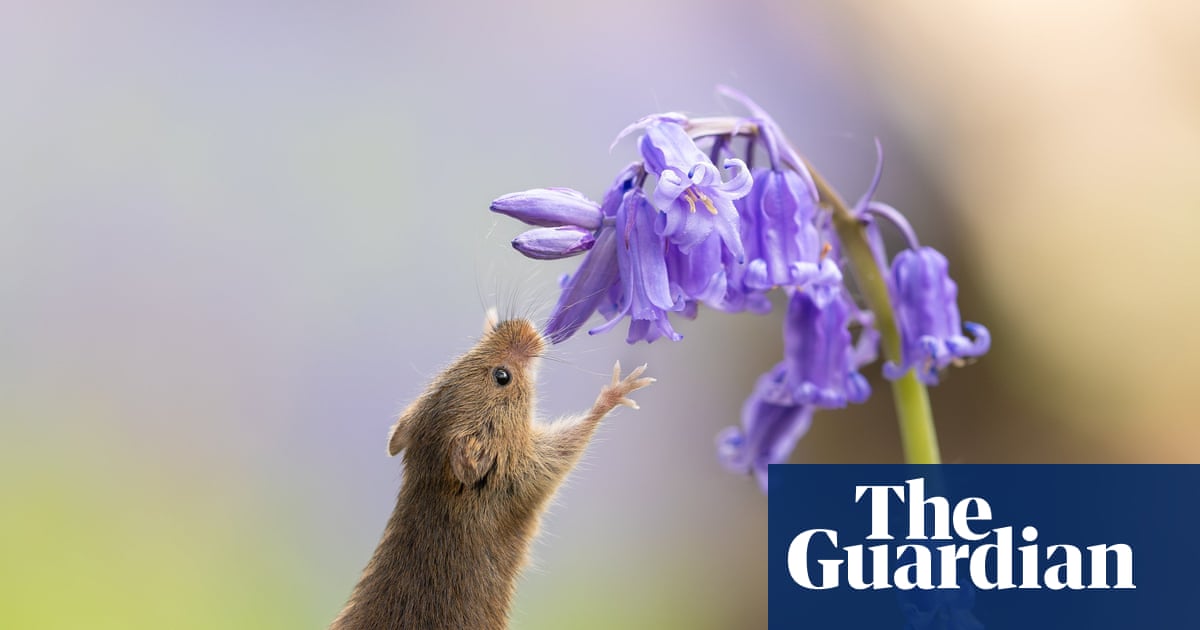
This week’s collection of wildlife photographs from around the globe offers a quiet reminder of the small wonders and resilient moments that often go unnoticed in the rush of daily life. From a tiny harvest mouse navigating a wheat stalk to a group of domestic cats lounging in sunbeams like fresh-baked bagels, and a solitary rhinoceros ambling across a grassy plain, the images capture both fragility and fortitude in the natural world. These scenes, drawn from diverse habitats across continents, reflect not only the beauty of biodiversity but also the ongoing stories of adaptation and survival that unfold beyond human observation.
The photographs, curated as part of a recurring visual series highlighting nature’s quiet marvels, emphasize moments of stillness and intention. Whether it’s the delicate balance of a rodent on a swaying stem or the deliberate pace of a megaherbivore moving through its territory, each frame invites viewers to pause and consider the lives unfolding just beyond the edge of perception. In an era marked by rapid environmental change, such imagery serves as both a record and a reflection — documenting what exists while prompting questions about what might be lost or preserved in the years ahead.
Among the standout images is one featuring a harvest mouse (*Micromys minutus*) perched atop a ripe wheat stalk in what appears to be a European farmland setting. Weighing as little as 4 grams, this species is Europe’s smallest rodent and is known for its remarkable agility in climbing stalks and reeds to build nests above ground level. Though widespread across parts of Eurasia, harvest mouse populations have declined in regions where intensive agriculture has reduced hedgerows and field margins — habitats essential for their survival. Conservation efforts in countries like the UK have focused on restoring field boundaries and promoting wildlife-friendly farming practices to support their numbers.
Another widely shared frame shows a group of domestic cats arranged in a curved line on a sunlit windowsill, their rounded forms and relaxed postures earning them the affectionate nickname “bagel cats” in online communities. While not wild animals, their inclusion in the series speaks to the broader theme of coexistence — how human spaces often become shared habitats, intentionally or not. Domestic cats (*Felis catus*), though descended from wild ancestors, now live in close proximity to humans across nearly every inhabited continent. Their behavior, especially in urban and suburban environments, continues to be studied for its implications on local wildlife, particularly bird populations, while also highlighting the deep bonds many people form with these animals.
The third focal image captures a single white rhinoceros (*Ceratotherium simum*) walking slowly across a savanna landscape, likely in southern Africa. As the second-largest land mammal after the elephant, the white rhino is distinguished by its broad mouth adapted for grazing. Despite its name, the “white” in white rhino is believed to derive from a mistranslation of the Dutch word “wijde,” meaning “wide,” referring to its wide lip. Once widespread across sub-Saharan Africa, the species has faced severe pressure from poaching driven by demand for its horn. Today, the majority of wild white rhinos are found in South Africa, Namibia, Zimbabwe, and Kenya, with conservation programs focusing on anti-poaching patrols, habitat protection, and community engagement to reduce human-wildlife conflict.
These images, while seemingly simple, touch on larger ecological themes: the importance of habitat connectivity for small mammals, the complex role of domesticated animals in shared environments, and the ongoing challenges faced by megafauna in a changing world. They also reflect the power of photography to foster empathy — turning fleeting moments in nature into opportunities for reflection and awareness. As one conservation biologist noted in a recent interview, “When people see an animal not as a symbol or a statistic, but as an individual going about its day, that’s when concern can turn into care.”
The broader context of such wildlife imagery extends beyond aesthetics. Visual documentation plays a growing role in scientific observation, public education, and advocacy. High-resolution images shared globally can help researchers track species behavior, monitor habitat conditions, and even detect early signs of disease or distress in wild populations. At the same time, they serve as accessible entry points for audiences who may not engage with technical reports but respond deeply to a well-composed photograph — a pause in the scroll, a moment of recognition.
In recent years, initiatives like citizen science projects and conservation photography grants have expanded the reach of such imagery, encouraging photographers — both professional and amateur — to contribute to long-term ecological monitoring. Some organizations now leverage image databases to study shifts in animal distribution linked to climate change, while others partner with local communities to train residents in wildlife monitoring techniques that include photographic documentation. These efforts underscore a growing recognition that conservation is not only about data and policy, but also about connection.
As the seasons shift and ecosystems continue to respond to both natural cycles and human influence, the quiet moments captured in these frames — a mouse on a stalk, cats in sunlight, a rhino on the move — remain significant. They remind us that life persists in countless forms, often just beyond the edge of our notice, and that paying attention, even briefly, can be an act of stewardship in itself.
For those interested in learning more about the species featured or supporting conservation efforts, reputable organizations such as the International Union for Conservation of Nature (IUCN), the World Wildlife Fund (WWF), and regional wildlife trusts offer science-based resources and opportunities for engagement. Updates on population statuses, habitat initiatives, and coexistence strategies are regularly published through their official channels.
To stay informed about similar stories and the ongoing perform to document and protect global biodiversity, readers are encouraged to follow trusted environmental journalism outlets and scientific institutions that prioritize accuracy and context in their reporting.
Have you encountered a quiet moment in nature recently that made you pause? Share your experience in the comments below, and consider sharing this article with others who appreciate the quieter wonders of the natural world.
Related reading