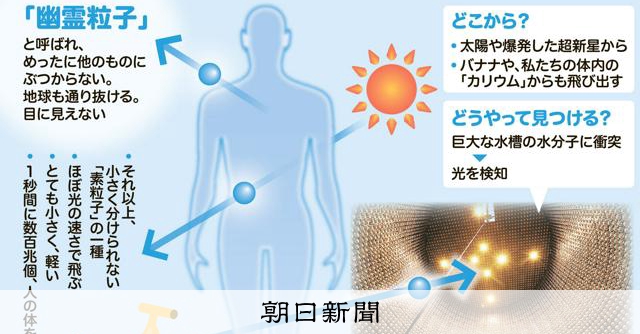
Neutrinos are subatomic particles that constantly pass through normal matter like ghosts, moving near the speed of light while rarely interacting with anything in the universe. According to the University of Tokyo’s Kavli Institute for the Physics and Mathematics of the Universe, scientists study these elusive entities to understand the fundamental laws of physics and the origins of matter. Because neutrinos pass straight through the Earth, the sun, and human bodies without stopping, detecting them requires massive, specialized scientific instruments buried deep underground or underwater.
Recent scientific coverage, including reports by Asahi Shimbun, highlights ongoing efforts to observe these ghostly particles using ultra-pure water detectors. These facilities use vast underground tanks filled with purified water to capture the faint flashes of light produced when a rare neutrino occasionally collides with an atomic nucleus. Understanding how these detectors operate reveals the immense technical challenges involved in capturing particles that fundamentally resist being measured.
What Makes Neutrinos Ghost Particles
Neutrinos are fundamental particles created by nuclear reactions inside stars, supernovas, radioactive decay on Earth, and cosmic ray interactions. According to CERN, they carry no electrical charge and have an extremely tiny mass that physicists are still working to measure precisely. Because they lack charge and interact only via the weak nuclear force and gravity, trillions of neutrinos pass through every square centimeter of the human body every second without leaving a trace.
This invisible nature makes them exceptionally difficult to study. While photons of light bounce off matter easily and electrons interact constantly with electromagnetic fields, neutrinos pass through lead shields light years thick as if nothing were there. To catch even a tiny fraction of them, researchers must build detectors on a monumental scale, utilizing millions of liters of ultra-pure water surrounded by sensitive light sensors.
How Water Detectors Capture Invisible Particles
Detecting neutrinos requires turning water into a giant trap. Facilities like the Super-Kamiokande detector in Japan rely on 50,000 tons of ultra-pure water housed in a cylindrical stainless steel tank located 1,000 meters underground in the Kamioka mine, as documented by the Kamioka Observatory. When a neutrino travels through the water and occasionally strikes a water molecule’s electron or nucleus, it can produce a charged particle moving faster than the speed of light in water.
This movement creates a faint, cone-shaped blue flash known as Cherenkov radiation. Thousands of high-sensitivity photomultiplier tubes mounted on the inner walls of the tank detect this optical glow. By analyzing the ring-shaped pattern and timing of the light signals, physicists can determine the direction, energy, and flavor of the original neutrino, transforming an invisible flash into concrete data about deep space and subatomic reactions.
Why Underground Placement Matters
Placing neutrino detectors deep underground is a strict physical necessity rather than an optional design choice. The Earth’s surface is constantly bombarded by cosmic rays from space, which would easily overwhelm any surface-level detector with a deafening background noise of secondary particles. By building facilities deep beneath mountains or inside mines, researchers use the Earth itself as a massive radiation shield.
According to research details published by KEK (High Energy Accelerator Research Organization), rock layers thousands of meters thick filter out cosmic muons while allowing neutral, penetrating neutrinos to reach the underground caverns undisturbed. This environment enables detectors to isolate the rare, genuine neutrino interactions from unwanted interference.
Implications for Modern Physics and Astronomy
Studying neutrinos helps scientists answer some of the biggest questions in cosmology, including why the universe is made almost entirely of matter rather than antimatter. Because neutrinos travel directly from the cores of active stars and distant supernova explosions without being deflected by magnetic fields, they serve as unique messengers from regions of the universe that remain completely hidden from traditional telescopes.
International collaborations continue to upgrade existing detectors and build larger next-generation facilities, such as the Hyper-Kamiokande project. These initiatives aim to gather unprecedented datasets on neutrino oscillation—the quantum phenomenon where neutrinos change types as they travel. As researchers refine these water-based observation techniques, humanity gains a clearer window into the invisible forces shaping our universe.
Keep reading