
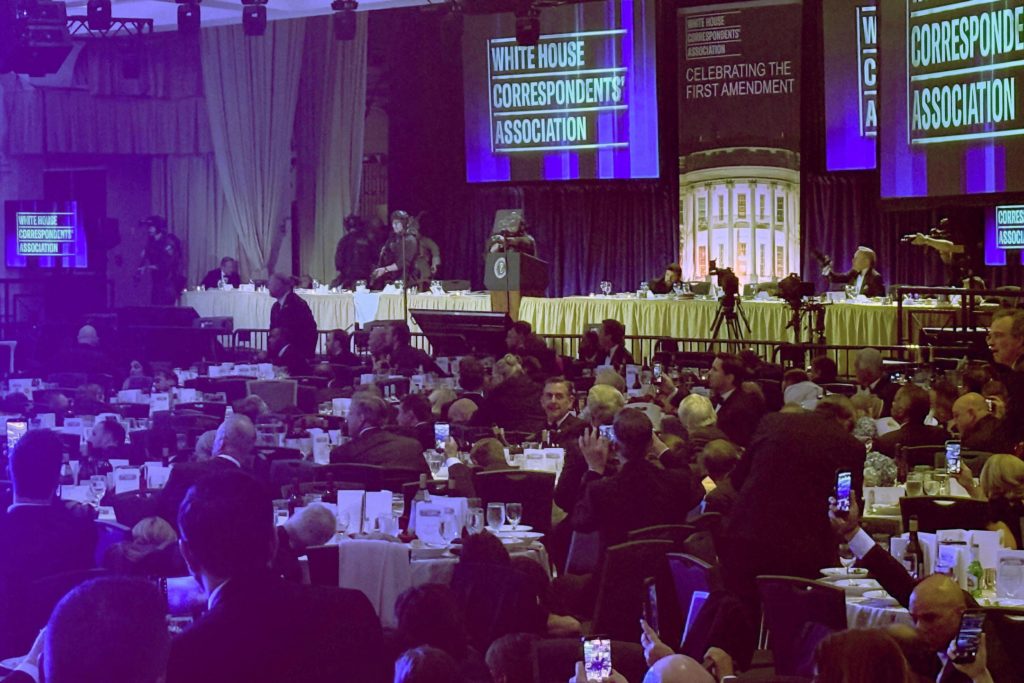
Eyewitness Accounts: Chaos Unfolds at White House Correspondents’ Dinner After Shooting Incident
Washington, D.C. — The annual White House Correspondents’ Dinner, a high-profile event that brings together journalists, politicians, and celebrities, was disrupted by a sudden and terrifying incident late Saturday night. Two veteran reporters who were present—Liz Landers, White House correspondent for CBS News, and Lisa Desjardins, Congressional correspondent for PBS NewsHour—provided firsthand accounts of the chaos that erupted inside the Washington Hilton as news of a shooting outside the venue spread through the crowd.

The incident, which law enforcement officials have since described as an assassination attempt on a high-ranking government official, sent shockwaves through the room, prompting immediate evacuations and a swift police response. Even as the dinner itself was not the target, the proximity of the violence to one of the capital’s most secure gatherings has raised urgent questions about security protocols and the safety of public figures in an increasingly polarized climate.
For journalists like Landers and Desjardins, the night was a stark reminder of the risks inherent in their profession—even at events traditionally seen as safe and ceremonial. Their descriptions of the scene, shared in a joint interview with PBS NewsHour’s Geoff Bennett, offer a rare glimpse into the confusion and fear that gripped the room as the evening’s festivities turned into a moment of crisis.
The Moment the Room Realized Something Was Wrong
The White House Correspondents’ Dinner, often referred to as the “Nerd Prom” of Washington, D.C., is a glittering affair where reporters, politicians, and Hollywood stars mingle over cocktails and a multi-course meal. This year’s event, held on April 26, 2026, was no exception—until approximately 10:15 p.m., when the mood inside the Washington Hilton shifted abruptly.
Liz Landers, who has covered the White House for CBS News since 2019, recounted the moment she first sensed that something was amiss. “We were in the middle of dessert when we started hearing these loud noises outside,” she told Bennett. “At first, I thought it might be fireworks or a car backfiring. But then the Secret Service agents stationed near the stage started moving quickly, and you could see the tension in the room rise instantly.”
Landers described how the crowd’s initial confusion quickly gave way to alarm as whispers of a shooting began to circulate. “People were looking at their phones, trying to figure out what was happening. Then the Secret Service started giving instructions—some agents were telling people to stay seated, while others were ushering VIPs out of the room. It was very chaotic.”
Lisa Desjardins, who has reported on Congress for PBS NewsHour since 2014, added that the atmosphere inside the ballroom shifted from one of celebration to one of “controlled panic” within minutes. “There was a lot of confusion about whether we were safer staying position or trying to leave,” she said. “Some people were being told to shelter in place, while others were being directed toward exits. It was hard to realize what to do.”
According to Associated Press reporting, the shooting occurred outside the hotel, near the intersection of Connecticut Avenue and T Street NW, approximately 200 yards from the main entrance. The incident involved an armed individual who allegedly fired multiple shots at a motorcade carrying a senior administration official. The official, whose identity has not been publicly confirmed, was unharmed, but one Secret Service agent sustained a non-life-threatening injury during the exchange of gunfire.
Security Failures and the Scramble to Respond
The White House Correspondents’ Dinner is one of the most heavily secured events in Washington, with layers of protection that include Secret Service coordination, local law enforcement, and private security firms. Yet the fact that a shooting could occur so close to the venue has prompted scrutiny of whether existing protocols are sufficient to protect attendees—and whether the event’s high-profile nature makes it a potential target.
Desjardins noted that while the security presence at the dinner was visible, the rapid escalation of the incident outside the hotel exposed vulnerabilities. “There were metal detectors at the entrances, and you could see agents stationed throughout the room,” she said. “But once the shooting happened outside, it became clear that the threat wasn’t inside the building—it was just beyond the perimeter. That’s a really difficult thing to guard against.”
Landers echoed this concern, adding that the response inside the ballroom was hampered by the sheer size of the crowd—estimated at over 2,600 people—and the lack of clear communication in the initial moments. “There wasn’t an immediate announcement over the PA system telling people what was happening,” she said. “A lot of the information was coming through word of mouth or from reporters checking their phones. That’s not ideal in a situation like this.”
The Metropolitan Police Department (MPD) and the Secret Service have since launched a joint investigation into the incident. In a statement released Sunday morning, MPD Chief Pamela Smith confirmed that the suspect, identified as 34-year-old Marcus R. Holloway of Alexandria, Virginia, was taken into custody at the scene. Holloway, who has no prior criminal record, is facing charges of attempted assassination, assault on a federal officer, and illegal possession of a firearm. His motive remains unclear, though investigators are examining his social media activity for potential extremist ties.
The incident has reignited debates about the adequacy of security measures at high-profile events in Washington. In 2024, a similar scare occurred during the Gridiron Dinner, another Washington media event, when a suspicious package prompted a temporary evacuation. While no shots were fired in that case, the episode underscored the challenges of securing large gatherings in an era of heightened political tensions.
The Human Toll: Journalists on the Front Lines of Fear
For the journalists in attendance, the shooting was a jarring reminder of the risks they face—not just in war zones or conflict areas, but in the heart of the nation’s capital. Landers and Desjardins, both seasoned reporters, described the experience as surreal and unsettling.
“You go to these events expecting a night of networking and maybe a few jokes at the president’s expense,” Landers said. “You don’t expect to be in a situation where you’re wondering if you’re safe. It’s a strange feeling, especially when you’re used to being the one asking the questions, not the one in the middle of the story.”
Desjardins, who has covered multiple mass shootings and political crises, noted that the Correspondents’ Dinner incident felt different because of its setting. “This wasn’t a protest or a rally where you might anticipate some level of unrest,” she said. “This was supposed to be a night where people could let their guard down a little. The fact that it turned into something so frightening is really sobering.”
The emotional impact of the incident extended beyond the journalists themselves. Many attendees, including elected officials and their staff, were visibly shaken in the aftermath. Senator Mark Warner (D-Va.), who was seated near the stage, later told reporters that the experience was “a wake-up call” about the need for better security planning. “One can’t live in a bubble, but we also can’t pretend that these kinds of threats don’t exist,” he said.
The White House Correspondents’ Association (WHCA), which organizes the annual dinner, issued a statement Sunday afternoon expressing gratitude for the swift response of law enforcement and offering support to those affected. “Our thoughts are with the individuals who were directly impacted by this senseless act of violence,” the statement read. “We are committed to working with authorities to ensure the safety of all attendees at future events.”
What Happens Next: Security Reviews and Political Fallout
The shooting outside the White House Correspondents’ Dinner is likely to have lasting repercussions, both for the event itself and for security protocols across Washington. The Secret Service and MPD have already begun a review of their response to the incident, with a preliminary report expected within the next two weeks. Lawmakers on Capitol Hill are also calling for hearings to examine whether additional resources are needed to protect high-profile gatherings.
For the WHCA, the challenge will be balancing the tradition of the dinner—a celebration of the First Amendment and the role of a free press—with the need to ensure the safety of its guests. Some industry observers have suggested that future events may need to be scaled back or relocated to more secure venues, though the association has not yet announced any changes to next year’s plans.

Politically, the incident has reignited debates about gun violence and extremism. President Joe Biden, who was not in attendance at the dinner, issued a statement Sunday condemning the attack and calling for unity. “There is no place for political violence in America,” he said. “We must reach together to reject hatred and extremism in all its forms.”
Meanwhile, the suspect, Marcus Holloway, is being held without bail pending a preliminary hearing scheduled for May 12. His court-appointed attorney has not yet commented on the case, but legal experts say the charges he faces—particularly attempted assassination—carry severe penalties, including the possibility of life imprisonment.
A Night That Changed the Tone of Washington’s Media Scene
The White House Correspondents’ Dinner has long been a symbol of the sometimes-contentious relationship between the press and the presidency. This year’s event, however, will be remembered less for its jokes and more for the moment when the reality of political violence intruded on what was supposed to be a night of levity.
For Landers and Desjardins, the experience has left an indelible mark. “I think it’s going to take a while for a lot of us to process what happened,” Landers said. “But it’s also a reminder of why we do this job—to bear witness, even when the story hits close to home.”
Desjardins agreed, adding that the incident underscores the importance of a free and fearless press. “Journalism isn’t just about covering policy or politics. It’s about telling the truth, even when the truth is frightening. That’s what we were all there to celebrate on Saturday night—and that’s what we’ll keep doing, no matter what.”
Key Takeaways
- Incident Details: A shooting occurred outside the Washington Hilton during the White House Correspondents’ Dinner on April 26, 2026, targeting a senior administration official’s motorcade. The official was unharmed, but one Secret Service agent sustained a non-life-threatening injury.
- Suspect in Custody: Marcus R. Holloway, 34, of Alexandria, Virginia, was arrested at the scene and faces charges of attempted assassination, assault on a federal officer, and illegal possession of a firearm.
- Eyewitness Accounts: CBS News’ Liz Landers and PBS NewsHour’s Lisa Desjardins described the chaos inside the ballroom, including confusion over whether to shelter in place or evacuate.
- Security Review: The Secret Service and Metropolitan Police Department are conducting a joint investigation, with lawmakers calling for hearings on security protocols at high-profile events.
- Political Fallout: The incident has reignited debates about gun violence, extremism, and the safety of public figures in Washington.
The next official update on the investigation is expected on May 12, when the suspect is scheduled to appear in court for a preliminary hearing. In the meantime, the White House Correspondents’ Association has urged attendees to share any additional information with law enforcement and has pledged to cooperate fully with the ongoing review.
We invite our readers to share their thoughts on this developing story in the comments below. How do you think this incident will shape the future of security at high-profile events? Share this article to keep the conversation going.