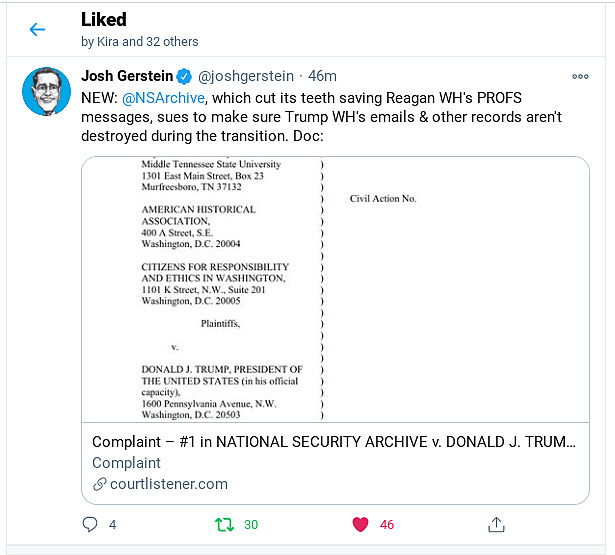
On April 25, 2026, a lawsuit filed by Citizens for Responsibility and Ethics in Washington (CREW) and the Freedom of the Press Foundation alleges that the White House permitted officials to delete text messages and other electronic communications, potentially violating the Presidential Records Act (PRA). The legal challenge, filed in the U.S. District Court for the District of Columbia, contends that such deletions undermine federal requirements to preserve records related to presidential duties.
The suit follows recent changes to White House record-keeping policies reported by The Washington Post, which described a loosening of rules governing the preservation of presidential records. According to the Post’s reporting, the adjustments raised concerns among transparency advocates about compliance with the PRA, which mandates that presidential records be maintained as public property and transferred to the National Archives at the complete of an administration.
CREW and the Freedom of the Press Foundation argue that allowing the deletion of text messages—now a primary mode of official communication—creates a significant gap in the historical record. Their lawsuit seeks a court declaration that the White House’s actions violate the PRA and an injunction to halt any further destruction of potentially relevant communications.
The Presidential Records Act, enacted in 1978 following the Watergate scandal, requires that all records created or received by the President and White House staff in the course of official duties be preserved. This includes electronic communications such as emails and text messages. The National Archives and Records Administration (NARA) is responsible for overseeing compliance and ensuring these materials are eventually made available to the public.
In response to the allegations, the White House has maintained that It’s following legal guidance regarding record preservation. CNN reported that administration officials told the court they are preserving presidential records despite internal debates about the constitutionality of certain PRA provisions, a position attributed to discussions within the Department of Justice.
The lawsuit filed by CREW and the Freedom of the Press Foundation echoes similar legal actions, including one referenced in Yahoo News coverage where former President Donald Trump was sued over a memo allegedly permitting officials to delete records. That case also centered on interpretations of the PRA and the scope of what constitutes a presidential record requiring preservation.
Legal experts note that the proliferation of informal communication channels, particularly encrypted and ephemeral messaging apps, has complicated compliance with the PRA. Unlike formal email systems that may be automatically archived, text messages on personal or government-issued devices often lack centralized retention policies unless specific preservation protocols are enforced.
The case highlights ongoing tensions between executive branch practices and legislative mandates designed to ensure governmental transparency. As federal courts continue to interpret the PRA in the context of modern communication technologies, the outcome of this litigation could influence how future administrations manage electronic records.
As of the filing date, no court ruling has been issued on the merits of the claims. The next procedural step in the case will be the White House’s formal response to the lawsuit, which must be filed within the timeframe prescribed by the Federal Rules of Civil Procedure. No hearing date has been publicly scheduled at this time.
For updates on the case, interested parties may monitor the docket of the U.S. District Court for the District of Columbia or consult official filings through the Public Access to Court Electronic Records (PACER) system.
We encourage readers to share this article and join the conversation by leaving thoughtful comments below.
Related reading