
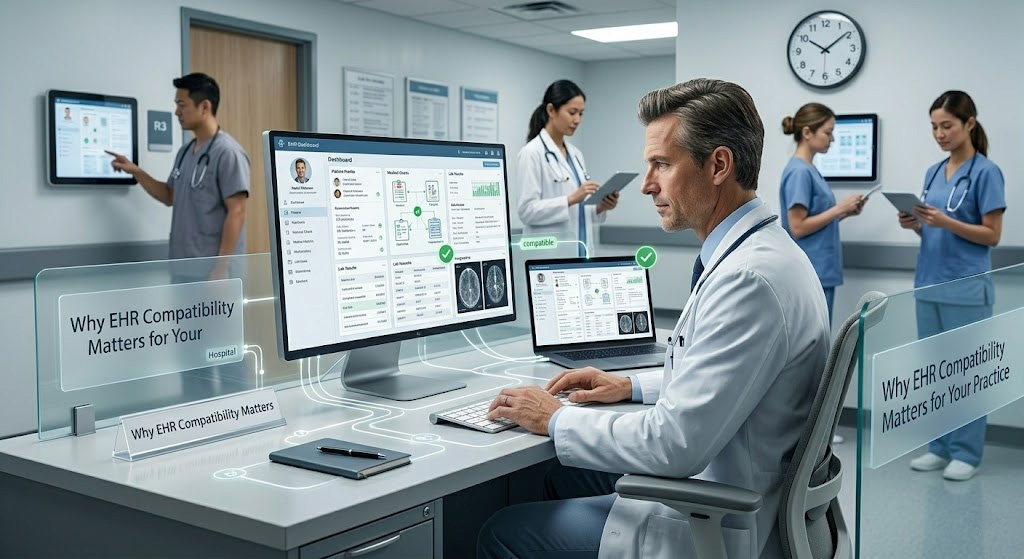
Every healthcare provider eventually confronts a stark reality: despite investing in electronic health records, their systems remain isolated islands in a sea of disconnected tools. Billing flows through separate clearinghouse portals, referrals still travel by fax, and lab results arrive via email. What was promised as a digital transformation has instead created a modern layer of administrative complexity.
This challenge, known as interoperability, represents one of the most persistent frustrations for medical practices adopting EHR systems. When electronic records cannot communicate effectively with laboratories, pharmacies, insurance providers, or other healthcare facilities, the promised efficiencies dissolve into manual workarounds and fragmented workflows.
Understanding EHR compatibility requires looking beyond surface-level features to examine how well systems exchange, interpret, and use data across the healthcare ecosystem. It is not a single capability but a spectrum that determines whether information flows seamlessly between a practice and its external partners.
At its foundation, compatibility determines whether claims can be submitted to insurers without manual data entry. At its most advanced, it enables real-time access to patient records by authorized providers across different systems and geographic locations.
Understanding the Three Dimensions of EHR Compatibility
Technical compatibility forms the backbone of data exchange, relying on established standards that govern how systems communicate. HL7 version 2.x remains the dominant legacy messaging standard in healthcare, widely supported despite its origins in earlier computing eras. Meanwhile, FHIR (Fast Healthcare Interoperability Resources) has emerged as the modern standard designed for web-based exchange, enabling easier integration with contemporary tools, mobile applications, and emerging technologies through standardized APIs.
Integration compatibility addresses the practical tools used in daily clinical operations. When e-prescribing functions directly within an EHR, clinicians avoid switching to separate pharmacy portals. Built-in billing integration with clearinghouses eliminates the need for manual claim re-entry. Native patient portal functionality reduces administrative burden by enabling online appointment scheduling, form completion, and secure messaging. Telehealth integration keeps virtual visits within the same platform where clinical documentation occurs.
The more deeply these functions are integrated natively into an EHR, the less staff time is consumed by context-switching and duplicate data entry. This directly impacts workflow efficiency and reduces opportunities for errors during manual transfers.
Data portability governs the ability to retain and transfer clinical information when changing systems or when patients seek care elsewhere. Since patient records legally belong to individuals, practices must ensure they can export complete datasets in usable formats before committing to any EHR vendor. The capacity to transfer records directly to another system—without costly re-entry or data loss—becomes critical when switching providers or when patients transition between care settings.
The Tangible Costs of Poor EHR Integration
When EHR systems fail to communicate effectively, expenses accumulate through multiple channels. Claim denials resulting from formatting errors demand staff time for correction and resubmission, delaying reimbursement. Processing delays create cash flow gaps that particularly strain smaller practices without substantial reserves. Referral information requiring printing and faxing introduces risks of document loss, transcription errors, and treatment delays. Paper-based intake processes that cannot be completed online perpetuate phone tag and consume valuable clinical time.
For solo practitioners and small clinics, these inefficiencies hit hardest due to limited administrative support. Tasks that larger organizations might absorb through dedicated staff become direct burdens on clinicians already managing full patient loads. What begins as a minor inconvenience scales into significant opportunity cost—time diverted from patient care to administrative overhead.
Essential Questions Before Selecting an EHR System
Prospective buyers should demand specific, verifiable answers regarding interoperability capabilities. Critical inquiries include: which interoperability standards does the system support (with particular attention to HL7 v2.x and FHIR capabilities)? Which clearinghouses and major payers offer direct integration to eliminate manual claims processing? Does the e-prescribing function connect to the pharmacies most commonly used by the patient population?

Equally important are questions about patient engagement tools: what specific functions does the patient portal actually enable beyond basic access? Can complete clinical records be exported in standard formats, and what fees or restrictions apply to data extraction? Finally, does the system offer a documented API that would allow future connections to specialized tools or emerging technologies?
Why Compatibility Transcends IT Concerns
EHR compatibility fundamentally shapes operational viability rather than serving as a mere technical checklist. It determines how efficiently a practice runs, how seamlessly care coordinates with external providers, and how much staff time gets consumed by tasks that should be automated. Practices that prioritize compatibility when selecting EHR systems consistently report spending less time troubleshooting technology and more time delivering patient-centered care.
The true value of interoperable systems reveals itself in reduced administrative burden, faster reimbursement cycles, improved care coordination, and enhanced patient experience—all outcomes that directly support the core mission of healthcare delivery.