
In the annals of cinematic crime dramas, few dynamics are as electric or as enduring as the partnership between a stoic federal agent and his street-wise mentor. When Brian De Palma’s The Untouchables hit theaters in 1987, it was marketed as the story of Eliot Ness’s crusade against Al Capone. Still, for many viewers and critics, the film became a vehicle for one of the most charismatic supporting performances in history. Sean Connery, portraying the grizzled police sergeant Jim Malone, did more than just support the narrative; he frequently commanded the screen, creating a tension and a warmth that redefined the mentor-protégé trope.
The chemistry between Sean Connery and Kevin Costner provided the emotional heartbeat of the film. While Costner’s Ness represented the rigid, unwavering morality of the law, Connery’s Malone offered the pragmatic, often cynical reality of the streets. This friction is exactly why the Sean Connery The Untouchables Oscar win remains a cornerstone of his late-career legacy. By playing the foil to Costner’s straight-laced lead, Connery didn’t just occupy the space—he expanded it, turning every scene he entered into a masterclass in screen presence.
For those revisiting the film in 2026, the brilliance of the performance lies in its subtlety. Connery avoided the trap of playing a caricature of a veteran cop, instead layering Malone with a weary wisdom and a dry wit that made him the immediate favorite of the audience. It was a strategic casting choice that paid off both critically and commercially, ensuring that while Ness led the charge, Malone provided the soul of the operation.
The Art of the Scene-Stealer: Malone vs. Ness
The narrative architecture of The Untouchables relies on the evolution of Eliot Ness from a naive agent to a hardened leader. Central to this transformation is Jim Malone. In the early acts of the film, the power dynamic is skewed; Malone is the one with the connections and the knowledge, while Ness is the one with the badge. This setup allowed Connery to dominate the dialogue and the pacing of their interactions, often using a single look or a well-timed pause to undercut Ness’s formality.

Critics have long noted that Connery’s ability to steal the spotlight
didn’t detract from Costner’s performance but rather elevated it. By providing a formidable presence to bounce off of, Costner was forced to develop Ness’s character in response to Malone’s influence. The relationship evolved from one of professional necessity to genuine mutual respect, a transition that anchored the film’s high-stakes action in human emotion.
This dynamic was further enhanced by Brian De Palma’s direction, which often framed the two actors in ways that highlighted their contrast—the vertical, stiff posture of Costner against the relaxed, leaning confidence of Connery. This visual storytelling reinforced the theme of the film: the necessity of blending official procedure with street-level intuition to defeat a systemic evil like Al Capone.
The Road to the 60th Academy Awards
By the time the awards season arrived in early 1988, it was clear that Connery was the frontrunner for the supporting categories. His portrayal of Malone had resonated globally, bridging the gap between his iconic status as James Bond and his emergence as a versatile character actor. The performance was a departure from the polished sophistication of 007, replacing it with a rough-edged, working-class authenticity that felt fresh and earned.
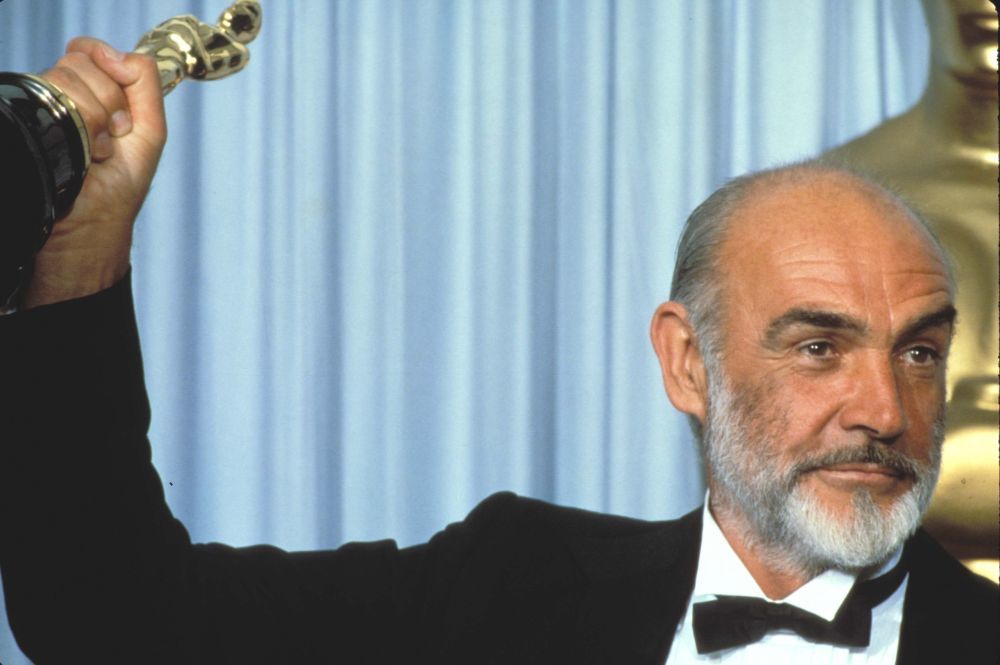
At the 60th Academy Awards, held on March 29, 1988, Sean Connery officially took home the award for Best Supporting Actor. The win was a validation of his ability to adapt his legendary screen persona to fit a specific, gritty role. It was a victory not just for the actor, but for the character of Jim Malone, who had become the unexpected heart of the movie.
“I’ve always enjoyed the challenge of playing someone completely different from myself, and Malone had a grit that I found incredibly appealing.” Sean Connery, interview regarding his role in The Untouchables
The victory was a significant milestone in Connery’s career, marking his first and only Oscar win. It solidified his standing as an actor who could command a film without needing to be the titular lead, proving that a supporting role, when executed with precision, can be the most memorable element of a production.
Analyzing the Impact of Jim Malone on the Crime Genre
The influence of the Malone character can be seen in countless police procedurals and crime dramas that followed. The seasoned veteran and the rookie
dynamic became a staple of the genre, but The Untouchables set the gold standard for how that relationship should function. Instead of the veteran simply giving advice, Malone challenged Ness, pushed him to his limits, and taught him that the law is sometimes a blunt instrument that requires a finer edge to be effective.
the film’s depiction of Prohibition-era Chicago benefited immensely from Connery’s grounding presence. While the film featured stylized action sequences and a menacing Al Capone played by Robert De Niro, Malone provided the necessary realism. He was the bridge between the glamorous corruption of the mob and the grim reality of the police precincts.
In a modern context, the performance is studied for its efficiency. Connery does not overact; he allows the writing and the chemistry with his co-stars to do the heavy lifting. His ability to convey authority without shouting and affection without sentimentality is what makes the performance timeless.
Key Takeaways: Sean Connery’s Legacy in The Untouchables
- Award Recognition: Sean Connery won the Academy Award for Best Supporting Actor at the 60th Academy Awards in 1988.
- Character Dynamic: The role of Jim Malone served as the essential pragmatic foil to Kevin Costner’s idealistic Eliot Ness.
- Genre Contribution: The film helped codify the mentor-protégé relationship in the modern crime cinema landscape.
- Career Shift: The role successfully transitioned Connery from a leading-man archetype to a powerhouse character actor.
- Cinematic Balance: Connery’s performance provided the emotional grounding necessary to balance the film’s stylized action and high-profile antagonist.
Frequently Asked Questions
Did Sean Connery win the Oscar for Best Actor or Best Supporting Actor?
Sean Connery won the Oscar for Best Supporting Actor for his role as Jim Malone in The Untouchables.
Who played the lead role opposite Sean Connery in The Untouchables?
Kevin Costner played the lead role of federal agent Eliot Ness.
When was The Untouchables released?
The film was released in 1987, with the accompanying Oscar win occurring in 1988.
Who directed The Untouchables?
The movie was directed by Brian De Palma.
The Enduring Appeal of a Classic Performance
Decades after its release, The Untouchables remains a masterclass in casting. The decision to pair the then-rising star Kevin Costner with the established legend Sean Connery created a cinematic synergy that is rarely replicated. While the film is technically a biography of Eliot Ness, it is remembered as the movie where Sean Connery reminded the world that he was more than just a spy—he was one of the greatest actors of his generation.
As we look back from 2026, the performance of Jim Malone serves as a reminder that the most impactful roles are often those that support others. By stealing the spotlight, Connery didn’t diminish the film; he illuminated it, leaving behind a legacy of charisma, grit, and an Oscar that remains one of the most deserved wins in the history of the Academy.
For those interested in the history of the Academy Awards, official records and nominee lists can be found via the Academy Awards database.
What is your favorite scene between Jim Malone and Eliot Ness? Share your thoughts in the comments below and let us know which classic performance you think deserves a modern re-evaluation.