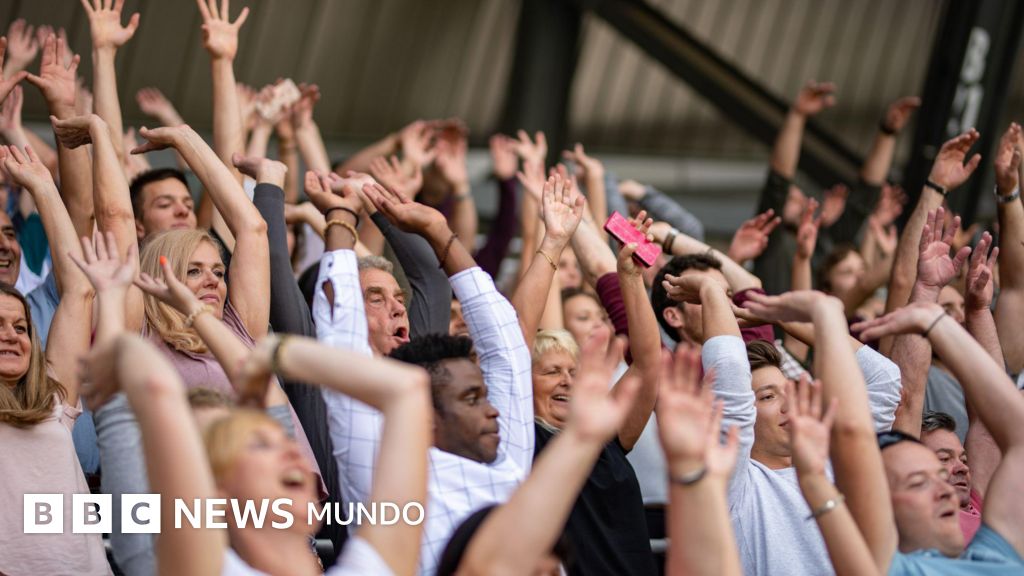
The collective stadium phenomenon known as “the wave” creates a synchronized display of human movement that has captivated spectators at sporting events since at least the early 1980s. While often viewed as a spontaneous expression of fan enthusiasm, the movement relies on a surprisingly predictable set of physical rules that allow thousands of individuals to act with the coordination of a single organism.
At its core, the wave typically travels through a stadium in a clockwise direction, moving at an average speed of approximately 20 seats per second. This consistent velocity and directional flow have drawn the interest of researchers, including physicists who study how simple, localized rules can generate complex, large-scale patterns in human crowds.
The Physics of Synchronized Motion
The scientific study of this phenomenon gained traction in 2001, when Illes Farkas, a researcher with the statistical and biological physics group of the Hungarian Academy of Sciences in Budapest, began investigating the mechanics of stadium crowds. Farkas and his colleagues, Tamas Vicsek and Dirk Helbing, treated the audience members as particles, observing that humans often adhere to specific behavioral protocols when participating in a wave.
Through computer modeling and the analysis of television footage from over a dozen separate events, the team identified three primary parameters that dictate the movement of the wave:
- The physical distance between individual spectators.
- The number of neighbors that each individual can observe.
- The “readiness” or probability of an individual to rise from their seat, which is heavily influenced by the behavior of nearby fans.
Farkas noted that the process is remarkably similar to how physical systems, such as melting ice, transition from one state to another. When a sufficient number of people stand up, they create a trigger that forces the surrounding crowd to follow suit, maintaining the momentum of the wave as it circles the stadium.
Human Behavior in Crowds
The transition from an individual’s decision to stand to the collective action of the stadium is a study in social psychology and statistical mechanics. According to the research conducted by Farkas and his team, the wave is not entirely random; rather, it is a highly coordinated reaction to visual stimuli. Spectators do not wait for a formal cue; instead, they observe their immediate neighbors and react to the encroaching movement.
This “readiness” factor is essential to the wave’s survival. If the probability of individuals standing up is too low, the wave will dissipate or fail to start. However, once the threshold is crossed, the movement becomes self-sustaining. This behavioral pattern allows the wave to travel across massive arenas, overcoming gaps in the seating or areas where fan participation might be lower.
A Legacy of Stadium Culture
Though “the wave” has become a staple of global sports culture, its origins remain rooted in the early 1980s. Since that time, it has evolved from a novel diversion into a predictable feature of large-scale sporting events. Researchers emphasize that while the individual participants may feel they are acting on a whim, the resulting phenomenon follows mathematical principles that are consistent across different venues and cultures.
By breaking down the movement into measurable parameters, physicists have been able to provide a clearer understanding of how complex human behaviors can emerge from simple, local interactions. The study of these stadium waves continues to serve as an example of how human crowds can mimic the behavior of physical particles, demonstrating that even the most spontaneous displays of fan enthusiasm are governed by the underlying laws of physics.
For those interested in the ongoing research into crowd dynamics and statistical physics, further information regarding the work of the Hungarian Academy of Sciences and related studies on collective human behavior can be found through academic repositories and scientific journals specializing in biological and statistical physics. We invite our readers to share their own experiences with this enduring stadium tradition in the comments section below.
Related reading