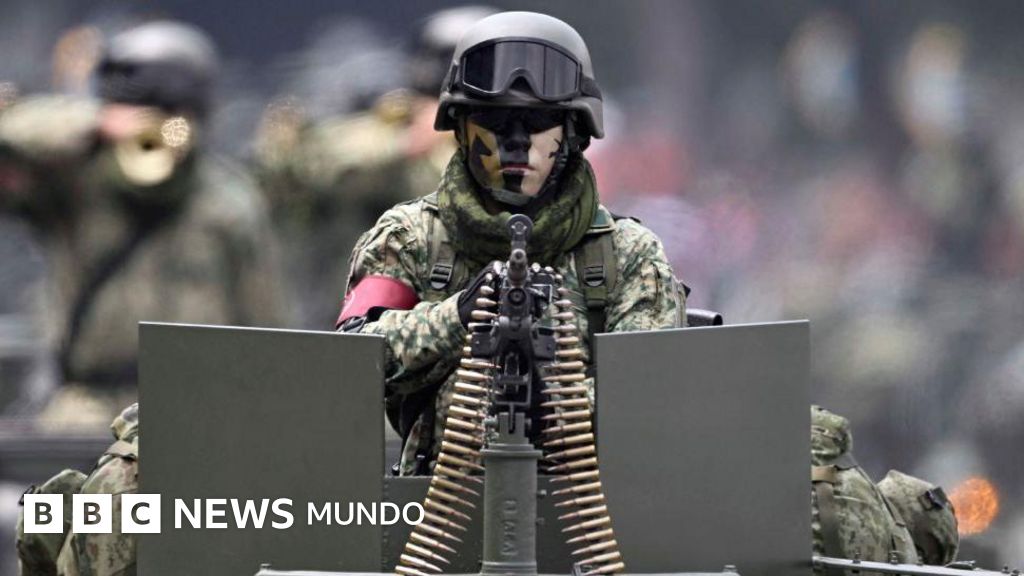
The recent elimination of one of Mexico’s most elusive drug lords has highlighted a paradox at the heart of the nation’s security strategy. While the Mexican military is a potent symbol of national identity, its actual operational capacity for conventional warfare is strikingly limited, a reality that complicates the ongoing struggle against organized crime.
In February 2026, a special military operation in the municipality of Tapalpa, Jalisco, resulted in the death of Nemesio Oseguera Cervantes, better known as “El Mencho” who was the leader of the Cartel Jalisco Nueva Generación (CJNG). While the operation was a significant tactical success, the aftermath revealed the fragility of the state’s control over its territory. Criminal responses to the hit included blockades, fires, and gunfights that paralyzed 20 different states.
This inability to contain the ripple effects of a high-profile arrest points to a deeper structural issue: the Mexican army is not equipped for large-scale warfare. From a lack of heavy armor to a depleted air force, the military’s composition reflects a historical relationship with the United States and a domestic focus on internal security rather than external defense.
A Depleted Arsenal: The State of Mexican Air Power
The most visible sign of Mexico’s limited military reach is its air force. The country has gone nearly half a century without purchasing a new supersonic aircraft. The current fleet consists of Northrop F-5 fighters, which were acquired in 1982 through U.S. Mediation. Of the 12 originally purchased, only nine remain, and according to General Román Carmona Landa, only three are currently capable of operating.
This puts Mexico in a unique position compared to its neighbors. While Mexico operates only three functional supersonic jets for a population of 130 million, other Latin American nations maintain significantly larger fleets: Brazil has 47, Chile has 46, Argentina has 24, and Colombia has 22.
Manpower and Equipment Gaps
Beyond the skies, the Mexican military lacks the heavy hardware typical of a conventional army. This proves one of the few regional militaries that does not possess heavy battle tanks. This deficiency is reflected in its Global Military Index score, which is the lowest among its regional peers.
The numbers tell a similar story regarding personnel. Mexico maintains approximately 2.7 military members—including the Guardia Nacional—per 1,000 inhabitants. This is significantly lower than the ratios found in Chile (5.8), Brazil (3.5), or Colombia (8.2).
The Impact on the War Against Cartels
The lack of conventional war capabilities creates a strategic gap when facing the CJNG and other cartels. The CJNG, which the U.S. Government designated as a terrorist organization in early 2025, operates with a level of violence and territorial extension that challenges the army’s ability to maintain order. Under the administration of Donald Trump, the U.S. Has shifted its approach, treating links to the CJNG as grounds for investigation without needing to prove a direct threat to a U.S. Citizen due to the group’s terrorist designation.
When the military focuses on “surgical” strikes—such as the operation that killed “El Mencho”—it can achieve specific goals. But, the lack of widespread troop density and heavy equipment means the state often struggles to secure the surrounding areas once the initial operation is complete.
Who Was “El Mencho”?
To understand why the Mexican military’s limitations are so critical, one must understand the target. Nemesio Oseguera Cervantes, 59, was the maximum leader of the CJNG and one of the most wanted men in both Mexico and the United States. The U.S. Drug Enforcement Administration (DEA) had listed him as a primary target in 2020, offering a reward of $15 million for information leading to his capture.
The CJNG’s ability to mobilize violent responses across 20 states following Oseguera’s death demonstrates that while the “head” of the organization may have been removed, the operational infrastructure of the cartel remains a formidable force that the Mexican army is not traditionally equipped to dismantle through conventional military means.
Key Comparison: Regional Military Presence
| Country | Military Personnel (per 1,000 people) |
|---|---|
| Colombia | 8.2 |
| Chile | 5.8 |
| Brazil | 3.5 |
| Mexico | 2.7 |
The data illustrates that Mexico’s military footprint is the smallest among these regional powers, further emphasizing the challenges the government faces when attempting to project force across its vast and often lawless territories.
The death of “El Mencho” marks a pivotal moment in the fight against organized crime, but it similarly serves as a reminder of the limitations of the Mexican state’s coercive power. As the CJNG continues to operate and the U.S. Increases its pressure through terrorist designations, the question of whether the Mexican army needs a fundamental restructuring for modern internal conflict remains open.
Following the operation in Jalisco, security forces remain on high alert. The next critical checkpoint will be the government’s official report on the stabilization of the 20 states affected by the criminal response to the operation.
Do you believe the Mexican military should pivot toward a more conventional war footing to combat cartels, or is the current special-operations approach more effective? Share your thoughts in the comments below.
Worth a look