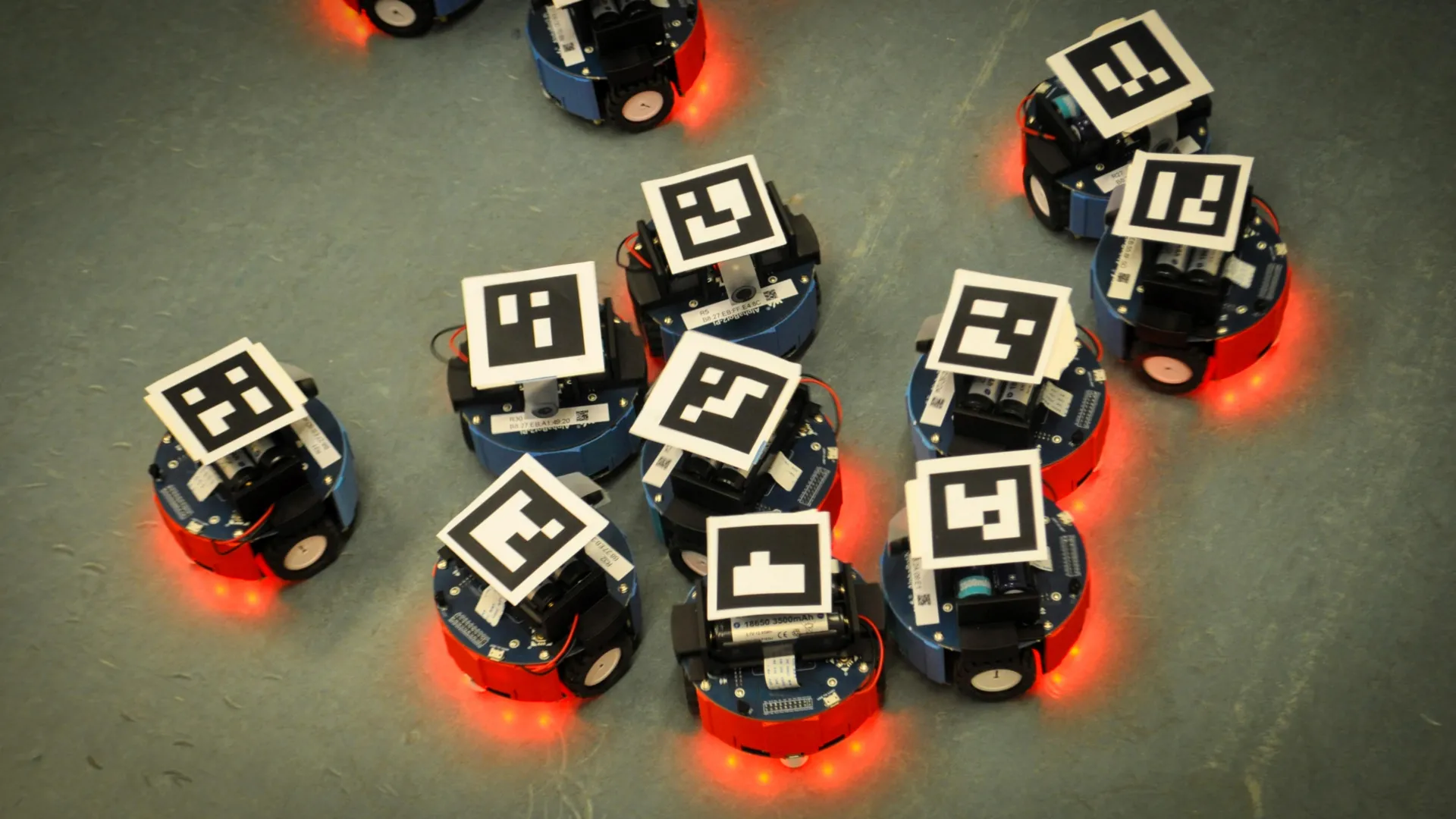
In crowded environments, more robots don’t always mean faster results—in fact, too many can bring everything to a standstill. Harvard researchers discovered a surprising fix: adding a bit of randomness to how robots move can actually prevent gridlock and boost efficiency. By allowing robots to “wiggle” slightly instead of marching in straight lines, they can slip past each other and keep tasks flowing smoothly.
This counterintuitive finding emerged from a study led by L. Mahadevan, the Lola England de Valpine Professor of Applied Mathematics, Organismic and Evolutionary Biology, and Physics at Harvard John A. Paulson School of Engineering and Applied Sciences. The research, published in April 2026, demonstrates that introducing controlled algorithmic noise into robotic movement patterns reduces congestion in dense swarms, enabling self-organization without centralized control.
The study combined mathematical modeling, computer simulations, and physical experiments using wheeled robots. Researchers observed that as robot density increased beyond a critical threshold, traffic jams formed when robots followed deterministic paths. Yet, when each robot was programmed with a small degree of random directional variation—referred to as “wiggle” or algorithmic noise—the swarm maintained fluid motion and improved task completion rates.
According to the Harvard John A. Paulson School of Engineering and Applied Sciences, the work reveals how basic local movement rules can lead to organized, efficient outcomes at scale. The findings suggest that robotic fleets do not require powerful central AI or constant communication to avoid gridlock; instead, simple stochastic rules enable emergent coordination.
Physical validation of the theory was conducted in collaboration with researchers at Eindhoven University of Technology, where swarms of small, wheeled robots were tested in confined environments. These experiments confirmed that adding noise to individual trajectories prevented permanent blockages and allowed the swarm to adapt dynamically to changing conditions.
The mathematical advantage of this approach lies in the “averaging” effect: while individual paths appear unpredictable, the collective behavior becomes statistically regular. This predictability allows researchers to derive precise formulas for goal attainment rates under various density and noise conditions, offering a design framework for optimizing swarm performance.
Experts note that the principles observed in robotic swarms mirror those seen in natural systems like ant colonies, bird flocks, and pedestrian crowds—all examples of active matter that self-organize through local interactions. This connection suggests broader applications beyond robotics, including traffic flow management, warehouse automation, and emergency response scenarios such as oil spill cleanups or disaster zone navigation.
Linda Mahadevan emphasized that the study challenges the assumption that intelligence in swarms must be centralized. “We’ve shown that you don’t need a super-brain to solve complex spatial problems,” she stated in the Harvard press release. “Local rules with a touch of randomness are sufficient for robust, scalable coordination.”
The research team included graduate students and postdoctoral fellows from Harvard’s Department of Applied Mathematics and the Wyss Institute for Biologically Inspired Engineering. Their work builds on prior studies in active matter and non-equilibrium physics but advances the field by providing experimentally verified, scalable strategies for swarm robotics.
As industries increasingly deploy autonomous systems in logistics, manufacturing, and environmental monitoring, the insights from this study offer a practical path to improving efficiency without increasing computational overhead. By embracing minimal unpredictability at the individual level, engineers can design swarms that remain productive even under high congestion.
Future work will explore how these principles apply to heterogeneous swarms—where robots have different capabilities—or in three-dimensional environments like underwater or aerial operations. Researchers also aim to investigate whether similar noise-based strategies can enhance resilience in robotic networks facing communication delays or sensor noise.
For now, the study provides a clear takeaway: sometimes, a little chaos is exactly what keeps everything running smoothly.