
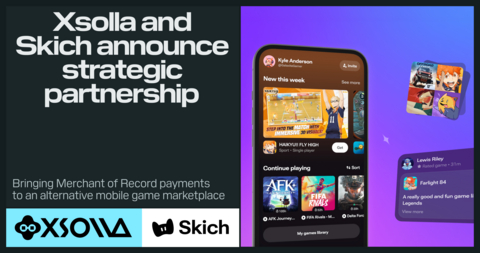
The landscape of mobile gaming distribution is undergoing a fundamental shift as regulatory pressures dismantle the long-standing duopoly of major platform storefronts. In a move to capitalize on this opening, global commerce company Xsolla has announced a strategic partnership with Skich, an alternative mobile game marketplace, to integrate Merchant of Record payments in alternative mobile game marketplaces.
Under the terms of the agreement, Xsolla will act as the Merchant of Record (MoR) for all paid game sales and in-app purchases distributed through the Skich Store. This arrangement allows Skich to operate as a non-exclusive distribution channel for developers on Android globally and on iOS within the European Union, where Apple’s ecosystem has been forced open by new legislation.
For the average game studio, the transition to alternative marketplaces often presents a daunting operational hurdle: the legal and financial complexity of global commerce. By stepping in as the MoR, Xsolla assumes the responsibility for payment processing, tax collection, refunds and regulatory compliance. This removes the significant legal barriers that typically prevent smaller studios from venturing outside the primary app stores.
Understanding the Merchant of Record Advantage
To understand why this partnership is significant, one must understand the distinction between a payment processor and a Merchant of Record. While a processor simply moves money from a buyer to a seller, a Merchant of Record becomes the legal entity responsible for the transaction. Which means Xsolla, not the game developer, is the entity that manages the complex web of international tax laws, including the calculation and remittance of value-added tax (VAT) and goods and services tax (GST) across different jurisdictions.
This “commerce layer” is critical for developers who lack the infrastructure to manage tax compliance in 200+ geographies, a scale at which Xsolla currently operates. By utilizing Xsolla’s global payments infrastructure, which provides access to over 1,000 local payment methods, developers can monetize their titles globally without needing to establish legal entities in every country where their players reside.
Developers using the Skich Store will also integrate Xsolla’s Mobile SDK and gain access to a dedicated Publisher Account. This setup provides direct visibility into revenue data and transaction reporting, offering a level of transparency and control over financial data that is often restricted within traditional, closed-loop platform storefronts.
Regulatory Catalysts: The DMA and Beyond
The emergence of marketplaces like Skich is not an accident of the market, but a result of aggressive regulatory intervention. The primary driver in Europe is the Digital Markets Act (DMA), which has mandated that “gatekeeper” platforms, including Apple, allow third-party marketplaces to operate on iOS within the EU. This legislation is designed to foster competition and prevent platform owners from unfairly favoring their own services.
Similar antitrust momentum is appearing in Asia. Japan has enacted the Mobile Software Competition Act, which introduces antitrust requirements aimed at opening up mobile ecosystems to more competitive distribution and payment options. These laws collectively signal a global trend toward “open” mobile commerce, where developers are no longer tethered to a single payment system or distribution channel.
The shift is also extending to the Android ecosystem. According to the partnership announcement, Google Play will be required to open up to alternative app stores in the United States by mid-2026. Android has announced a simplified installation process for alternative app stores worldwide, set for implementation in 2026. These changes are expected to create a surge in demand for compliant commerce infrastructure as more developers seek to reclaim a larger share of their revenue.
Impact on Game Monetization and Discovery
For the gaming industry, the ability to distribute games through alternative channels changes the economic equation of mobile development. Traditionally, platform holders have taken a significant percentage of every transaction. By diversifying their distribution through marketplaces like Skich, developers can explore new monetization strategies and direct player engagement models.
“The alternative app store ecosystem is maturing rapidly, and developers need commerce infrastructure that keeps pace,” said Chris Hewish, President at Xsolla. “Our partnership with Skich gives developers a compliant, scalable way to monetize through emerging distribution channels — with the same advanced payments depth and global reach they expect from Xsolla.”
The partnership currently supports games utilizing in-app purchases, with support for premium paid titles expected to arrive soon. This flexibility allows studios to experiment with different pricing models—from free-to-play with microtransactions to traditional “buy-to-play” models—without being restricted by the rigid requirements of a single storefront.
Sergey Budkovski, CEO of Skich, emphasized that the partnership allows his platform to focus on its core mission of discovery. “Working with Xsolla as our Merchant of Record gives Skich and the developers on our platform a strong commercial and compliance foundation,” Budkovski stated. “This partnership lets us focus on discovery and distribution while Xsolla handles the complexity of payments infrastructure at a global scale.”
The Broader Ecosystem Strategy
This collaboration is part of a larger strategic effort by Xsolla to build a vetted ecosystem of third-party partners. By integrating these services directly into the Xsolla Publisher Account, the company is attempting to create a “one-stop shop” for the game development lifecycle, from funding and marketing to distribution and monetization.

Xsolla’s market position is already substantial. the company is trusted by more than 60% of the top 100 highest-grossing games. By aligning itself with alternative marketplaces, Xsolla is positioning itself as the essential financial plumbing for the next generation of mobile distribution. As the industry moves away from the “walled garden” model, the value shifts from the entity that controls the access (the store) to the entity that facilitates the transaction (the MoR).
For developers interested in this new distribution model, the process has been streamlined. Studios can begin the onboarding process for the Skich Store through the Xsolla Publisher Account portal. This integration allows them to leverage a non-exclusive channel, meaning they can maintain their presence on traditional stores while simultaneously expanding their reach through Skich.
The next major milestone for this sector will be the mid-2026 deadline for Google Play to open its ecosystem to alternative stores in the U.S., a move that will likely trigger a new wave of marketplace launches and partnerships across the North American market.
Do you believe alternative marketplaces will fundamentally change how we discover and pay for mobile games? Share your thoughts in the comments below.