
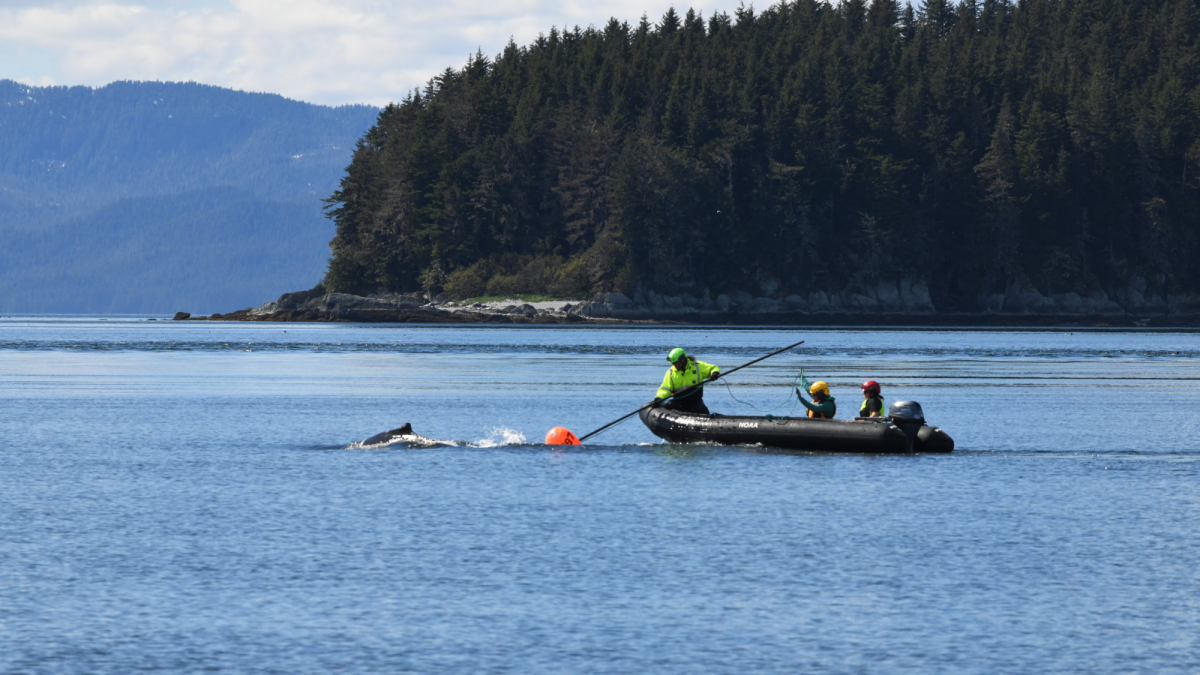
A juvenile humpback whale, trapped by heavy commercial fishing gear in the remote waters of Alaska’s Endicott Arm, was successfully freed by a multi-agency rescue team following a coordinated effort on May 11. The whale had been immobilized by two 800-pound Tanner crab pots, which acted as anchors and left the animal unable to move. According to NOAA Fisheries, the rescue followed a report from mariners who spotted the entangled animal the previous evening.
The incident highlights the ongoing challenge of marine mammal entanglements in Alaskan waters. Since 1998, there have been more than 140 confirmed reports of entangled large whales, though experts suggest the actual number is likely higher due to unreported cases. The rescue operation in Endicott Arm, located approximately 50 miles southeast of Juneau, involved biologists from NOAA Fisheries, the Alaska Department of Fish and Game, and local partners from Alaska Sea to Shore.
Coordinated Response and Rescue Operations
The rescue mission began immediately after mariners contacted the NOAA Fisheries Alaska Marine Mammal Stranding Network 24-hour hotline on the evening of May 10. The quick reporting enabled regional coordinators to establish a communication chain with vessels in the area. “We formed a network of eyes on the water—vessel crews coordinating real-time updates between one another and relaying them to us,” said Suzie Teerlink, a NOAA Fisheries Marine Mammal Specialist. “That communication was critical. It gave us insight into the nature of the entanglement, helped us build a safe response plan, and gave us confidence that we could relocate the whale.”
Once the team arrived on-site the following day, they spent five hours executing a delicate extraction. To free the whale, the team performed four precise cuts to remove the crab pots and the majority of the trailing lines. Because the whale was a 40-ton animal, the team utilized long poles equipped with specialized knives to perform the cuts from a safe distance. “Cutting gear off an animal of this size can be dangerous,” noted John Moran, a NOAA research fisheries biologist and advanced responder. “That allows us to cut lines while reducing the risk of being injured by a 40-ton animal.”
The Impact of Entanglements on Marine Wildlife
Entanglements are a major problem in Alaska. When a whale is anchored by heavy gear, it faces risks, including the inability to move, the potential to drown or starve, the development of life-threatening infections, and the risk of being hit by vessels.

While the rescue team was able to remove the primary source of the entanglement, some gear remained on the animal. Responders are hopeful the remaining will eventually fall off the whale. Sadie Wright, Large Whale Entanglement Response Coordinator for the NOAA Fisheries Alaska Region, emphasized the vital role of public vigilance in these missions. “We are incredibly grateful to the whale watch community and everyone who reported this entangled whale to the NOAA Fisheries hotline,” Wright said. “The details provided by the public enabled our response team to prepare and execute a safe response to this life-threatening entanglement, leading to a successful outcome.”
How to Report Marine Mammal Distress
For mariners and members of the public who encounter distressed or entangled marine mammals, observers are encouraged to report the sighting to the NOAA Fisheries Alaska Marine Mammal Stranding Network 24-hour hotline.
As of the most recent update from NOAA, the whale was released from the immediate danger of the crab pots.