
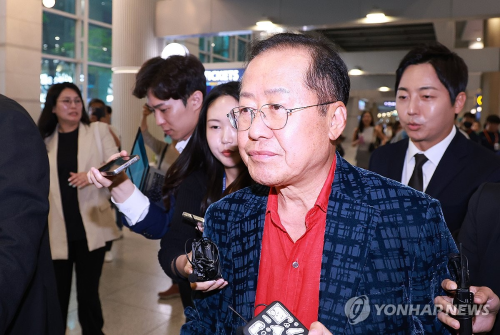
Former Daegu Mayor Hong Joon-pyo has issued a sharp critique of the ruling party’s current strategic direction, labeling the ongoing debate over the “dismissal of public prosecution” as a significant political miscalculation. In a statement released via social media on May 9, Hong argued that raising such a contentious legal issue on the eve of local elections demonstrates a lack of political maturity and a failure to align with public sentiment.
The controversy centers on whether certain legal proceedings involving President Lee Jae-myung should be subject to a dismissal of public prosecution—a rare legal maneuver that could effectively halt ongoing trials. Hong cautioned that the ruling party’s focus on this issue at this specific juncture is not only ill-timed but potentially detrimental to their electoral prospects, urging leaders to instead pursue “big-hearted politics” that resonates more effectively with the general electorate.
This intervention comes at a time of heightened tension within the conservative camp, exacerbated by internal fractures and a volatile electoral landscape. By framing the debate as a “political misjudgment,” Hong is positioning himself as a voice of pragmatic realism, suggesting that the pursuit of legal technicalities should not supersede the broader goal of winning local mandates.
The Legal Mechanism of Public Prosecution Dismissal
To provide clarity on the core of the dispute, Hong Joon-pyo detailed the specific legal parameters of the “dismissal of public prosecution” (공소취소). According to Hong, this mechanism is traditionally employed by prosecutors before a first-instance judgment is delivered, specifically in cases where the actual perpetrator has been identified or when it becomes evident that the initial indictment was fundamentally flawed.
In the context of the South Korean judicial system, such a move is rare and typically reserved for clear-cut errors of fact or law. Hong’s emphasis on the “first-instance judgment” threshold highlights the urgency and the limited window in which such a legal correction can be made. By defining the term, Hong suggests that applying this mechanism to high-profile political figures often deviates from standard judicial practice and enters the realm of political expediency.
Historical Precedents and Political Reconciliation
Hong drew a historical parallel to the administration of former President Kim Young-sam (YS) to illustrate the difference between legal innocence and political necessity. He cited the case of former POSCO Chairman Park Tae-joon, whose charges under the Act on the Aggravated Punishment of Specific Economic Crimes regarding tax evasion were dismissed following instructions from the Blue House.
Hong clarified that the dismissal of charges against Park Tae-joon was not predicated on a finding of innocence, but was instead a calculated measure for “political reconciliation.” This distinction is critical to Hong’s argument: while the law allows for the dismissal of prosecutions, doing so for political figures is often a tool for national unity or strategic stability rather than a reflection of judicial merit.
Applying this logic to the current situation, Hong asserted that for the legal matters surrounding President Lee Jae-myung to be handled in a similar vein, a specific set of “political and judicial environments” must first be established. He maintained that while such a discussion is valid, it is entirely inappropriate to initiate it before the conclusion of the local elections, calling the current timing a “mistake” by both the Democratic Party and the ruling coalition.
Internal Friction and the Busan By-Election
Beyond the legal debates, Hong extended his criticism to the internal state of the ruling party, specifically targeting the candidacy of former People Power Party leader Han Dong-hoon. Han is currently running as an independent candidate in the by-election for the Busan Buk-gu Gap National Assembly seat.
Hong described the circumstances surrounding the Busan Buk-gu Gap election as “clumsy” (조잡), suggesting that the party’s inability to maintain a unified front and the resulting independent run reflect a broader systemic failure in political management. This critique underscores a deepening rift between the party’s pragmatic wing, represented by Hong, and the factions currently navigating the by-election turmoil.
The intersection of the “prosecution dismissal” debate and the chaotic by-election in Busan paints a picture of a ruling party struggling to find a cohesive narrative. For the global observer, this internal volatility highlights the precarious nature of political alliances in South Korea, where legal battles often serve as proxies for leadership struggles within the parties themselves.
Key Takeaways from Hong Joon-pyo’s Critique
- Strategic Timing: Hong views the discussion of dismissing public prosecutions as a “political misjudgment” because it occurs immediately before local elections.
- Legal Definition: Public prosecution dismissal is intended for cases of mistaken identity or clearly erroneous indictments prior to the first trial.
- Political vs. Legal: Using historical examples like Park Tae-joon, Hong argues that such dismissals are often tools for political reconciliation, not proofs of innocence.
- Party Instability: The independent run of Han Dong-hoon in Busan is characterized by Hong as “clumsy,” indicating severe internal party friction.
What So for the Local Elections
The primary risk, according to Hong, is that the ruling party is engaging in “unnecessary controversy” that distracts from the core issues of local governance. When political discourse shifts from policy and regional development to the minutiae of prosecutorial discretion, the party risks alienating moderate voters who prioritize stability over legal warfare.
the call for “big-hearted politics” suggests that Hong believes the current approach is too narrow and punitive. By urging a shift in tone, he is advocating for a strategy that prioritizes electoral viability over the desire to settle legal scores—or the desire to grant legal favors—in the immediate short term.
The impact of this critique will likely depend on how the ruling party responds to the internal pressure. If the party continues to lean into the prosecution dismissal debate, they may find themselves further isolated from the “public sentiment” that Hong insists they must embrace. Conversely, a pivot toward a more inclusive, less litigious campaign strategy could potentially mitigate the damage caused by the current internal divisions.
As the local elections approach, the focus remains on whether the ruling party can move past these “clumsy” organizational failures and the distracting legal debates to present a unified front to the voters.
The next critical checkpoint will be the official campaign filings and the subsequent polling data for the Busan Buk-gu Gap by-election, which will serve as a bellwether for the ruling party’s current standing and the effectiveness of its political strategy.
We invite our readers to share their perspectives on the intersection of law and politics in South Korea in the comments section below.